Conjunctions for Kids: Because, So, But

Conjunctions like 'because, so, but, and or' help connect sentences and ideas smoothly. They turn choppy speech or writing into clearer, richer English. Place one bridge word between two sentence parts; choose by meaning.
📥 Conjunctions Mini Practice Cards
Build stronger sentences with because, so, but, and or.
Leave your email — we'll send the PDF to your inbox.No spam — the PDF plus one short reminder. Unsubscribe anytime.
Why Do Conjunctions Matter?

Conjunctions build clear communication. They signal why something happened, what result followed, how two ideas differ, or which option fits. Without them, children’s sentences sound brief and jumpy.
Connecting words give stories and explanations stronger flow. Children express richer thoughts, build richer sentences, and shift from "I like cats. I like dogs." to "I like cats and I like dogs." That shift builds stronger speaking and writing.
Understanding Each Conjunction
Conjunction learning starts with each word’s job. Each bridge word has one clear role in connecting your thoughts and ideas.
1. Because: Showing Reasons
Use "because" for reasons. It answers "Why?".
Form: [Sentence 1] + because + [Reason/Sentence 2].
Examples: For parents, Connect Your Ideas: A Simple Guide to 'Because, So, But & Or' for Kids works best when practice stays quick, visual, and repeated every week.
- I am happy because it is sunny today. (Why are you happy? It is sunny.)
- She ate dinner because she was hungry. (Why did she eat? She was hungry.)
2. So: Showing Results
Use "so" for results or consequences. It answers "What happened next?".
Form: [Sentence 1] + so + [Result/Sentence 2].
Examples: For parents, Connect Your Ideas: A Simple Guide to 'Because, So, But & Or' for Kids works best when practice stays simple, visual, and repeated every week.
- It was raining so I took my umbrella. (What happened because it rained? I took my umbrella.)
- He studied hard so he passed the test. (What was the result of studying hard? He passed.)
3. But: Showing Contrast
Use "but" for different or opposite ideas. It marks contrast.
Form: [Sentence 1] + but + [Contrasting idea/Sentence 2].
Examples: For parents, Connect Your Ideas: A Simple Guide to 'Because, So, But & Or' for Kids works best when practice stays bite-sized, visual, and repeated every week.
- I like apples but I don't like oranges. (Apples and oranges are different preferences.)
- The book was long but it was very interesting. (Long usually implies boring, but this one was interesting.)
4. Or: Showing Choices
Use "or" for choices or alternatives. It links two or more options.
Form: [Option 1] + or + [Option 2].
Examples: For parents, Connect Your Ideas: A Simple Guide to 'Because, So, But & Or' for Kids works best when practice stays focused, visual, and repeated every week.
- Do you want milk or juice? (You have two options.)
- We can play inside or we can play outside. (Two different places to play.)
Small bridge words make ideas flow together. For everyday phrases, explore common English phrases and expressions for everyday life.
💡 Key Idea
Match each conjunction with its idea relationship: 'because' means cause, 'so' means effect, 'but' means difference, and 'or' means choice. For parents, Connect Your Ideas: A Simple Guide to 'Because, So, But & Or' for Kids works best when practice stays short, visual, and repeated every week.
Common Mistakes When Using Conjunctions
Correct conjunction use starts with clear meaning. Children mix words when idea relationships feel fuzzy. Each conjunction needs one specific job. For parents, Connect Your Ideas: A Simple Guide to 'Because, So, But & Or' for Kids works best when practice is concise, visual, and repeated every week.
Step-by-Step Learning Progression
Conjunction learning works best through structure: input, guided practice, supported sentence making, independent use, then feedback. Use age-friendly tasks across stages. For parents, Connect Your Ideas: A Simple Guide to 'Because, So, But & Or' for Kids works best when practice is manageable, visual, and repeated every week.
1. Input
Learners meet conjunctions through listening and reading.
- school-age kids: Read picture books aloud and stress conjunctions. Example: "The bear was sleepy so he went to bed." Point out 'so' and explain its job.
- school-age kids: Watch short animated stories or educational videos. Ask "Why did he do that?" to prompt 'because'. Ask "What happened next?" for 'so'.
- school-age kids: Read brief stories or articles. Identify conjunctions, discuss their role in complex idea links, and explain sentence structures using conjunctions. Build broader vocabulary through 100 most common English vocabulary words for kids.
2. Controlled Practice
Learners use conjunctions in structured tasks with limited choices.
- school-age kids: Give incomplete sentences plus two conjunction options (e.g., "I like cats ___ dogs." options: and/but).
- school-age kids: Use fill-in-the-blank exercises with target conjunctions (e.g., "The boy ran fast ___ he was late." - because/so). Match sentence halves with the correct conjunction.
- school-age kids: Use multiple-choice questions requiring semantic understanding (e.g., choosing the best conjunction to logically connect two clauses). Rewrite simple sentences with a specific conjunction.
3. Semi-Controlled Practice
Learners create conjunction sentences with guidance.
- school-age kids: Ask simple "Why?" and "What happened?" questions from daily life. "Why are you wearing a coat?" (Because it's cold.) Encourage oral sentence completion.
- school-age kids: Give sentence starters and have children finish the idea with a given conjunction (e.g., "I like pizza, but." or "He was tired, so.").
- school-age kids: Describe an event or situation and ask children to explain it with all four conjunctions in different sentences. Across LearnLink lessons, our tutors help children build confident, everyday English step by step.so we stayed inside."
4. Free Production
Learners use conjunctions naturally in their own speaking and writing.
- school-age kids: Encourage storytelling with simple pictures. Ask open-ended play questions, such as "Tell me about your drawing. Why did you draw the sun?"
- school-age kids: Write quick journals or simple stories. Encourage conjunction use for connected events. Talk about the child’s day, prompting reasons, results, and choices.
- school-age kids: Write short essays, emails, or creative stories. Join debates or discussions requiring reasons, contrasts, and consequences.
5. Feedback
Give constructive feedback that improves accuracy.
- For all ages, keep feedback positive and useful. When a conjunction is misused, gently rephrase and explain why. Example: "You said 'I was cold so I put on a coat,' which is good! You could also say 'I put on a coat because I was cold' to show the reason."
- Build self-correction by asking children to think about their intended meaning. Turn correct-usage spotting in favorite books or shows into a game.
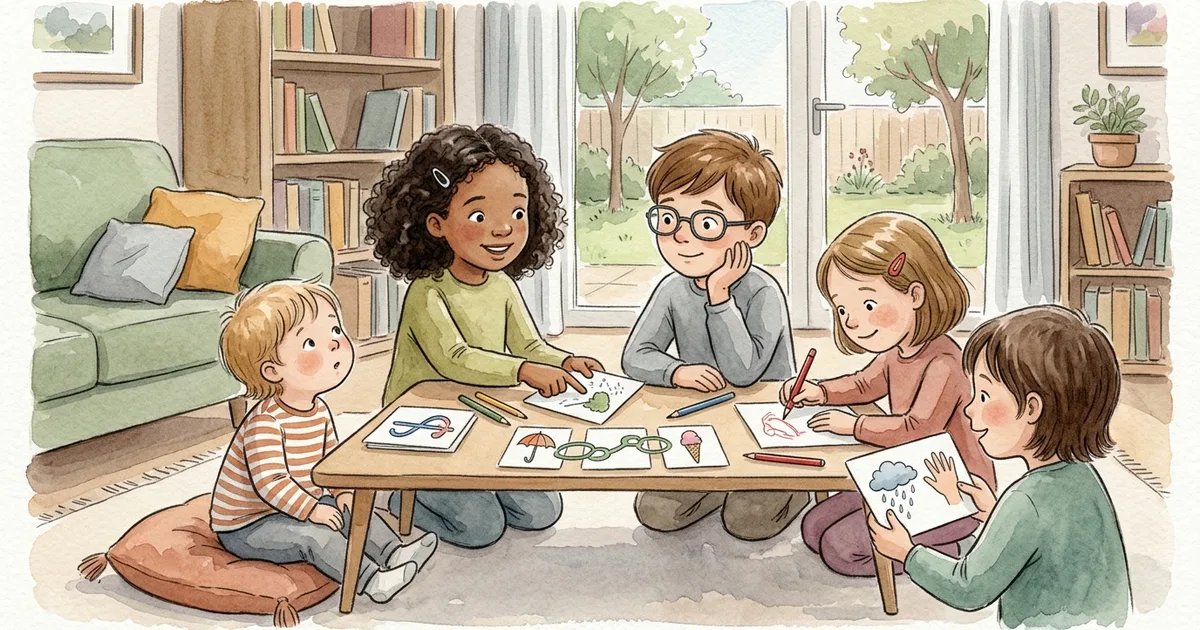
🔤 Task: Look at the image above and complete the tasks using only what you can clearly see.
1. Fill in the gaps with the correct words (because, so, but, or).
2. Choose the correct option (A/B).
3. Correct the mistake in the sentence.
Make sure all answers are based only on visible details in the image.
Conclusion
Understanding "because, so, but, and or" helps kids express themselves clearly. These four foundational conjunctions bridge simple ideas into complex thoughts and enrich spoken and written English.
With everyday conversation and focused exercises, children can confidently build stronger, more coherent sentences. LearnLink provides grammar resources that feel accessible and engaging for learners of all ages.
When a word has several meanings or pronunciations, Cambridge Dictionary is a useful check before turning it into child-friendly examples.
Start your child's English journey today — book a trial lesson with LearnLink.
Stay updated on our latest tips and resources by following us on Instagram LearnLink.