Comparatives and superlatives are special words we use to compare things, people, or ideas. Comparatives help us compare two items (e.g., 'bigger'), while superlatives help us compare three or more items and show which one is the 'most' (e.g., 'biggest'). Mastering these forms makes your sentences more descriptive and clear, allowing you to talk about differences easily.
Learning comparatives and superlatives can sometimes be tricky because English has both regular patterns (adding -er/-est) and many irregular forms (like good, better, best). Children often get confused about when to use 'more' or 'most' versus adding suffixes, and how to handle adjectives that change their spelling. However, with simple rules and plenty of practice, children of all ages can learn to use them correctly.
"Start with what children already understand: comparing toys, heights, or speeds. Then, gradually introduce the correct grammar forms through playful activities and real-life examples," says a LearnLink tutor.
👉 You can gently support your child’s progress by starting with a on LearnLink. Book a free trial lesson with LearnLink.
What Are Comparatives and Superlatives?
Comparatives and superlatives are grammar tools we use to describe how things are different. They make our descriptions more vivid.
Comparatives tell us that one thing has more of a quality than another. We use them when comparing two items. For example, if you have two apples, one might be bigger than the other. The word 'bigger' compares the size of two apples.
Superlatives tell us that one thing has the most of a quality among a group of three or more items. For example, if you have three apples, one might be the biggest of all. The word 'biggest' shows that this apple is the largest compared to all others in the group.
Why do they matter? Using these words helps us explain our world more precisely. Instead of just saying 'The dog is big,' you can say 'My dog is bigger than your dog' or 'My dog is the biggest dog in the park.' This makes your language richer and clearer for everyone.
Core Explanation: How to Use Comparatives and Superlatives
The way we form comparatives and superlatives depends on the adjective. Here are the main rules:
Example Sentences:
- My book is older than your book. (Comparative)
- She is the happiest girl in the class. (Superlative)
- This movie is more interesting than that one. (Comparative)
- That was the worst day ever! (Superlative, irregular)
Common Mistakes with Comparatives and Superlatives
Children often make a few common errors. Understanding these helps in correcting them early.

✍️ Task: Complete the sentences using the correct comparative or superlative form of the adjective in parentheses.
1. The blue car is ______ (fast) than the red car.
2. My sister is the ______ (young) person in our family.
3. This puzzle is ______ (difficult) than the last one.
4. Summer is the ______ (hot) season of the year.
5. Learning English is ______ (important) than playing games.
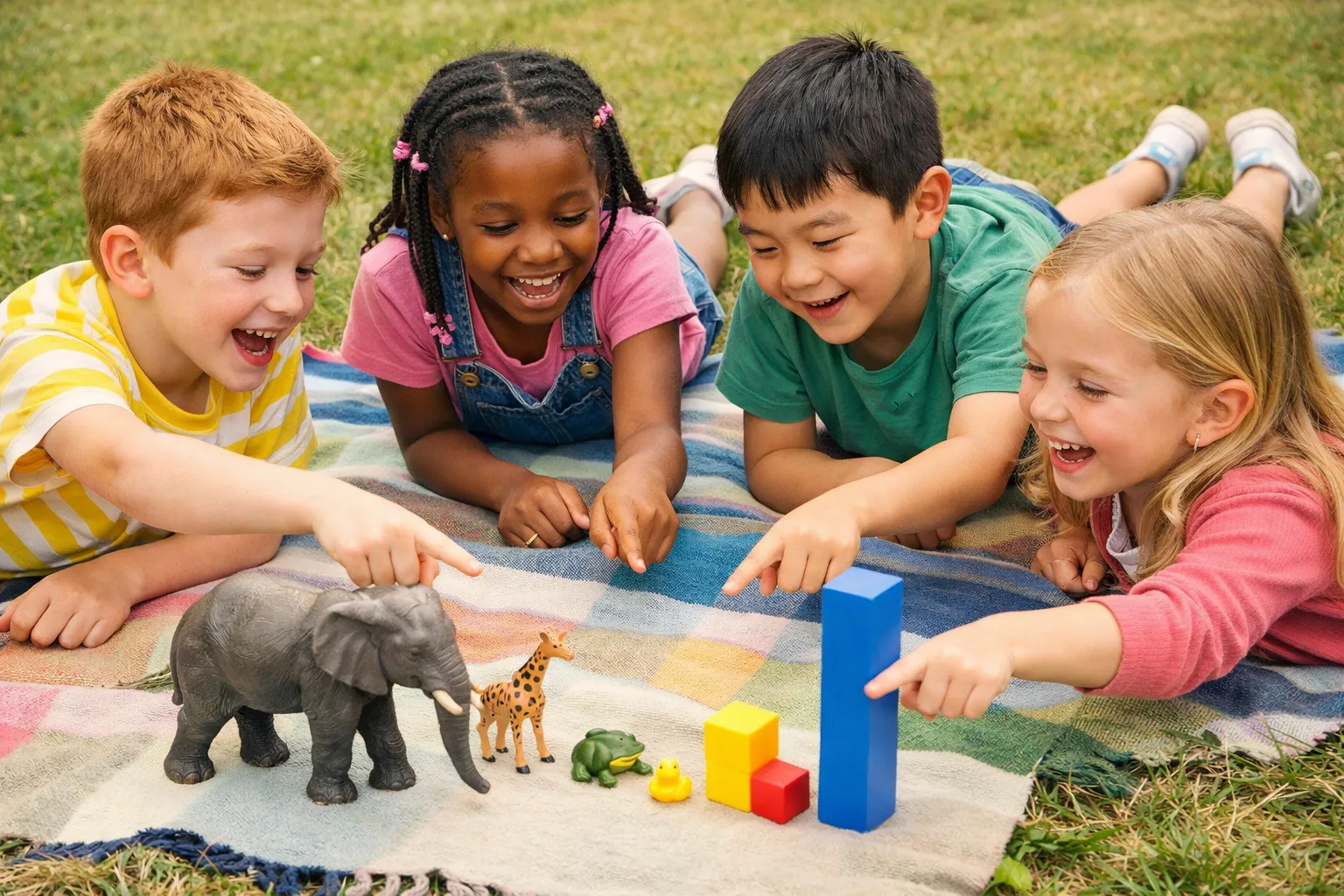
💬 Task: Look at the image of children in the park. Describe what is happening using comparatives and superlatives.
1. Compare the heights of two children.
2. Describe one child as the fastest or slowest.
3. Talk about the sizes of any objects you see (e.g., balls, slides).
✏️ Task: Create your own sentences about your favorite things.
1. Write a sentence comparing two of your favorite toys.
2. Write a sentence saying what your favorite animal is and why it's the best.
3. Write a sentence comparing two activities you enjoy, then add which one is your favorite overall.
Step-by-Step Learning Progression
Teaching comparatives and superlatives effectively involves a structured approach. This progression helps children build confidence and accuracy.
1. Input (school-age kids, 7-10, 11-15)
Start by exposing children to these forms. For younger kids (4-6), use stories or songs with simple comparisons ('This apple is big, this one is bigger!'). For school-age kids, read short texts where comparatives and superlatives appear naturally. Older learners (11-15) can identify these forms in articles or books, helping them recognize patterns and expand their growing their vocabulary.
2. Controlled Practice (school-age kids, 7-10, 11-15)
After input, children need guided practice. For school-age kids, use picture cards: 'Which animal is taller?' or 'Point to the smallest ball.' For school-age kids, fill-in-the-blank exercises are great. They choose between 'taller' or 'tallest' based on the sentence. For school-age kids, provide sentences and ask them to transform the adjective into the correct comparative or superlative form.
3. Semi-Controlled Practice (school-age kids, 7-10, 11-15)
This step encourages more independent use. For school-age kids, ask them to compare two objects in the room ('Is your chair bigger than mine?'). For school-age kids, show two pictures and ask them to write 2-3 sentences comparing them. For school-age kids, give a topic (e.g., 'sports' or 'movies') and ask them to compare different aspects, like 'football is more exciting than tennis.'
4. Free Production (school-age kids, 7-10, 11-15)
Now, children use the grammar without direct prompts. For school-age kids, during playtime, encourage them to describe their toys using comparisons. For school-age kids, ask them to write a short paragraph comparing two friends or two cities. For school-age kids, initiate a discussion about preferences, asking them to justify their opinions using comparatives and superlatives in everyday conversations.
5. Feedback (All Ages)
Provide constructive feedback at every stage. For younger children, gently rephrase incorrect sentences. For older children, point out specific errors and review the rules. Always focus on helping them communicate their ideas clearly rather than just marking mistakes. Encourage self-correction and peer correction where appropriate.
Conclusion
Learning comparatives and superlatives is an important step in building stronger English skills. By breaking down the rules, practicing regularly, and moving through a clear learning progression, children can confidently express differences and comparisons. Remember to keep learning fun and relevant to their lives. With these tools, your child will soon be making clearer, more descriptive sentences.
Stay updated on our latest tips and resources by following us on Instagram LearnLink.