Teach Kids English at Home: Parent Guide
Ten focused minutes of English practice each day usually works better than one long weekly session. The practical answer to how to help your child learn english at home is simple: connect new words to actions your child already understands, then repeat them in warm, low-pressure moments.
📥 Home English Routine Cards
A printable set of simple phrases parents can use during daily routines, stories, songs, and games.
Leave your email — we'll send the PDF to your inbox.No spam — the PDF plus one short reminder. Unsubscribe anytime.
How Can Our Tutors Teach My Child English at Home? A Step-by-Step Guide
Home instruction works best when it is structured but flexible. These steps support English practice for school-age kids and help families understand how to help your child learn english at home without turning every activity into a formal lesson.
A practical tutoring sequence often begins with a 5-minute warm-up, followed by 10 minutes of listening or reading, 15 minutes of guided speaking or writing, and a short review. For children ages 6-8, the focus may be on phonics, sight words, and simple sentence frames such as “I can see…” or “I like…”. For upper elementary kids, tutors can add short paragraphs, story retelling, and vocabulary sorting by topic. Teen learners usually benefit from discussion prompts, grammar correction in context, and writing tasks linked to school assignments. This structure keeps lessons predictable without making them rigid. If a child is tired, the tutor can switch from writing to oral practice while still working toward the same language goal.
At home, the tutor can also show parents how to reinforce English in small, repeatable ways between sessions. One useful technique is “model, repeat, extend”: the adult says a correct phrase, the child repeats it, and then adds one detail. For example, “The dog is running” becomes “The brown dog is running in the park.” Another technique is error recasting, where the adult repeats the child’s idea correctly instead of stopping the conversation for a long grammar explanation. If the child says, “She go school,” the adult can answer, “Yes, she goes to school every morning.” A common mistake is correcting every error immediately, which can make children speak less. Tutors usually choose one or two focus points per lesson, such as past-tense verbs or question forms, and let minor mistakes wait. This helps families understand how to help your child learn english at home through steady practice, not pressure.
Step 1: Use English in Daily Routines (School-age Kids)
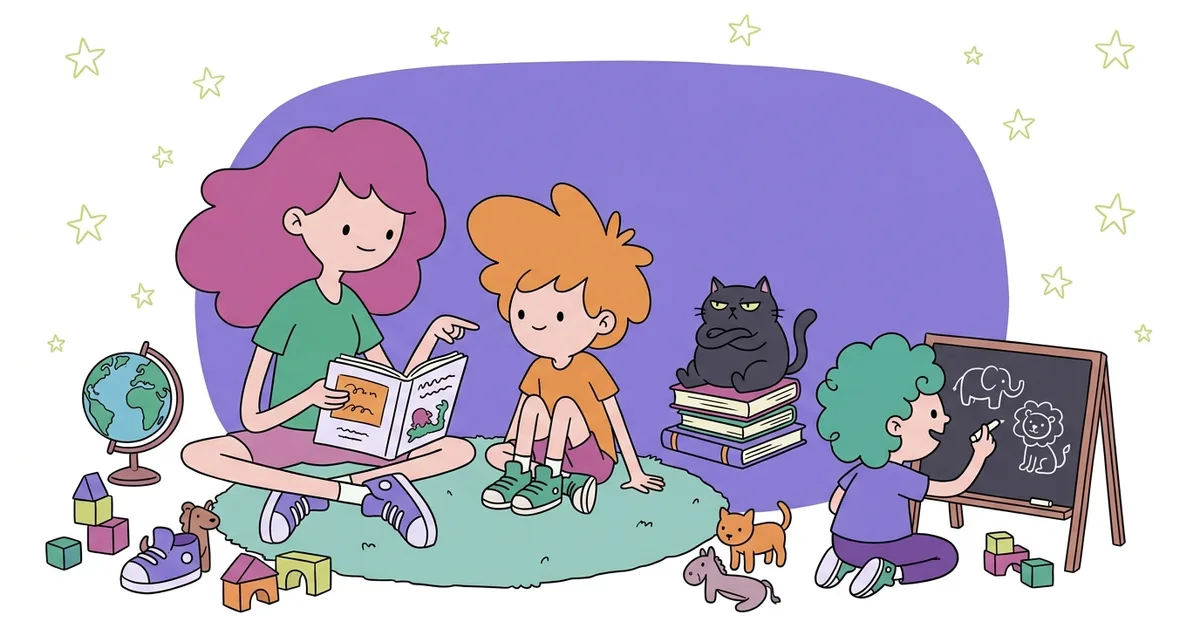
Routine-based practice uses mealtime, dressing, and hygiene habits as ready-made context. Narrate actions with short sentences and gestures so your child can link each word to an object, movement, or choice.
Example: During breakfast, use phrases like "Eat the apple" or "Drink the juice." Repeat them often. Recall grows through familiar moments.
Eat the apple.
Drink the juice.
Put on your shoes.
Open the door.
Read the book.
Clean your hands.
Step 2: Learn Through Stories and Songs (School-age Kids)
Nursery rhymes and illustrated storybooks introduce sound patterns. Rhythm helps children remember sentence shapes, while pictures make meaning clearer. Parents may utilize the best cartoons to learn English for kids to provide varied audio-visual input.
Reading aloud while pointing to illustrations clarifies meaning. Keep attention on context and voice, not word-by-word translation.
For elementary kids, use a short repeat-and-retell routine rather than asking them to memorize a full page. Choose one story or song for three or four days, with each session lasting 10-15 minutes. On the first day, let the child listen and follow the pictures. On the second day, pause after repeated phrases such as “Where are you going?” or “I can see…” and invite the child to finish the line. On the third day, ask two simple questions about meaning, then have the child retell the story in 3-5 sentences using the pictures as prompts. This builds listening, pronunciation, and sentence memory together. A useful technique is “echo reading”: the parent reads one short sentence with natural expression, and the child repeats it with the same rhythm and stress. Keep the sentence short enough to copy successfully; if the child struggles, reduce it to a phrase.
Older school-age children, around 9-12, can do more active work with stories and lyrics without turning the activity into a grammar lesson. After reading or listening, ask the child to find three useful phrases they might say in real life, such as asking for help, describing a place, or giving an opinion. Write the phrases on a small card and reuse them in a new sentence the next day. Songs can support this because chorus lines repeat naturally, but avoid the common mistake of playing a song many times without checking comprehension. Before singing along, preview 4-6 key words with pictures, gestures, or quick examples. Then let the child clap the beat, hum the melody, and finally say the words. If pronunciation is unclear, model only one sound or phrase at a time; correcting every word usually makes children quieter. The goal is confident, meaningful repetition, not perfect performance after one attempt.
Step 3: Play Simple English Games (All Ages)
Games reduce performance anxiety. Classic activities such as "Simon Says" or "I Spy" encourage active listening and spoken answers. These English learning games and activities for kids prioritize functional communication over grammatical precision.
Interactive play lets children use English in exciting, meaningful situations. That helps them move from understanding words to producing them.
Step 4: Watch English Cartoons and Videos (All Ages)
Digital media provides exposure to different accents, everyday phrases, and natural reactions. Educational platforms and top English learning YouTube channels offer curated content for school-age kids. Co-viewing lets parents ask simple questions about the plot.
Data current as of July 2026.
Step 5: Encourage Speaking Without Fear (All Ages)
A supportive environment builds confidence. When your child says, "She go," answer with the correct model: "Yes, she goes." This teaches accuracy without stopping the conversation.
Practical Tips for Success
- Maintain Engagement: Associate English with leisure to prevent resistance.
- Consistency: Daily 10-minute sessions outperform irregular, lengthy lessons.
- Patience: Progress is non-linear and needs steady repetition.
Common Mistakes Parents Make When Teaching English at Home
Why Parents Choose LearnLink
LearnLink English learning approach supports 4,000+ families across 100+ countries. The platform works with 200+ tutors specializing in child-centered pedagogy for ages 4-15. These resources complement home efforts by providing professional guidance and structured curriculum paths for families exploring how to help your child learn english at home.
When a word has several meanings or pronunciations, Cambridge Dictionary is a useful check before turning it into child-friendly examples.
👉 Start with a on LearnLink and make learning simple and enjoyable for your child — a trial lesson with LearnLink.
Stay updated on our latest tips and resources by following us on Instagram LearnLink.