Speak English More Confidently for Kids
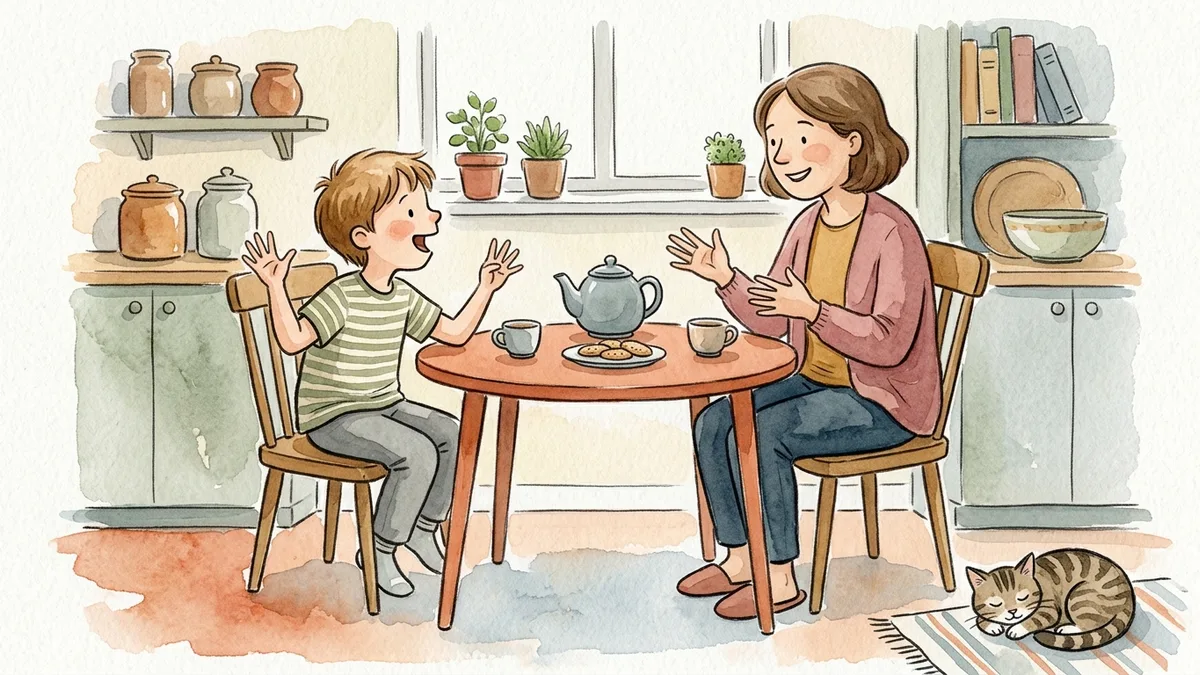
Language acquisition studies show that children who focus on phonemic awareness and sentence stress before age ten develop much stronger communication skills. Helping your child speak English more confidently is less about achieving a flawless accent and more about mastering the specific rhythm and clarity needed for others to understand them. When kids learn to prioritize clear sounds and natural flow, they gain the social tools necessary to express their ideas in any setting.
📥 Confidence Speaking Cards
Practice words and phrases that help kids sound clearer, smoother, and braver in English.
Leave your email — we'll send the PDF to your inbox.No spam — the PDF plus one short reminder. Unsubscribe anytime.
Breaking Down Confidence: Pronunciation and Flow
Clear pronunciation is the fastest way to feel sure of yourself when you speak, because it means the person listening understands you the first time. When a child has to repeat a word two or three times, that little pause chips away at their courage; when the sound lands cleanly, they get an instant "yes, I got it" and want to keep going. The trick is to train the handful of sounds that trip English learners up most, rather than worrying about every word at once. Kids can practise the tricky ones in front of a mirror so they can see how the mouth moves: put the tongue between the teeth for "th" in think and this, round the lips for "w" in water, and press the top teeth to the bottom lip for "v" in very. Minimal pairs make this into a game — say ship / sheep, rice / lice, or bat / bad out loud and ask a parent to point to the word they actually heard. A silly tongue twister a day, like "she sells seashells," turns the hardest sounds into something to laugh about instead of fear.
Speech flow — the rhythm and smoothness of how words join together — builds a different kind of confidence: the confidence to keep talking without freezing. English is spoken in connected chunks, not one stiff word at a time, so a child who can ride the natural rhythm sounds relaxed and stays relaxed. The best exercise for this is shadowing: play a short line from a favourite cartoon or song, then echo it back immediately, copying the speed, the pauses, and the way words blend (native speakers really do say "wanna" and "gonna"). Clapping or tapping the beat of a sentence helps too — "I WANT to GO to the PARK" — because it teaches which words to stress and which to say quickly. Encourage children to speak in short thought-groups and to breathe at the commas, so a long sentence feels like three easy steps instead of one scary leap.
Pronunciation and flow reinforce each other, and both grow through small, regular wins rather than one big push. A handy routine is to record a thirty-second voice memo — reading a paragraph or describing their day — then listen back once a week to hear real progress; children are often surprised and proud of how much smoother they sound. Keep the goal "clear and comfortable," never "perfect and accent-free," so that speaking stays low-pressure and fun. When clear sounds meet an easy rhythm, a child stops rehearsing every word in their head and simply talks — and that ease is exactly what confident English sounds like.
Mastering Tricky English Sounds
Many languages lack English sounds — a hurdle for young learners trying to speak English more confidently. The 'th' sound has two forms: soft /θ/ in 'think' and voiced /ð/ in 'this'. For Spanish or French speakers, these are new. Teach the physical action: place tongue tip between front teeth and blow air. Practice makes it automatic. These mechanics for basic English words build a strong base.
Visual aids are effective. Showing a child a tongue position diagram or using a mirror clarifies the concept. This detailed work is essential for pronunciation accuracy.

The Music of English: Stress and Intonation
Beyond single sounds, English melody is crucial. English is a stress-timed language; certain words are emphasized. This rhythm carries meaning. Consider 'She didn't take the blue car.' Stressing 'she' implies someone else did. Stressing 'blue' implies a different color car. Understanding this 'music' is a key step for young learners. It transforms speech from flat recitation to expressive communication. This is core to learning to speak English more confidently, conveying meaning beyond words. Our interactive English lessons for kids often use songs and rhymes to teach this naturally.
Rhythm Drill: Word Emphasis Game
Have your child repeat 'I like to eat apples,' emphasizing a different word each time. First 'I' (implying others don't). Then 'like' (strong feeling). Then 'eat' (not throw). Finally 'apples' (not oranges). Ask what meaning changes. This game builds awareness of sentence rhythm and helps kids speak English more confidently. Try it with 3-4 short sentences per session.
Practice Makes Progress: Fun Activities at Home
Consistent, low-pressure practice builds speaking skills effectively. Integrate English into daily fun. Tongue twisters excel for muscle memory around difficult sounds. Start slow with 'She sells seashells by the seashore,' speeding up as your child gets comfortable. Listening to native speakers is another tool; English podcasts for kids provide clear, engaging audio models. Reading stories aloud helps a child connect written words with their spoken sound. Quality English reading for kids materials serve this purpose.
Small phrasing shifts, practiced through role-play games, change how confident a child sounds. Teaching kids to speak English more confidently means giving them ready-made phrases for tricky moments. This is core to kids English speaking practice.
Your Accent Is an Asset, Not a Barrier
International parents worry their accent might hurt their child's English. It won't. The key factor is a positive, encouraging language environment. Native-pronunciation exposure comes from teachers, media, and our tutors in afterschool English classes online. Your role: foster willingness to try, make mistakes, and communicate. An encouraged child develops faster than a hesitant one — regardless of parental accent. Daily 5-minute English routines at home matter more than perfect pronunciation. Try reading 1 short story aloud together each night; these consistent efforts to teach English to your kids at home outperform occasional formal lessons. Parents who model curiosity (asking «What did you learn today?» in English) raise kids who speak English more confidently sooner.
Summary and Next Steps
To recap the points for building your child's speaking confidence:
- Focus on one sound at a time. Master the 'th' or the short 'i' (as in 'ship') before moving to the next. Use mirrors and repetition.
- Practice sentence rhythm. Use songs, rhymes, and stress-repetition games to teach the natural music of English.
- Make it fun and consistent. Short, daily activities like tongue twisters or reading a story aloud outperform long, infrequent lessons.
- Model confidence. Encourage your child to speak without fear of making mistakes. The goal is communication, not perfection.
These steps provide a solid framework for confident bilingual development. They are central to a quality English for primary school program.
When a word has several meanings or pronunciations, Cambridge Dictionary is a useful check before turning it into child-friendly examples.
Frequently Asked Questions
At What Age Should My Child Focus on Pronunciation?
While exposure can start at any age, focused pronunciation work is often most beneficial for children. At this stage, they have improved motor control of their tongue and lips, and can understand instructions about mouth shapes. For younger children, focus on listening and absorption through songs and stories as part of their English learning for toddlers journey.
Will Learning American and British English at the Same Time Confuse My Child?
Exposure to different accents is generally beneficial and reflects the real world. But for a young beginner, we recommend choosing one model (either American or British) for primary instruction. This consistency in early stages helps avoid confusion with core vocabulary and vowel sounds (e.g., 'tom-AY-to' vs 'tom-AH-to'). Once they have a solid foundation, introducing other accents is easier.
How Can I Help My Shy Child Speak English More Confidently?
Create a safe, low-pressure environment. Use puppets or stuffed animals for conversations; this lets the child speak through a character. Play fun games to learn English involving spoken commands, like 'Simon Says'. The goal is to make speaking playful, not a performance. Praising effort, not just accuracy, helps them feel secure and willing to try.
How Much Practice Is Needed Daily for Noticeable Improvement?
Consistency is key. We find 10-15 minutes of focused, interactive practice daily yields superior results than one long lesson per week. This could be a short story time, a song, or a game. Regular engagement keeps the language fresh and builds momentum.
Ready to see your child's confidence grow? Our certified tutors create personalized, engaging lessons making learning to speak English fun. Discover the difference one-on-one attention can make — book a trial lesson with LearnLink.