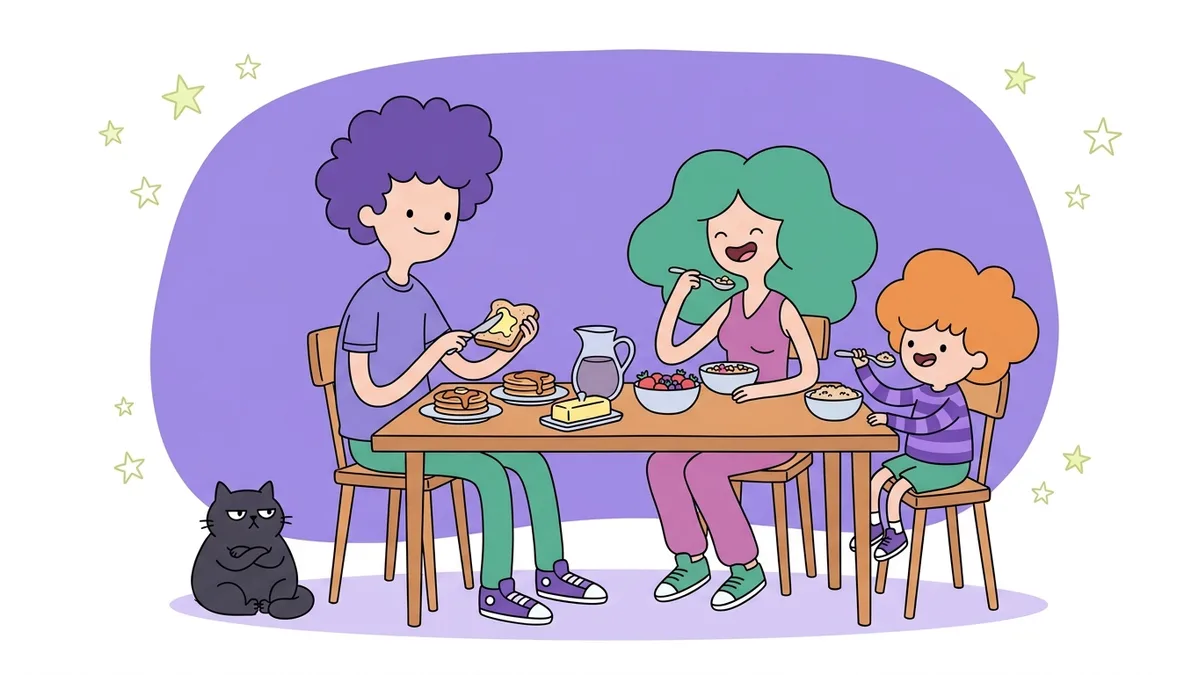
The conjunction "and" serves as a fundamental linguistic tool for linking similar objects, actions, or concepts. Early language learners typically utilize this word to create simple lists of nouns. Mastery of "and" allows children to transition from isolated statements to cohesive, descriptive narratives. Effective instruction focuses on expanding its application to verbs, adjectives, and independent clauses.
📥 And Connector Practice Sheet
Fun printable activities to help children connect words, actions, and ideas with and.
Leave your email — we'll send the PDF to your inbox.No spam — one email with your PDF. Unsubscribe anytime.
Functional Applications of Conjunctions
"And" functions as a bridge between linguistic elements, indicating addition or connection. While initial usage often involves listing nouns, advanced application includes linking diverse parts of speech. Using common phrases with 'and' reinforces these structural patterns in daily contexts.
- Noun Linkage: Connects multiple subjects or objects (e.g., "apples and grapes").
- Verb Linkage: Combines sequential or simultaneous actions (e.g., "sings and flies").
- Adjective Linkage: Pairs descriptive qualities for greater detail (e.g., "small and fluffy").
- Clause Linkage: Joins two independent thoughts into a compound sentence.
💡 Key Idea

The conjunction 'and' integrates related ideas, actions, or descriptions to enhance sentence length and informational density.
For elementary kids, and is often the first coordinating conjunction they use with confidence because it mirrors spoken storytelling: “I saw a dog and it ran.” A practical classroom technique is the “two-card sentence” activity. Give the child two idea cards, such as The rabbit jumped and The rabbit hid, then ask them to join the cards with and: The rabbit jumped and hid. This shows that and can connect two actions without repeating every word. With ages 8-10, the same technique can be expanded to combine descriptions: The cave was dark and cold, or related details: Maya packed a map and a flashlight. The goal is not simply to make sentences longer, but to help children see which ideas belong together.
A common mistake is using and to link ideas that do not share a clear relationship, such as I ate breakfast and the moon is far away. Another frequent issue is the “and-chain,” where a child keeps adding actions without punctuation or order: We went to the park and played and ate and ran and went home. A useful correction routine is to limit practice sentences to 2 connected ideas first, then ask one question: “Do these ideas happen together, describe the same thing, or belong in the same moment?” If yes, and is likely appropriate. If not, the child may need a new sentence or a different connector. This helps learners master and as a tool for connection, not as a catch-all word for every next thought.
Common Syntactic Errors in Early Usage
Learners often encounter specific challenges regarding punctuation and subject-verb agreement when using conjunctions. Identifying these patterns allows for targeted correction. The following table outlines frequent errors and their standard academic corrections.
Instructional Methodology for Language Development
Systematic progression ensures students internalize conjunction usage across various contexts. Utilizing common words during practice reduces cognitive load. Educators should follow a structured five-step sequence to build proficiency.
- Auditory Input: Read stories emphasizing the word "and" to build recognition.
- Controlled Practice: Use fill-in-the-blank exercises with visual aids for immediate application.
- Semi-Controlled Practice: Provide sentence starters requiring the student to add connected ideas.
- Free Production: Encourage creative storytelling or journaling to foster independent usage.
- Corrective Feedback: Model accurate syntax through positive reinforcement and rephrasing.
🔤 Task: Analyze the image above and complete the following linguistic tasks.
1. Insert the conjunction "and" where appropriate:
a. A girl is flying a red kite _____ smiling.
b. A boy is riding a blue bicycle _____ wearing a helmet.
c. A dog is chasing a yellow ball _____ running on the grass.
2. Identify the correct descriptive pair:
a. The kite is (A. red and flying / B. blue and sitting).
b. The boy is (A. riding a bike and sitting / B. riding a bike and moving).
General Questions on Conjunction Usage
How Does the Word 'And' Improve Writing?
The word 'and' connects related ideas, which reduces repetitive sentence starts and increases narrative flow.
At What Age Do Children Learn Conjunctions?
Most children begin using 'and' between ages 2 and 3 to link simple nouns or actions.
Is a Comma Always Required Before 'And'?
Commas are required before 'and' in lists of three or more items and when joining independent clauses.
For mastering and simple ways for kids to connect ideas, start with oral sentence combining before moving to written practice. A useful age band is 5 to 7, when many children can hear that “I packed a pencil. I packed a notebook.” sounds smoother as “I packed a pencil and a notebook.” One practical technique is the two-card method: place one idea on each card, ask the child to read both aloud, then choose a conjunction that shows the relationship. Use “and” for adding, “but” for contrast, “or” for choice, “because” for reason, and “so” for result. Keep the first round short, using 6 to 8 sentence pairs, so the focus stays on meaning rather than copying long sentences.
A common mistake is using “and” for every connection, even when the ideas do not simply add information. For example, “I wanted to play outside, and it was raining” is grammatically possible, but “but” usually explains the contrast more clearly. Children also often create run-on sentences by adding too many ideas with repeated “and”: “We went to the park and we played soccer and we ate lunch and we saw a dog.” A teacher or parent can ask the child to stop after two linked ideas, then decide whether the next thought needs a period, a comma, or a different conjunction. By ages 8 to 10, many learners are ready to compare sentence pairs and explain why one connector fits better than another. This builds grammar knowledge and writing judgment at the same time, because the child is not just naming conjunctions but using them to show addition, contrast, choice, cause, and effect.
Why Parents Choose LearnLink
LearnLink provides specialized English instruction for 4,000+ families across 100+ countries. The platform features 120+ qualified tutors who implement pedagogical strategies for effective language acquisition. To support student progress, follow these steps:
Data current as of July 2026.
- Review daily vocabulary lists.
- Practice combining simple sentences during conversation.
- Use visual prompts to elicit descriptive language.
- Monitor progress through consistent feedback.
For additional resources, follow the official Instagram LearnLink page.
When a word has several meanings or pronunciations, Cambridge Dictionary is a useful check before turning it into child-friendly examples.
"Learning 'and' is a cornerstone for building rich sentences. Start by modeling short, descriptive sentences using 'and' for everyday objects and actions, making it a natural part of conversation," says a LearnLink tutor.
👉 You can gently support your child’s progress by starting with a on LearnLink — book a free trial lesson with LearnLink.
Stay updated on our latest tips and resources by following us on Instagram LearnLink.