Unlock Pronoun Power with Talking Animal Tales
Unlock Pronoun Power with Talking Animal Tales helps children ages 4-7 practice he, she, they, it, we, and you through brief animal-story scenes. When a fox shares snacks or two rabbits build a den, your child links each pronoun with a clear speaker and action. Playful context makes grammar feel like shared conversation, not rule lists. Unlock Pronoun Power with Talking Animal Tales turns pronoun practice into simple, repeatable home learning moments.
📥 Talking Animal Pronoun Cards
A printable practice pack for choosing he, she, it, they, him, her, and them in fun animal sentences.
Leave your email — we'll send the PDF to your inbox.No spam — the PDF plus one short reminder. Unsubscribe anytime.
Why Do Children Struggle with Pronouns?
Pronouns are small words that take the place of nouns. They keep sentences smooth. Without them, names or objects repeat again and again. For example, instead of saying, "Lily went to the park. Lily saw a dog. Lily played with the dog," we say, "Lily went to the park. She saw a dog. She played with it."
Children often struggle because pronouns shift by sentence role. 'He' works as a subject because he does the action; 'him' works as an object because he receives the action. Subject and object roles can feel abstract, especially when a noun disappears and a shorter word replaces it. Consistent practice and fun activities are key. This foundation also supports later grammar skills, including sentence building, story retelling, and clearer everyday speech.
Understanding Pronouns Through Engaging Stories
AI storyteller adventures make pronoun learning active and natural. These tools create interactive stories where children hear and see pronouns in action. They can help children understand personal pronouns (I, you, he, she, it, we, they), object pronouns (me, you, him, her, it, us, them), and possessive pronouns (my, your, his, hers, its, our, their).
For instance, an AI story might feature a brave fox. Story lines can highlight, "The fox ran fast. He chased a butterfly." Or, "The owl watched the fox. It saw him jump high." Talking animals help children grasp how pronouns replace nouns and make sentences sound natural. Unlock Pronoun Power with Talking Animal Tales supports this shift from word memorization toward understanding who acts, who receives action, and what each pronoun points toward inside the story.
💡 the Power of Interactive Grammar
Learning pronouns through engaging, interactive stories with AI and talking animals makes grammar less intimidating and more memorable for children of all ages. For parents, Unlock Pronoun Power with Talking Animal Tales works best when practice stays short, visual, and weekly.
Common Mistakes When Using Pronouns
Children often make predictable pronoun mistakes. Pattern recognition helps parents and teachers guide them through clearer prompts, quick corrections, and short practice sentences. Here are common errors and corrections: For parents, Unlock Pronoun Power with Talking Animal Tales works best when practice stays short, visual, and weekly.
Step-by-Step Learning Progression
1. Input
Children meet pronouns through stories and songs. AI storytellers provide rich audio and visual input, so children hear and see correct pronoun use in context. They listen to tales with talking animals and absorb patterns such as "he runs," "she helps," "they play," and "it sleeps."
2. Controlled Practice
Learners complete simple tasks focused on one pronoun type. They might choose between 'he' and 'she' in a story, fill in a missing pronoun, or point to the character matching a sentence. AI apps can give immediate feedback, correct mistakes, and reinforce accurate usage before longer responses.
3. Semi-Controlled Practice
Children start using pronouns with greater independence. They might retell part of a story using given pronouns, answer questions requiring full sentences, or describe a character's action after hearing a model sentence. The talking animal characters can prompt them with questions such as "Who helped the rabbit?" or "What did she carry?"
4. Free Production
At this stage, children create their own sentences or short stories using pronouns freely. They might describe animal actions, create dialogue between two characters, or explain what happened first, next, and last. The goal: communication with correct pronouns, without heavy guidance. Unlock Pronoun Power with Talking Animal Tales works well here because animals, actions, and dialogue give children enough context to choose the right word.
5. Feedback
Feedback matters at every stage. AI tools can offer instant corrections. Across LearnLink lessons, our tutors help children build confident, everyday English step by step. Over time, they understand mistakes, build confidence, and build a strong vocabulary.
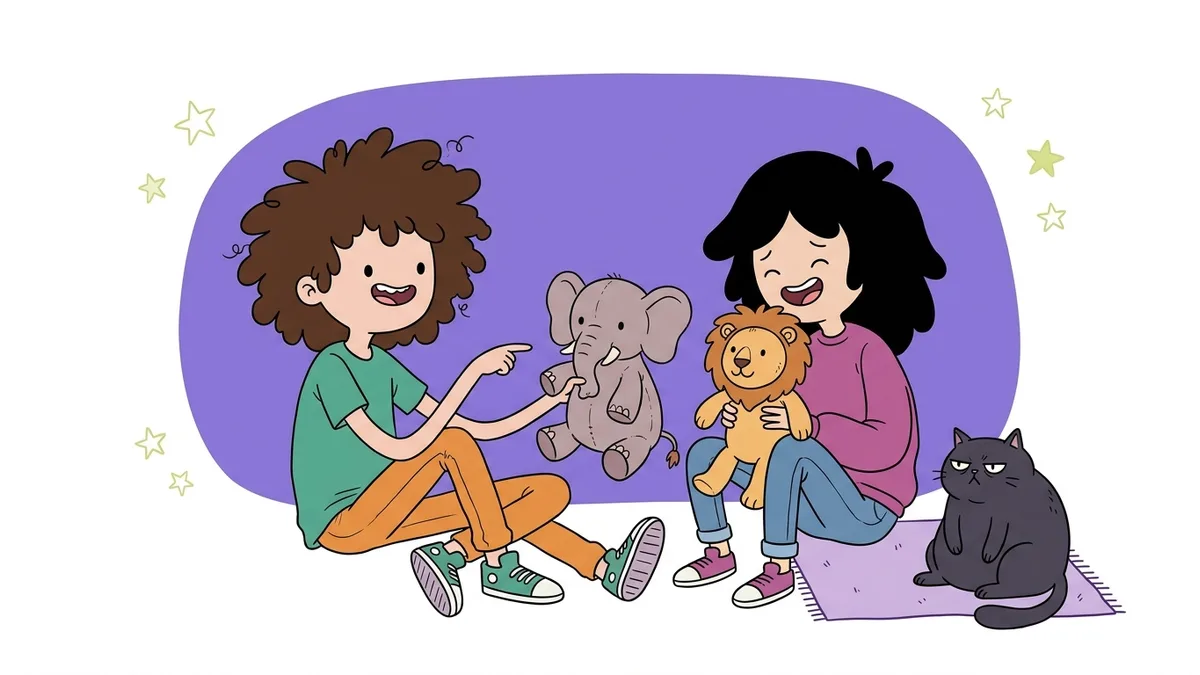
🔤 Task: Look at the image above. Create 4–6 short controlled practice tasks based only on what is clearly visible.
1. The girl is pointing at the board. Her has braids. (Correct: ____)
2. The teacher stands near the whiteboard. ____ is observing the children.
3. What is written on the whiteboard? ____ is a story about a cat and a dog.
4. The children are looking at the board. ____ are holding pencils.
5. Give the pen to ____. (Choose: she / her)
6. My story is on the whiteboard. Is ____ on the whiteboard too? (Choose: yours / your)
🔤 Task: Use the same image. Ask the learner to describe the scene or create their own sentences based on it. Provide 3–5 guiding prompts.
1. Describe the teacher. What is she doing?
2. What do you think the girl pointing at the board is saying? Use 'she' or 'her' in your answer.
3. Imagine the story on the whiteboard. What might 'it' be about? How would you use 'he' or 'she' for the cat and dog?
4. What are the other children doing? How would you use 'they' or 'them' to describe their actions?
5. Write three sentences about what you see in the classroom, using a different pronoun in each sentence.
Conclusion
Mastering pronouns marks a vital step in building strong English grammar skills. AI storyteller adventures give children a dynamic path for learning these essential language tools. Captivating tales, talking animals, repeated sentence patterns, and instant feedback turn dry grammar drills into practice children can understand and enjoy. Unlock Pronoun Power with Talking Animal Tales supports every stage, from early recognition to confident, independent usage.
Stay updated on our latest tips and resources by following us on Instagram LearnLink.
For the rule wording, Wikipedia — English Grammar is a useful reference while the practice examples here stay adapted for children.
Start your child's English journey today. Book a trial lesson with LearnLink.