Example Sentences with Adjectives for Kids
An adjective describes a noun: a person, place, animal, or thing. Example Sentences with Adjectives for Kids: A Practical Guide shows how words such as small, happy, and green sharpen sentences. “I see a small green bird” creates a stronger picture than “I see a bird.” Connect each adjective to a familiar noun. Give younger learners short spoken examples; ask older children to compare meanings, check word order, and choose precise descriptions.
📥 Adjectives in Action
Sentence examples and independent practice for young learners
Leave your email — we'll send the PDF to your inbox.No spam — the PDF plus one short reminder. Unsubscribe anytime.
What Children Need to Understand
Children first need to understand an adjective’s job. In “The noisy bus stopped,” noisy describes the bus. In “The bus is noisy,” the adjective follows is but still describes the bus. Ask “What is it like?” to help a child find the adjective.
The examples in Example Sentences with Adjectives for Kids: A Practical Guide pair new grammar with familiar nouns: a warm coat, sweet mango, crowded street, or tired dog. The examples suit varied homes and cultures without assuming identical school days, meals, or celebrations.
Adjectives do not change for singular and plural nouns in English. We say “one red apple” and “three red apples,” not “three reds apples.” Multilingual children may need practice if their other languages mark gender or number on describing words.
How Adjectives Work in a Sentence
An adjective appears before a noun or after a linking verb. The main linking verb is be, but adjectives follow look, feel, seem, sound, smell, and taste. In “The soup smells fresh,” fresh describes the soup, not the act of smelling.
Read Example Sentences with Adjectives for Kids: A Practical Guide aloud and pause before the adjective. Say, “The water feels…” and ask your child to add cold or warm. Accept either answer when the sentence and situation support it.
Useful Rules and Clear Examples
Start with qualities children can see, hear, touch, taste, or measure. Teach “The pillow is soft,” “We heard a loud bell,” and “That is a tall tree” before abstract words such as fair or responsible. Then add feelings and opinions: “The child looks worried,” “The puzzle seems difficult,” and “Our game was exciting.”
Example Sentences with Adjectives for Kids: A Practical Guide helps children notice these patterns:
She carries a yellow bag.
A tiny insect landed on the window.
We drew a round moon.
They crossed an old bridge.
The players felt proud.
That was a clever answer.
He opened the wooden box.
This path is shorter than the other path.
Vocabulary cards for practice
She carries a yellow bag.
A tiny insect landed nearby.
We drew a round moon.
They crossed an old bridge.
The players felt proud.
That was a clever answer.
He opened the wooden box.
This path is shorter.
When several adjectives precede a noun, English places opinion before size, age, colour, origin, and material: “a lovely small wooden boat.” Teach one natural pair at a time, such as “a big blue ball,” then compare it with the awkward “a blue big ball.”
Choosing Examples for Different Ages
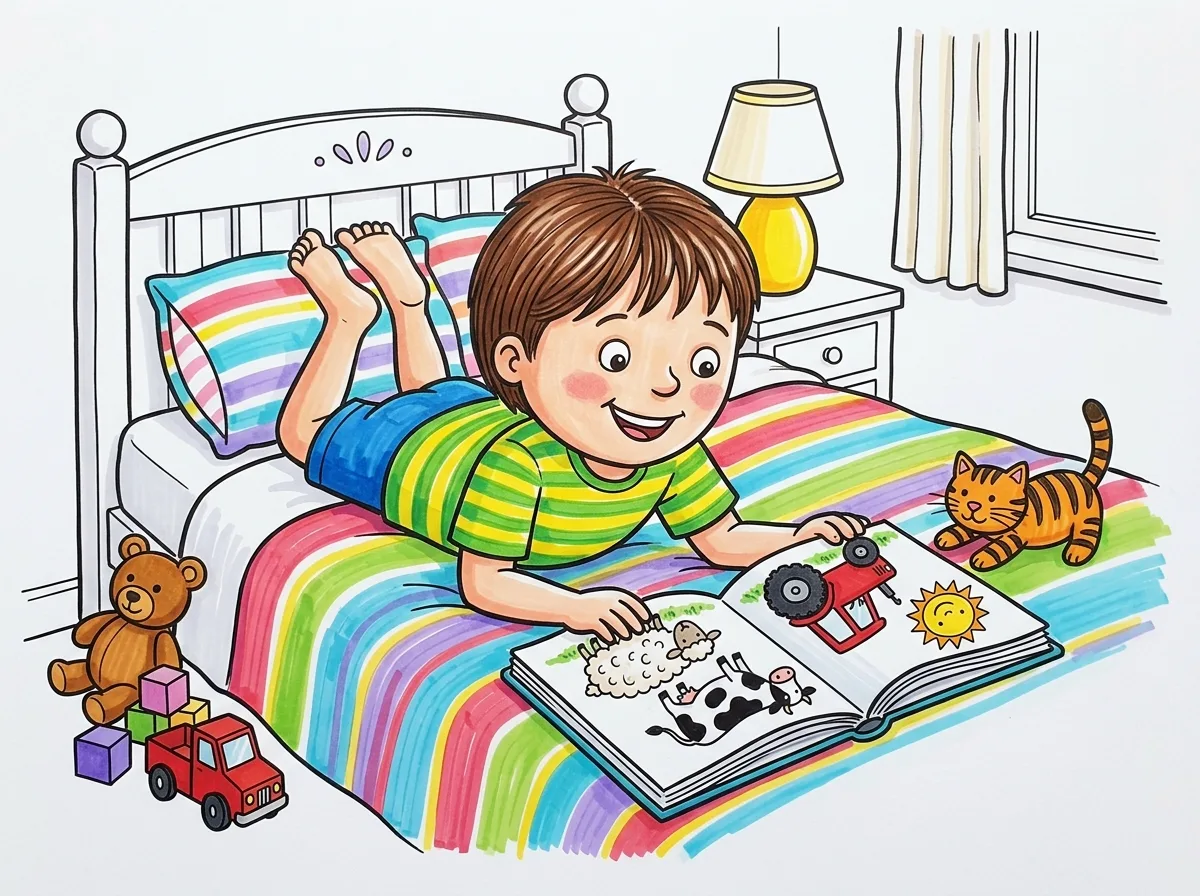
For school-age kids, use visible objects and short sentences: “The cup is full,” “I have clean hands,” or “That cat is sleepy.” Let the child point, act, or choose between two words. The goal is to connect each adjective with its meaning, not recite a definition.
For school-age kids, ask children to expand a basic sentence. “We saw a house” can become “We saw a narrow white house.” Children can sort opposite pairs: fast/slow, early/late, and heavy/light. Each sentence should reveal the intended meaning.
Older learners can practise precision, adjective order, and comparison. They might replace nice in “It was a nice meal” with fresh, filling, or spicy. Across LearnLink lessons, our tutors adapt Example Sentences with Adjectives for Kids: A Practical Guide to each learner’s vocabulary and speaking confidence while respecting multilingual knowledge.
Common Mistakes and How to Correct Them
Children may place the adjective after the noun: “a car red.” Standard English uses “a red car.” They may add a plural ending: “two olds houses.” The correct form is “two old houses.” Ask the child to underline the noun and draw an arrow from the adjective to it.
Children may confuse adjectives and adverbs. Compare “She is quiet” with “She speaks quietly.” Quiet describes the person; quietly explains how she speaks. After a linking verb, use an adjective: “The music sounds beautiful.” An action verb may need an adverb: “The musician plays beautifully.”
Check the article before an adjective. Choose a or an by the next sound, not the next letter: “an old bicycle” but “a yellow bicycle.” Avoid stacked descriptions. “A friendly young dog” communicates more sharply than six adjectives a child cannot explain.
Practice Activities at Home or in a Lesson
Keep practice active and brief. Request a full sentence, then change one part: “The blanket is soft,” “The towels are soft,” and “We bought a soft blanket.” The adjective stays unchanged while the noun and verb shift.
Fill in the Missing Adjective
Choose from cold, bright, hungry, heavy.
1. The children are ___ after the walk.
2. This bag feels ___.
3. The stars look ___.
4. My water is ___.
Answers: 1. hungry; 2. heavy; 3. bright; 4. cold.
Expand and Correct the Sentences
Add a suitable adjective to “We saw a bird” and “They entered a room.” Then correct these sentences: “She has a scarf green” and “The cakes are sweets.”
Possible answers: “We saw a colourful bird.” “They entered a quiet room.” “She has a green scarf.” “The cakes are sweet.” Other adjectives are acceptable when the sentences make sense.
Ask the child to explain one choice: “Why did you choose heavy?” An answer such as “The bag is hard to lift” confirms meaning, not memory. Reuse difficult examples in speech another day before assigning longer written work.
For the rule wording, Wikipedia — English Grammar is a useful reference while the practice examples here stay adapted for children.
Frequently Asked Questions
At What Age Can a Child Begin Learning Adjectives?
Children can learn adjectives once they name familiar objects. A 4-year-old may use “big ball” and “small ball”; an older learner can explain position and adjective order. Example Sentences with Adjectives for Kids: A Practical Guide supports this progression from visible qualities to feelings, opinions, and comparisons.
How Many New Adjectives Should a Child Learn at Once?
No fixed number suits every learner. Begin with a small group the child can use in full sentences. Four themed words—hot, cold, warm, and cool—work better than a long mixed list. Add words after the child understands and reuses earlier ones.
How Can My Child Tell an Adjective from an Adverb?
Ask what the word describes. An adjective describes a person or thing: “The runner is quick.” An adverb often describes an action: “The runner moves quickly.” Linking verbs connect the subject to an adjective. In “The runner looks tired,” tired describes the runner, not how the person looks.
Should a Multilingual Child Translate Adjectives?
Translation can confirm meaning but should not stand alone. Connect the English adjective to an object, picture, gesture, or situation, then use it in a sentence. Compare languages openly: another language may change an adjective for gender or number, while English keeps the same form.
How Can I Check Whether My Child Understands Adjectives?
Ask the child to find an adjective, identify its noun, and create a new sentence with the same word. After reading “The narrow road was busy,” the child might say, “We walked through a narrow gate.” Accurate reuse proves understanding better than a memorised definition.
If your child needs steady speaking practice, start small — choose a trial lesson.
Stay updated on our latest tips and resources by following us on Instagram LearnLink.