Possessive nouns and pronouns indicate ownership or association between subjects and objects. Mastery typically begins in early childhood as students distinguish personal belongings from shared items. Research suggests starting with concrete physical objects before moving to abstract relationships improves retention of possessive nouns and pronouns for kids.
📥 Ownership Words Practice Pack
Kid-friendly phrases for showing who something belongs to
Leave your email — we'll send the PDF to your inbox.No spam — one email with your PDF. Unsubscribe anytime.
Understanding Possessive Nouns & Pronouns for Kids
Possessive forms identify owners by answering the question "Whose?". The phrase "Emily's bag" identifies Emily as the owner. This tool facilitates precise communication regarding property. Proper application eliminates wordy constructions, streamlining sentence structure. Learning common English phrases requires a fundamental grasp of these ownership markers.
Takeaway: Possessive words show ownership, making sentences clearer.

For children ages 6 to 9, the clearest starting point is the difference between a possessive noun and a possessive pronoun. A possessive noun keeps the owner’s name in the sentence and usually adds an apostrophe plus s: the teacher’s desk, Sam’s pencil, the dog’s bowl. A possessive pronoun replaces the noun phrase when the owner is already clear: mine, yours, his, hers, ours, theirs. A simple 3-step classroom technique works well: first, ask “Whose is it?”; second, name the owner; third, choose either the owner’s name with an apostrophe or a pronoun that stands alone. For example, point to a crayon and ask, “Whose crayon is this?” A child can answer, “It is Mia’s crayon,” then shorten it to “It is hers.” This movement from full phrase to pronoun helps children see that both forms show ownership, but they do different jobs in a sentence.
A common mistake is adding an apostrophe to possessive pronouns, such as writing her’s, your’s, or their’s. These forms are not standard because possessive pronouns already show ownership without an apostrophe. Another frequent confusion is between its and it’s: its shows ownership, as in The bird flaps its wings, while it’s means it is. A useful check is the “it is test”: if the sentence still makes sense with it is, use it’s; if not, use its. Children also need practice with plural owners. One cat’s toy is the cat’s toy, but toys belonging to several cats are the cats’ toys. Using 5 familiar classroom objects, such as a backpack, ruler, lunchbox, book, and jacket, gives enough repetition without overload. Have children sort sentence cards into two groups: “names the owner” and “replaces the owner.” This concrete sorting activity turns ownership from an abstract grammar rule into a visible pattern they can recognize and use.
Core Explanation: Showing Ownership Simply
Grammar rules for possession are categorized by noun type and pronoun function. Consistent application ensures clarity in academic writing and daily speech.
Data current as of June 2026.
Possessive Nouns: Adding 'S
Singular possession requires an apostrophe followed by 's'. Plural nouns ending in 's' require only a trailing apostrophe.
- Singular Rule: Noun + 's (e.g., the boy's hat).
- Plural Rule: Noun + s' (e.g., the students' books).
- Irregular Plurals: Noun + 's (e.g., the children's toys).
Possessive Pronouns: Stand-Alone Words
Possessive pronouns replace nouns to indicate ownership without apostrophes. These words function as adjectives or independent pronouns.
- Determiner forms: my, your, his, her, its, our, their.
- Independent forms: mine, yours, his, hers, its, ours, theirs.
- Example: "The ball is theirs" replaces "The ball belongs to them."
Takeaway: Use 's for singular, ' for plural 's', and specific possessive pronouns.
Common Mistakes with Possessive Nouns and Pronouns
Errors frequently occur regarding apostrophe placement and confusing possessive pronouns with contractions.
Takeaway: Distinguish between singular 's, plural s', and the possessive 'its'.

Step-by-Step Learning Progression
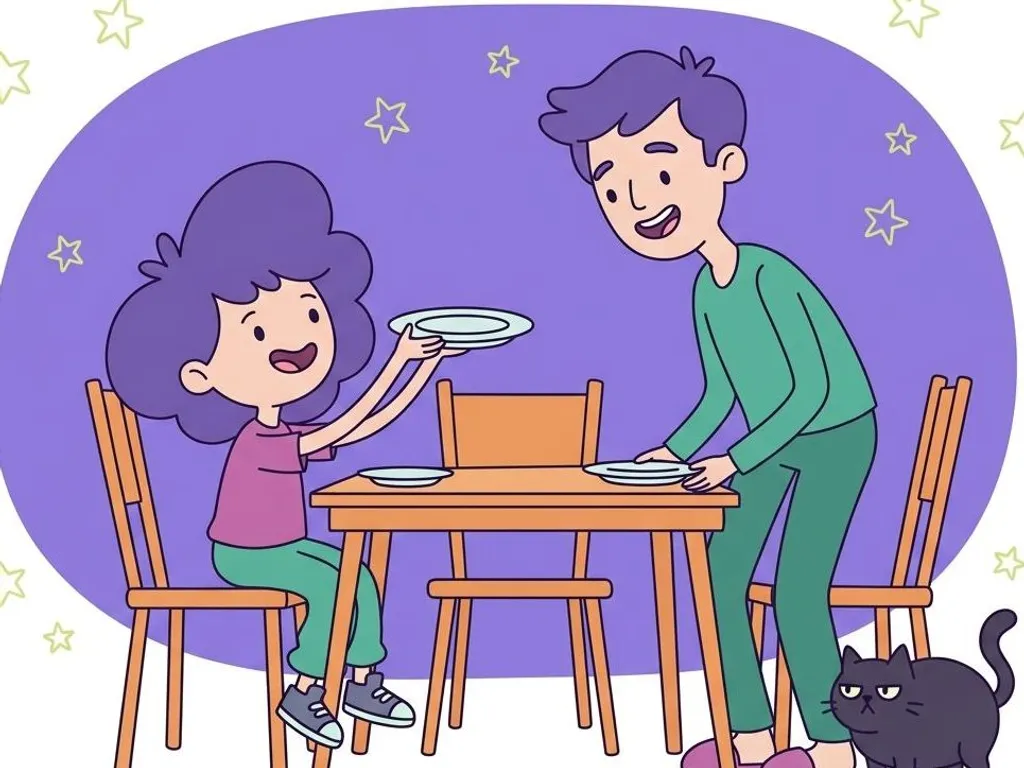
Effective instruction follows a scaffolded model. Educators move from recognition to production through five stages:
- Input: Identification of ownership in literature. Students observe "the cat's toy" in books.
- Controlled Practice: Fill-in-the-blank tasks. Students select "my" or "your" based on prompts.
- Semi-Controlled Practice: Sentence generation. Students describe classroom settings using possessive markers.
- Free Production: Composition of narratives. Students integrate "their luggage" into stories. Expanding vocabulary supports this stage.
- Feedback: Correction of apostrophe errors. Instructors explain singular versus plural logic.
For children ages 6-8, the progression works best when each stage is tied to a visible object and a repeated oral routine. Across LearnLink lessons, our tutors help children build confident, everyday English step by step. During the input stage, learners first hear the pattern at least 8-10 times before being asked to produce it. In controlled practice, sentence frames reduce cognitive load: “The ___ belongs to ___,” followed by “It is ___.” This helps children connect possessive nouns with possessive pronouns rather than treating them as separate grammar facts.
A useful semi-controlled technique is the “ownership swap.” Students work in pairs with 6 picture cards. Partner A says, “This is my kite,” then passes the card to Partner B, who must change the sentence to “This is your kite” or “The kite is yours.” This exposes a common mistake: children often add apostrophes to possessive pronouns, writing “her’s,” “our’s,” or “their’s.” The teacher can address the error by sorting examples into two columns: possessive nouns that may need apostrophes, such as “Maya’s,” “dogs’,” and “teacher’s,” and possessive pronouns that never take apostrophes, such as “hers,” “ours,” and “theirs.” For ages 8-10, add plural ownership after singular ownership is secure. Start with one owner, “the boy’s backpack,” then move to more than one owner, “the boys’ backpacks,” using a drawing of one child beside a drawing of three children. In free production, a short 5-sentence classroom mystery can require at least three ownership forms: one singular possessive noun, one plural possessive noun, and one possessive pronoun. Feedback should be brief and targeted. Instead of marking every error, the instructor can circle only ownership words and ask students to explain whether the owner is one person, more than one person, or a pronoun. This keeps correction tied to meaning while reinforcing the grammatical form.
Why Parents Choose LearnLink
LearnLink supports families around the world across many countries with 120+ specialized tutors. Systematic practice with possessive nouns and pronouns for kids ensures grammatical proficiency. Consistent exposure facilitates natural communication and academic success. Follow Instagram LearnLink for resources.
Exercise 1: Practice With
Complete the activity below to reinforce what you learned.
- Try this: Think of an example from your daily routine.
- Try this: Think of an example from your daily routine.
- Try this: Think of an example from your daily routine.
For the rule wording, British Council LearnEnglish Kids is a useful reference while the practice examples here stay adapted for children.
👉 You can gently support your child’s progress by starting with a on LearnLink — a free trial lesson with LearnLink.
Stay updated on our latest tips and resources by following us on Instagram LearnLink.