Mixed Tense Exercises for Kids
Mixed tense exercises for kids require learners to choose verb forms from each sentence’s time meaning. Children connect grammar with routines, current actions, finished events, and future plans. Younger learners can practise through speech, pictures, and movement before writing. Older children can compare more forms and explain each choice. The goal is to identify when an action happens, choose the tense, and express the meaning accurately.
📥 Mixed Tense Exercises for Kids
Choose the tense that matches each time clue
Leave your email — we'll send the PDF to your inbox.No spam — the PDF plus one short reminder. Unsubscribe anytime.
What Families Need to Know
Mixed tense practice should follow separate work with each tense. A learner who can say “I play on Mondays” and “I am playing now” is ready to compare them. Starting with two choices keeps mixed tense exercises for kids manageable.
The verb form follows the meaning, not one signal word. Ask whether the sentence describes a routine, current action, finished event, or plan. Time phrases help, but children must read the whole sentence.
Children do not need all six forms together. Start with the present simple and present continuous. Add the past simple after those choices become steady, followed by future forms. The present perfect suits older or more experienced learners.
A Simple Way to Choose the Tense
Teach three questions in order: When does the action happen? Is it a routine, action in progress, finished event, or future plan? Who performs it? This check prevents guessing from one familiar word.
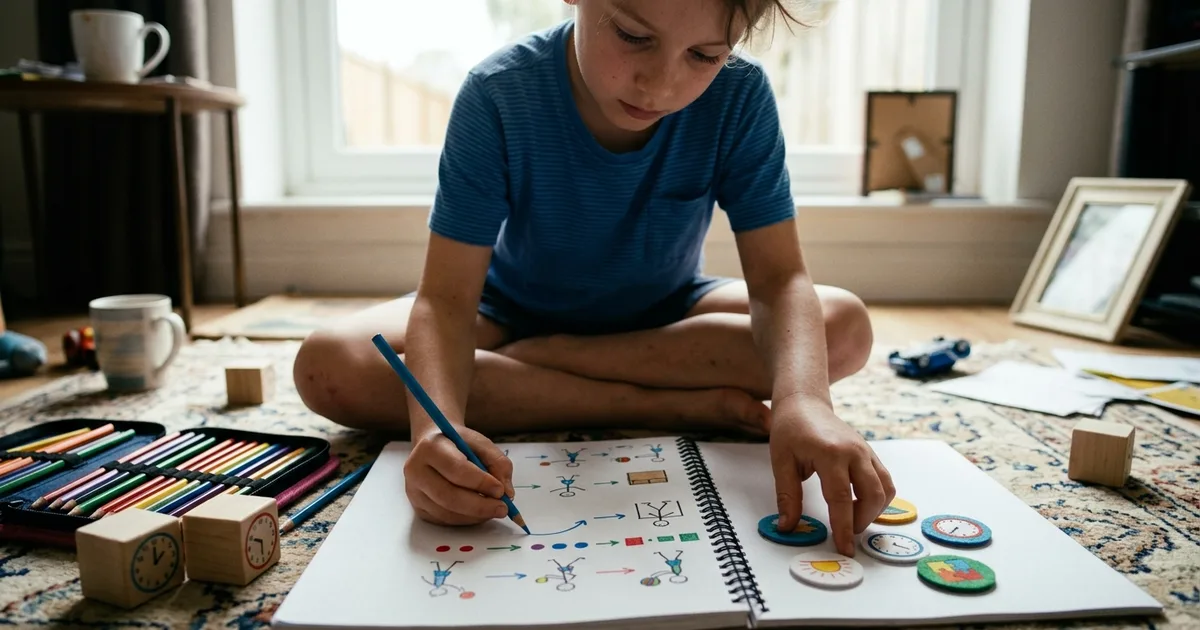
A timeline shows the contrast. Write “past,” “now,” and “future” across a page. Position “We visited our cousins,” “We are visiting our cousins,” and “We will visit our cousins” correctly. Discuss each change in the verb phrase.
When checking mixed tense exercises for kids, request a reason before giving the answer. “It happened yesterday, so I need the simple form for a completed action” demonstrates more understanding than a corrected verb.
Examples by Age and Experience
For school-age kids, keep comparisons oral and concrete. Show one picture of a daily routine and another of an action happening now. Ask, “She brushes her teeth every morning” or “She is brushing her teeth now?” The child can point, repeat, and act.
For school-age kids, use short sets covering two or three tenses. Children can complete sentences, sort time phrases, and change a sentence from present to past. Topics such as meals, pets, school, games, and family plans reduce reading demands.
For school-age kids, include connected texts. A short diary entry can move from a routine to yesterday’s events and tomorrow’s plans. Learners underline the verbs and explain each change. Across LearnLink lessons, our tutors can adjust the tense choices to the learner’s control.
How to Practise at Home
Use mixed tense exercises for kids in short, regular sessions. Start with two spoken examples, complete four written items, and finish with one sentence about the child’s day. Ten focused minutes can beat a long page completed by guessing.
Correct calmly and specifically. If the child says, “Yesterday I go swimming,” repeat the time clue and ask, “Is yesterday past, present, or future?” Supply the required verb form only if needed, then ask the child to repeat the complete sentence.
Practice 1: Choose the Correct Form
Complete each sentence: 1. My brother usually ___ (walk) to school. 2. Look! The dog ___ (run). 3. We ___ (watch) a film yesterday. 4. I think it ___ (rain) tomorrow. 5. They ___ already ___ (finish) lunch. 6. We ___ (visit) our grandparents this weekend; the trip is planned.
Answers: 1. walks; 2. is running; 3. watched; 4. will rain; 5. have already finished; 6. are going to visit.
Practical Activities with a Clear Purpose
Make a three-column chart labelled “Usually,” “Yesterday,” and “Tomorrow.” Choose a verb such as play, cook, or travel, then write a sentence for each column. The event stays similar while its time and verb form change.
Play tense detective with a family photo, drawing, or familiar room. One person gives a sentence in the wrong tense: “The child is opening a gift last Saturday.” The learner identifies the clue, repairs the verb, and says, “The child opened a gift last Saturday.” Correction becomes a reasoning task.
Practice 2: Change the Time
Rewrite “We make pizza on Fridays” for these times: 1. right now; 2. last Friday; 3. next Friday, with a firm plan. Then explain each change.
Answers: 1. We are making pizza right now. 2. We made pizza last Friday. 3. We are going to make pizza next Friday.
Common Mistakes and Useful Responses
Some children select a tense from one clue without reading the sentence. Cover the choices and ask them to describe the time first. Mixed tense exercises for kids should test meaning and verb-form recognition.
Missing helping verbs cause errors such as “She playing” or “They finished already?” Build the entire verb phrase with movable cards or written chunks: “she + is + playing” and “have + they + finished.” The grammar words become visible.
Irregular verb forms for earlier events require recall because children cannot build them with -ed. Group pairs such as go–went, make–made, see–saw, and take–took. Revisit them in new sentences instead of correcting a long list.
- Try three mixed-tense sentences with children aged seven to nine after dinner.
- Use one familiar picture book to identify earlier-time, present, and future verbs.
- Practice Mixed tense exercises for kids in five-minute sessions twice daily.
- Ask your child to correct two tense mistakes aloud, then explain each choice.
- Praise one accurate response before gently modeling the correct form for errors.
For the rule wording, Wikipedia — English Grammar is a useful reference while the practice examples here stay adapted for children.
Frequently Asked Questions
Which Tenses Should a Child Learn First?
Begin with the present simple for routines and the present continuous for actions happening now. Daily life and movement demonstrate both meanings. Add the past simple for finished events, then a future form for plans. Older learners can compare will, going to, and the present perfect after understanding each form’s purpose.
Can a 5-year-old Do Mixed-tense Practice?
Yes, but practice should be oral, visual, and limited to two choices. A 5-year-old might compare “I jump every day” with “I am jumping now” while performing the action. Written rules and long worksheets are unnecessary. The aim is to express the difference between a routine and an action in progress.
How Often Should We Practise at Home?
Two or three short weekly sessions provide repetition without making grammar a long test. Use several sentences and revisit difficult forms later. Stop while the child can explain each choice calmly. If attention fades and errors rise, save the remaining items for another day.
Do Worksheets Help Children Understand Tenses?
Worksheets help after a child understands time contrasts through speech and examples. Choose mixed tense exercises for kids that require meaningful decisions, not pages of identical verb endings. Ask the child to mark the time clue and explain one or two answers aloud. The explanation shows whether the learner understands or follows a visual pattern.
Does Speaking Several Languages Make Tense Learning Harder?
Not necessarily. A multilingual child may notice grammar patterns and time meanings across languages, though their forms may differ from English. Compare how each language expresses a routine or completed event, then return to a complete English example. Avoid using direct translation as a rule because languages organise time differently.
Start your child's English journey today — book a trial lesson with LearnLink.
Stay updated on our latest tips and resources by following us on Instagram LearnLink.