English Pharmacy Vocabulary for Kids
English Pharmacy Vocabulary and Activities for Kids teaches words, phrases, and role-play for pharmacy conversations. Children learn item names, describe symptoms, and ask an adult for help. Younger learners need pictures and short phrases; older children can manage full dialogues and regional differences. The goal is language practice, not medical advice. Children must never choose, handle, or take medicine without guidance from a parent, caregiver, pharmacist, or qualified health professional.
Words to Use at a Pharmacy
Start with words your child can see or act out safely. Teach the place and person before adding products, symptoms, and phrases. Say each word naturally instead of spelling every item.
Review English Pharmacy Vocabulary and Activities for Kids by category: people, products, symptoms, and actions. Categories connect each word with its purpose and prevent context-free memorisation.
Putting the Words into Context
Build short exchanges before a full role-play. A younger child might say, “I have a sore throat,” and hear, “Let us ask a pharmacy professional.” Practise “Where does it hurt?” with “My head hurts” or “My finger hurts.”
Add polite questions: “Could you help us, please?”, “Where are the bandages?”, and “Is this cream for the skin?” Older learners can check meaning: “Do you mean a tablet or a capsule?” and “Should we speak to a doctor?” A qualified adult must make real health decisions.
When practising English Pharmacy Vocabulary and Activities for Kids, vary the speaker and purpose. Your child can play the customer, pharmacist, parent, or family interpreter. A multilingual child may explain the scene in another language before rebuilding the exchange in English, using existing knowledge as a bridge.
Activities for Different Ages
School-age kids: Use drawings of a pharmacy, pharmacy worker, thermometer, bandage, cream, and medicine bottle. Say a word and ask your child to point to its picture. Next, show two pictures and give a clue: “You use this to check temperature.” Keep each round under five minutes and repeat the words across several days.
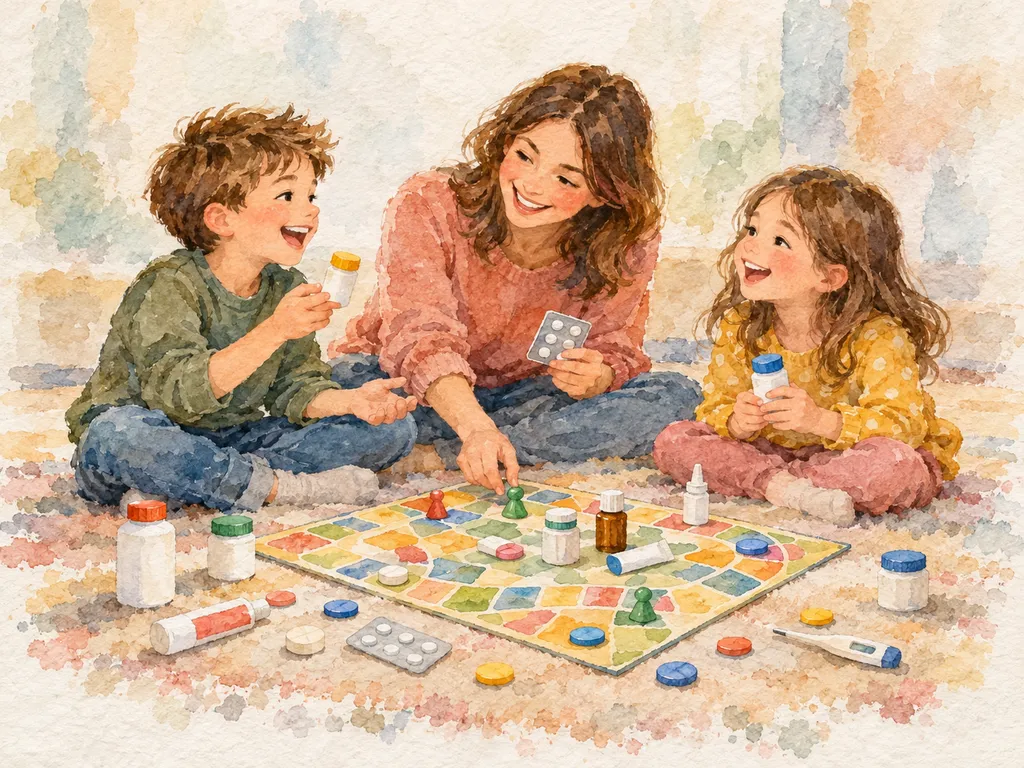
School-age kids: Create a pretend pharmacy with paper cards and toy props that cannot be mistaken for medicine. Give a task such as “Ask for a bandage” or “Tell the staff member you have a cough.” Swap roles after each exchange. Add one phrase when the earlier pattern feels easy.
School-age kids: Practise fuller situations. Learners can explain symptoms, ask about an unfamiliar word, or compare regional terms. They can write a six-line dialogue and perform it twice: slowly for accuracy, then at a natural pace. The goal is accurate communication, not dramatic acting.
Simple Ways to Practise at Home
Practise English Pharmacy Vocabulary and Activities for Kids for ten minutes instead of holding one long session. Try picture matching on Monday, listening on Wednesday, and role-play on Saturday. Repetition matters more than covering every word at once. Ask your child to recall each word before revealing the answer.
Try a category race. Say “person,” “symptom,” “product,” or “phrase,” then request one matching example. Older children can give a sentence or explain their choice. Correct the key error, model the natural version, and invite another attempt.
Try a Pharmacy Role-play
Give this prompt: “You are at a pharmacy with an adult because you have a sore throat. Greet the person behind the counter, explain the problem, ask one polite question, and thank them.” Change one detail, such as the symptom or required item. Use paper pictures and keep real medicines outside the activity.
Common Vocabulary Mistakes
Pharmacy terms may look similar while serving different roles. Correct each mistake with a full sentence instead of a grammar lecture. The comparison offers reusable models.
Regional terms require care. Pharmacy is widely understood. British English often uses chemist or chemist’s; North American English uses drugstore, sometimes for a broader shop. A small sticky dressing may be an adhesive bandage or a plaster. Teach one preferred term, then introduce alternatives for recognition.
- Practice five pharmacy words with children aged six to nine using picture cards.
- Use a children’s storybook to correct medicine, tablet, and pharmacist pronunciation.
- Try role-playing customer and chemist for ten minutes, correcting one mistake gently.
- Review English Pharmacy Vocabulary and Activities for Kids with a three-question quiz.
- Repeat difficult words twice, then use each correctly in one complete sentence.
When a word has several meanings or pronunciations, Cambridge Dictionary is a useful check before turning it into child-friendly examples.
Frequently Asked Questions
Which Pharmacy Words Should a Young Child Learn First?
Begin with pharmacy, pharmacy worker, medicine, bandage, thermometer, cough, sore throat, and headache. Add “I have…,” “My … hurts,” and “Could you help us, please?” Split the English Pharmacy Vocabulary and Activities for Kids in this guide across several short sessions. Children need not learn every term at once.
Should Children Practise with Real Medicine Packages?
No. Use drawings, printed cards, or unmistakably pretend props. Adults should store real tablets, bottles, inhalers, creams, and packages safely outside the game. Even an empty package may cause confusion later. Teach language and safe help-seeking: tell an adult, describe the problem, and follow a qualified health professional’s guidance.
Should My Child Learn British or American Pharmacy Terms?
Teach the variety your child encounters most, then introduce alternatives. Teach pharmacy first, followed by chemist’s and drugstore. Pair adhesive bandage with plaster. Recognition matters more than enforcing one form everywhere. Accept correct regional terms and model alternatives when needed.
How Can I Tell Whether My Child Remembers the Vocabulary?
Check comprehension, recall, and use. Say a word and request the matching picture. Show the picture and ask for the word. Finally, give a situation: “You have a small cut. What might you ask an adult for?” A fresh sentence demonstrates stronger knowledge than a memorised list.
A short one-to-one lesson can show what level and pace fit your child — book a trial English lesson.
Stay updated on our latest tips and resources by following us on Instagram LearnLink.