A Story About Wild Animals in English for Kids
A ten-minute lesson can teach six to eight wild-animal words: show a picture, model an action, and invite a sentence. This wild animals story in english for kids helps children name species, describe habitats and actions, and retell events. Begin with familiar animals. Let your child point or move before speaking; first-time online learners and multilingual children may understand more than they can say. Use the lesson across a week or choose one part daily.
📥 A Story About Wild Animals in English for Kids
Read, understand, and retell a short animal adventure.
Leave your email — we'll send the PDF to your inbox.No spam — the PDF plus one short reminder. Unsubscribe anytime.
Core Wild-Animal Words and Phrases
Teach each animal with a place and action. Connected facts are easier to use than labels: “A zebra lives in grasslands. It runs.” Your child can point, copy the movement, then repeat the sentence.
Once nouns feel secure, add descriptions: big, small, fast, slow, strong, furry, scaly, and striped. Body words include tail, wings, claws, horns, fur, feathers, and trunk. Young children may learn rhino before rhinoceros.
Practise four frames: “I can see a lion,” “The lion is resting,” “It lives in the savanna,” and “It can roar.” Use the wild animals story in english for kids to change one frame element instead of memorising every word.
Useful Sentence Patterns and Questions
Move from naming to describing step by step. Start with “It is a zebra,” then add facts: “It has stripes. It can run. It lives in grasslands. It eats plants.” Reusable patterns let your child focus on each new word.
Model paired questions and answers: “What is it?” “Where does it live?” “What does it eat?” and “Can it swim?” A seven-year-old might answer, “A seal can swim, but it cannot fly.” Older learners can compare: “A bear is bigger than a fox,” or give reasons with because, but, and while.
Use singular forms for one animal and plurals for a species: “An elephant has a trunk,” but “Elephants have trunks.” Show irregular forms: one wolf, two wolves; one mouse, two mice; one deer, two deer. The wild animals story in english for kids places these forms in context, linking grammar to meaning.
Read About Animals in Context
Read the wild animals story in english for kids aloud without stopping. Ask your child to identify animal names and point to matching pictures. On the second reading, pause before actions such as reaches, swings, or waddles. The child can supply the word, move, or make an animal sound.
Across the Wild World
At bedtime, a child opens an animal atlas. The first page shows a warm savanna at sunrise. A giraffe reaches for green leaves. Zebras graze while an elephant drinks at a water hole. Under a tree, a lion rests and watches.
The next page shows a green rainforest. A monkey swings above the path, and a parrot flies between the trees. Near the river, a crocodile waits. Farther into the forest, a tiger walks through shadows.
A strong wind turns the page. The child sees a cold, rocky coast. Penguins waddle towards the water and dive beneath the waves. An eagle soars overhead. The atlas closes. The quiet room holds memories of each roar, splash, call, and wing beat.
Ask text-based questions: “Where does the crocodile wait?” “What does the giraffe eat?” and “Which animals are near water?” Then ask, “Which page would you visit?” Accept “The rainforest” from a beginner, then expand it together: “I would visit the rainforest because I like monkeys.”
Build Understanding Before Retelling
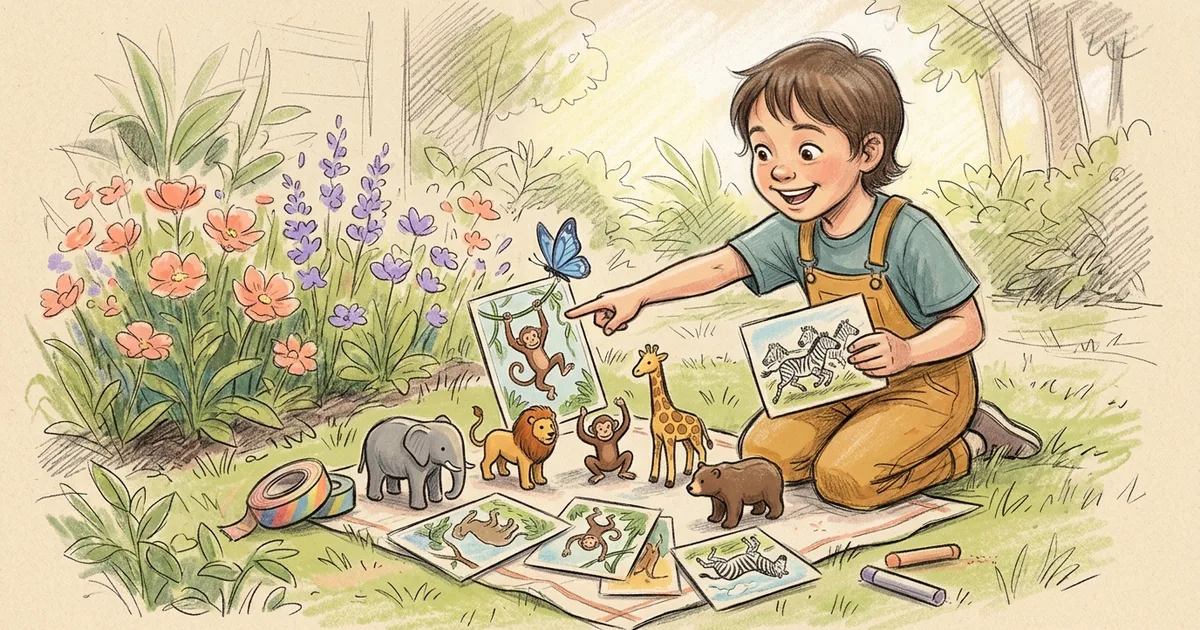
Start with meaning, not polished speech. Put three to six animal pictures on a table. Say, “It swings,” “It has stripes,” or “It lives near a river.” Your child selects the animal. Pre-readers can show understanding through pointing, movement, and sound before forming a complete English sentence.
Arrange pictures in story order: savanna, rainforest, and cold coast. Younger children can give one sentence per scene. Older learners can use first, next, after that, and finally. They can describe animal pictures in English with details that preserve the events.
Retell Three Scenes
Show one picture per habitat. Ask who is there, what the animal does, and where it lives. A beginner may say, “Monkey. It climbs.” Model: “A monkey climbs in the rainforest.” An older learner can connect the three scenes in a short retelling.
A brief home-language explanation can define habitat, grassland, or a story event. Then return to English. When rereading the wild animals story in english for kids, remove prompts gradually: the model sentence, action clue, then picture order.
Age-Appropriate Practice in Short Sessions
One animal picture supports several levels. Change the task, not the word set. Siblings can work together while producing language suited to their ages and English levels.
A multilingual child may know animal facts but need help forming an English sentence. Model one answer, ask the child to change one part, then remove the model. In online lessons, our tutors use pictures, questions, and prompts to keep language accessible while challenging the learner to think.
Make a Five-Line Animal Story
Choose one animal and complete these prompts: “I can see a…,” “It lives in…,” “It can…,” “One day, it finds…,” and “In the end….” Say the story, write it, or take turns adding lines.
For a ten-minute session, spend two minutes recalling names, three minutes reading the wild animals story in english for kids, three minutes retelling one scene, and two minutes creating a sentence. Repeat later that week with another animal. Short, focused practice beats continuing after attention fades.
Gently Correct Errors in Meaning and Grammar
Do not treat wild as a synonym for dangerous. A squirrel is wild; a pet dog is not. A wild species remains wild in a zoo. Avoid placing every animal in “the jungle”: lions live in grasslands, polar bears in the Arctic, and penguins mainly in the Southern Hemisphere.
Model articles within phrases: “a tiger,” “an elephant,” and “an eagle.” Check subject–verb agreement: “The lion runs,” but “The lions run.” After can, use the base verb: “A penguin can swim,” not “A penguin can swims.” Change “The tiger is live in the forest” to “The tiger lives in the forest.”
Correct one repeated pattern at a time. If your child says, “Elephant have trunk,” respond, “Yes, an elephant has a trunk,” then continue. This calm recast preserves meaning without turning the story into a test. For unfamiliar stress or pronunciation, check spoken examples in the Cambridge Dictionary before modelling the word.
- Read one wild animals story in English for kids aged five to seven.
- Repeat your child’s sentence correctly once, without asking them to imitate you.
- Praise the idea first, then model one accurate animal word or tense.
- Ask two simple questions about character, action, and setting after reading.
- Use toy animals to reenact three sentences, correcting meaning through playful choices.
Frequently Asked Questions
How Many Wild-animal Words Should a Child Learn at Once?
Begin with six to eight words for children aged five to nine. Add two or three after your child recognises the first group unaided and uses some words in short phrases. Older learners may handle a larger set, but recall matters more than length. Review familiar animals while adding actions, features, or habitats.
Can a Young Child Learn the Story Without Reading?
Yes. Read aloud while your child follows pictures, points, copies movements, or joins repeated lines. A word or animal sound can show understanding before independent reading. Expand responses without demanding repetition: if your child says “tiger,” answer, “Yes, the tiger walks through the forest.”
What If My Child Knows the Animal Names in Other Languages?
Use prior knowledge as a bridge. Let your child name the animal in another language, then connect the English word to its picture, action, and habitat. A multilingual learner might know three words for wolf yet need support with “It has grey fur.” The goal is a direct route from idea to English sentence.
How Often Should We Repeat the Animal Story?
Use the wild animals story in english for kids two or three times during one week, changing the purpose. Listen for names first, act out verbs next, then retell a scene. Once the language feels familiar, add an animal, question, or ending. Each reading should give the child a fresh job.
- Start with six to eight animals and pair each word with one habitat and action.
- Practice the sentence frames aloud before asking for a full retelling.
- Read the story again, remove one prompt, and let your child rebuild the scene independently.
If your child needs steady speaking practice, start small — choose a trial lesson.
Stay updated on our latest tips and resources by following us on Instagram LearnLink.