To use adverbs of frequency like always, sometimes, and never, place them before the main verb in a sentence, or after the 'be' verb. These words tell us how often something happens, making your sentences more descriptive and clear. For young learners, understanding these adverbs is key to expressing routines and habits effectively.
📥 Get the free printable PDF
Enter your email and we'll send the PDF to your inbox.No spam — one email with your PDF. Unsubscribe anytime.
What Are Adverbs of Frequency and Why Do They Matter?
Adverbs of frequency are special words that tell us how often an action happens. They answer the question "How often?" Knowing these words helps children talk about their daily routines and habits. Imagine telling someone you always brush your teeth or you sometimes eat ice cream. These words add important details to your sentences.
For children, introduce 'always' and 'never' with simple, clear actions. For example, "You always sleep at night." or "You never fly like a bird." Use hand gestures and visuals. Children can start using 'sometimes' and learn its placement. They can describe their week, saying, "I always go to school," and "I sometimes play video games." For school-age kids, focus on consistent placement and using a wider range of adverbs in more complex sentences. This helps them develop common English phrases and expressions.
A simple teaching scale helps children see the meaning, not just memorize words. For preschool kids, draw five boxes for a school week and color every box for always, three boxes for often, one or two for sometimes, and no boxes for never. Then ask children to place picture cards, such as brush teeth, read, swim, or eat pizza, under the word that matches their real routine.
When teaching how to use adverbs of frequency for kids, watch for one common mistake: putting the adverb at the end of every sentence. Children may say, "I eat breakfast always." Model the usual pattern with action verbs: "I always eat breakfast." With be, show the different pattern: "I am usually tired after soccer."
Core Explanation: The Rules for Always, Sometimes, Never
Adverbs of frequency show how often something takes place. Their position in a sentence is important. Generally, these adverbs come before the main verb, but after the 'to be' verb (am, is, are). This simple rule applies to most sentences your child will create.
Let’s look at the main adverbs: always (100% of the time), usually/often (most of the time), sometimes (50% of the time), hardly ever/rarely (almost never), and never (0% of the time). Mastering these helps children describe their world accurately. They are essential for forming sentences in the present simple tense, which describes routines, as detailed in our guide on teaching present simple.
A helpful teaching shortcut for elementary kids is the “verb sandwich” rule: put always, usually, often, sometimes, rarely, or never right before the action verb. Children can touch each word as they say, “I always brush my teeth,” then swap the adverb to change the meaning. Use five frequency cards labeled 100%, 75%, 50%, 10%, and 0% so the idea feels visual, not abstract.
The most common mistake is placing the adverb after the verb: “She eats always breakfast.” Correct it gently by asking, “What is the action?” Once the child finds eats, move always in front: “She always eats breakfast.” With am, is, and are, teach the opposite pattern: “He is never late,” not “He never is late.”
Common Mistakes When Using Adverbs of Frequency

Children often make mistakes with the placement of adverbs of frequency. They might put them at the end of a sentence or between the verb and its object. Correcting these errors early helps build strong grammatical foundations. Here are some common examples:
🔤 Task: Choose the correct adverb of frequency (always, sometimes, never) to complete each sentence.
1. Birds ______ fly. (100% of the time)
2. I ______ eat pizza for breakfast. (0% of the time)
3. It ______ rains in the desert. (almost never)
4. My friend ______ plays chess with me. (about 50% of the time)
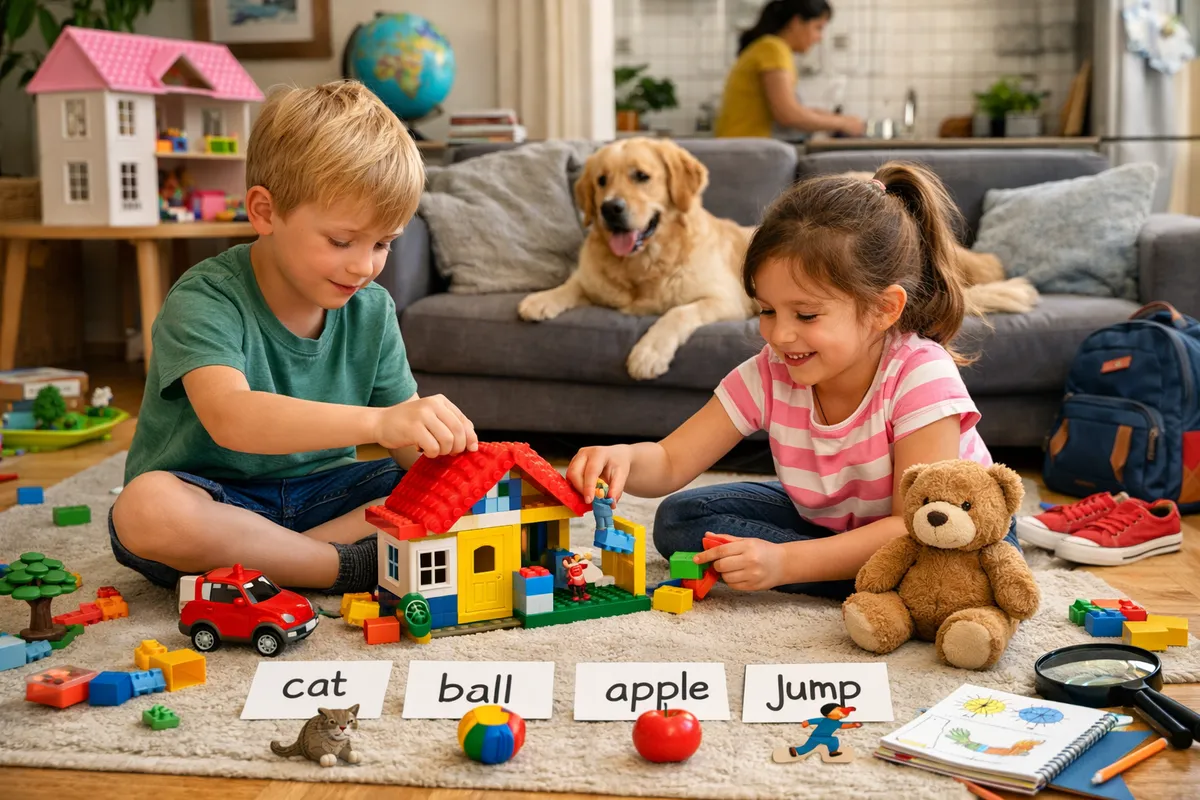
🔤 Task: Look at the image above. Write 2–3 sentences describing the children's activities using adverbs of frequency.
1. Describe what one child does often.
2. Describe what the other child does sometimes.
3. Combine their actions into one longer sentence, if possible.
🔤 Task: Create your own sentences about your daily routine or hobbies using adverbs of frequency (always, sometimes, never, usually, often).
1. Write one sentence about something you always do.
2. Write one sentence about something you sometimes do.
3. Write one sentence about something you never do.
4. Now, write a longer sentence combining two actions with different adverbs of frequency, for example: "I always read books, but I sometimes play video games."
Step-by-Step Learning Progression
Learning adverbs of frequency works best through a structured approach, allowing children to build confidence gradually.
1. Input (school-age kids, 7–10, 11–15): Begin by exposing children to adverbs of frequency in stories, songs, and daily conversations. For younger kids, point out actions: "You always smile." For older kids, read texts that naturally feature these adverbs. Use flashcards with visual representations of frequency.
2. Controlled Practice (school-age kids, 11–15): This stage involves guided activities. Children choose the correct adverb from a list or fill in blanks in simple sentences. Example: "My mom ______ drinks coffee in the morning (always/never)." This reinforces correct placement. For younger learners, this might be matching words to actions.
3. Semi-Controlled Practice (school-age kids, 11–15): Here, children use the adverbs in response to prompts or images. They have more freedom but still receive some guidance. For example, describing pictures of daily activities using 'always' or 'sometimes'. This helps them integrate the grammar point into meaningful contexts.
4. Free Production (school-age kids): Learners create their own sentences or short paragraphs about their lives, routines, or imaginative stories. They can talk about what they 'always' do on weekends or what they 'never' do at school. This allows for creative expression and true application of the grammar rule.
5. Feedback (All Ages): Provide constructive feedback at every stage. For young children, gently correct by rephrasing correctly. For older children, explain why a certain placement is wrong and offer alternatives. Focus on accuracy before fluency, encouraging them to try again without fear of mistakes. Positive reinforcement is key.
Conclusion
Adverbs of frequency are powerful tools for kids to describe how often things happen. By understanding where to place words like 'always,' 'sometimes,' and 'never,' young learners can express their routines and habits with greater clarity and confidence. Starting with simple examples and moving through structured practice helps solidify this important grammar concept. Remember that consistent, gentle practice is the best way to master these adverbs.
Stay updated on our latest tips and resources by following us on Instagram LearnLink.
For the rule wording, Wikipedia — English Grammar is a useful reference while the practice examples here stay adapted for children.
Want to see how these ideas work in a real lesson — try a free LearnLink lesson.
Stay updated on our latest tips and resources by following us on Instagram LearnLink.