Basic English Conversations with Children
Basic English conversations with children are short, repeatable exchanges about objects, actions, wants, and memories. Ask one question, wait, then build on the child’s words. A younger learner may name a toy or choose a snack. An older child can explain choices, compare ideas, or recount an event. Start with familiar language, model a reply, and add one challenge.
📥 Everyday English Conversation Practice
Build natural family conversations with useful questions, replies, and follow-ups
Leave your email — we'll send the PDF to your inbox.No spam — the PDF plus one short reminder. Unsubscribe anytime.
What Families Need to Know
Successful basic English conversations with children need regular practice. Try three minutes at breakfast instead of a forced weekly half-hour. Practise while dressing, preparing food, walking, drawing, or planning the weekend.
Conversation is a two-way skill. A child must understand the question, find words, reply, and follow what comes next. Accept short answers, then extend them. If the child says, “Blue,” answer, “Yes, you chose the blue cup.”
Multilingual children can use other languages to understand ideas before expressing them in English. Keep the English model direct without turning family talk into a test.
How to Build a Useful Conversation
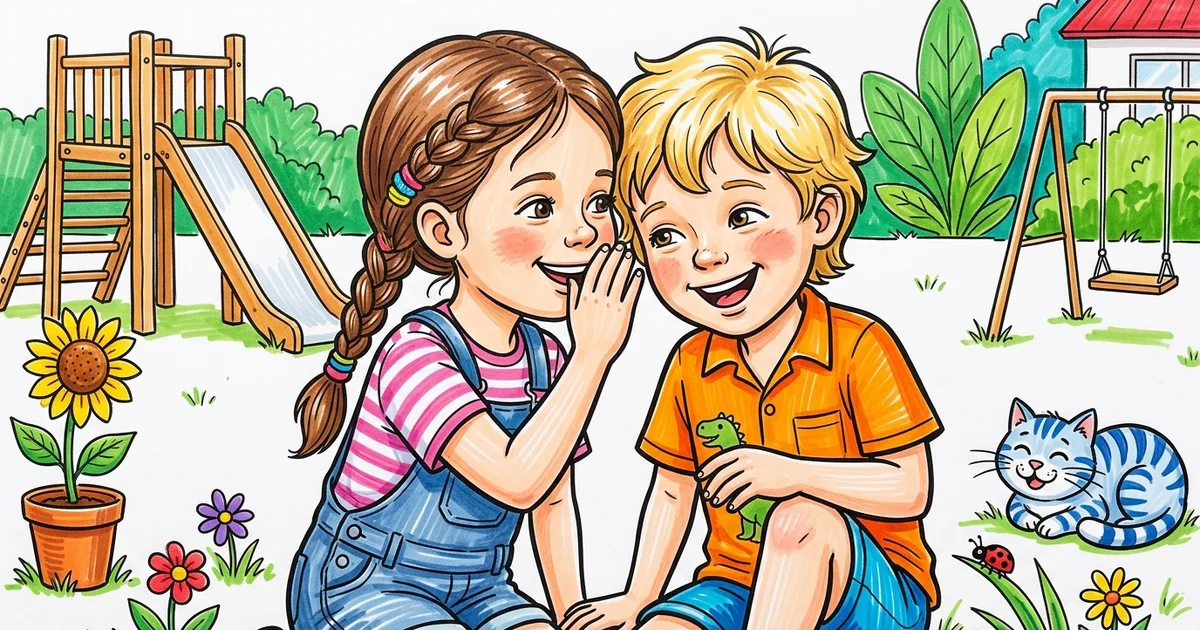
Use four steps: notice, ask, support, and extend. Notice something real: “Your bag is heavy.” Ask: “What is inside?” If needed, offer choices: “Books or toys?” Then extend the reply: “Three books? Which one do you need today?”
Match questions to the child’s skill. Yes-or-no questions reduce pressure, choice questions supply words, and open questions invite longer speech. Moving through these stages keeps basic English conversations with children manageable without sounding like drills.
Conversation Patterns for Daily Routines
Use patterns in daily situations. At breakfast, try: “What would you like?” “I’d like toast, please.” “What would you like on it?” At the door, use: “Are you ready?” “Almost.” “What do you still need?” These sequences connect questions and answers.
For basic English conversations with children, repeat the structure but change one detail. Ask, “Where is your hat?” one day and “Where is your notebook?” the next. The familiar frame supports a new noun. Other frames include “Can you help me with…?”, “What do we need for…?”, and “Tell me one thing about…”
Across LearnLink lessons, our tutors can model turn-taking in one-to-one exchanges. At home, families can reinforce the pattern through ordinary routines without copying a full lesson. Distinct roles keep conversation natural.
Examples for Different Ages
School-age kids:
Adult: “What is this?”
Child: “A train.”
Adult: “What colour is the train?”
Child: “Red.”
Adult: “Yes, it is a red train. Is it fast or slow?”
Use objects, gestures, pictures, and two-part choices. A reply of one to four words is a sound starting point.
School-age kids:
Adult: “What did you make?”
Child: “I made a paper boat.”
Adult: “How did you make it?”
Child: “I folded the paper.”
Adult: “What will you do with it?”
Children in this range can link actions in order. Words such as first, then, and after that support a fuller account.
School-age kids:
Adult: “Would you study alone or with a friend?”
Child: “With a friend because we can help each other.”
Adult: “When might studying alone work?”
Basic English conversations with children and teens should respect growing independence. Ask for reasons, comparisons, plans, and opinions instead of testing known facts.
Practical Activities That Encourage Real Conversation
Try a mystery-object game. Put a familiar item in a bag and let the child ask: “Is it soft?”, “Can we eat it?”, or “Do we use it at school?” Give younger learners question frames. Older children can describe the object while the family guesses.
Use pictures as prompts. Ask what each person is doing, what may happen next, or what the child would change. In the evening, discuss one success, one challenge, and one plan for tomorrow.
Practice 1: Complete the Reply
Fill each gap with your own idea.
1. “What would you like to drink?” “I’d like _____, please.”
2. “What are you doing?” “I’m _____.”
3. “What did you enjoy today?” “I enjoyed _____.”
4. “What will you do tomorrow?” “I’ll _____.”
Ask one follow-up question after each answer.
Practice 2: Grow the Answer
Add one detail to each short reply.
“It is a dog.” → “It is a small brown dog.”
“I played.” → “I played cards with my sister.”
“I like it.” → “I like it because it is funny.”
Now expand: “I’m hungry,” “School was fun,” and “I want that one.”
How to Respond to Silence and Mistakes
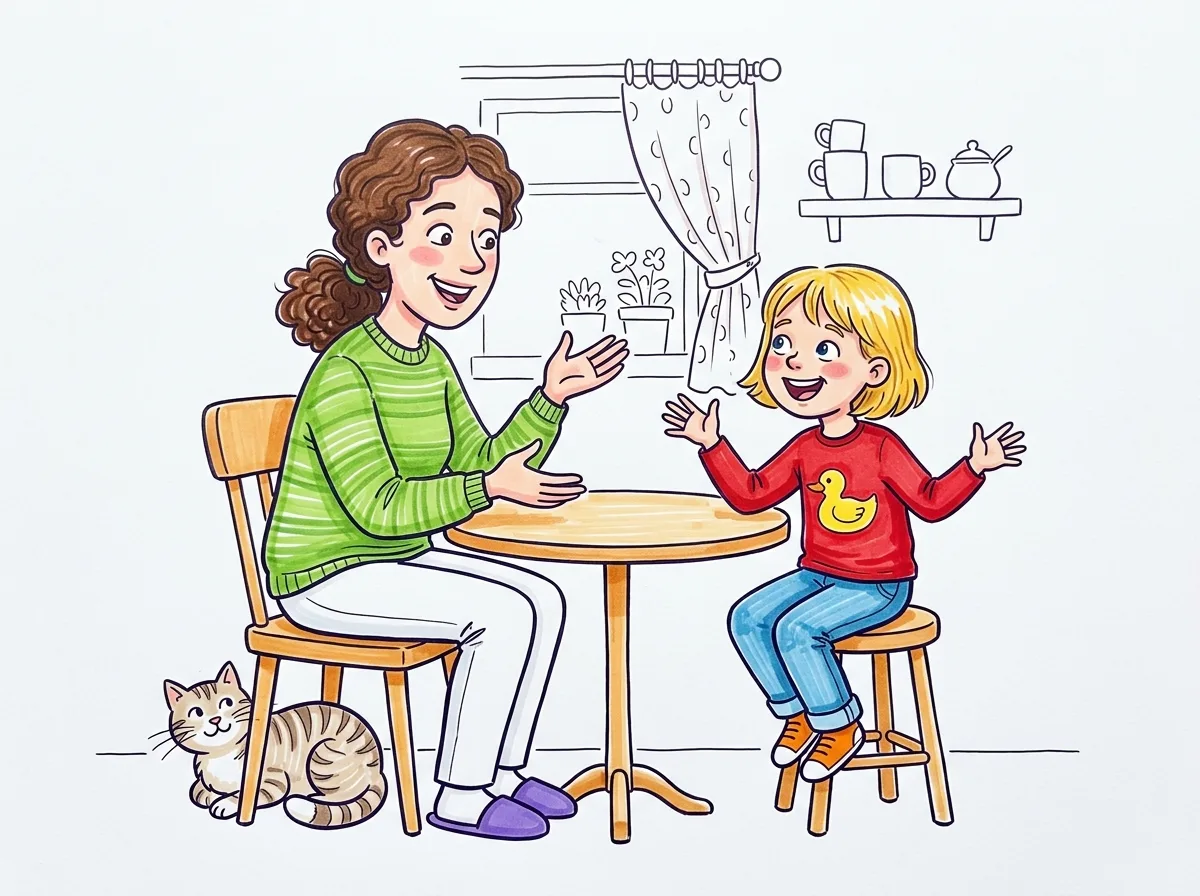
Silence may mean the child is forming an answer. Pause, stay calm, and avoid asking three questions at once. If no answer comes, narrow the task: change “What do you want to do?” to “Do you want to draw or play outside?” Gestures or visible objects can show the meaning.
Model the natural form in your reply. If the child says, “He go to school,” respond, “Yes, he goes to school by bus.” The child hears the correct pattern without losing the conversation. Request repetition when an error blocks meaning or you are practising that sentence.
Do not correct every accent feature or missing article. Choose one point and continue talking. The purpose of basic English conversations with children is communication supported by stronger language over time, not error-free speech in every turn.
- Wait five seconds after asking six-year-olds a simple question before prompting.
- Model one gentle correction, then invite your child to repeat without pressure.
- Use picture books to practice basic English conversations with children aged seven.
- Praise effort twice for every mistake you correct during a ten-minute practice.
- Offer two possible answers when silence lasts longer than eight seconds.
When a word has several meanings or pronunciations, Cambridge Dictionary is a useful check before turning it into child-friendly examples.
Frequently Asked Questions
How Long Should We Practise Each Day?
Begin with three to five minutes during an existing routine. Stop while the exchange remains manageable. A confident child may continue for ten or fifteen minutes; a new learner may prefer several brief conversations across the day. Regular contact matters more than a fixed duration.
Should We Correct Every Grammar Mistake?
No. Frequent interruption can shift attention from meaning to error avoidance. Repeat the child’s idea in a correct sentence and continue. Use direct correction for one current learning point, especially when the mistake changes meaning. Praise the message without calling every answer “perfect.”
What If My Child Answers in Another Language?
Show that you understood, then give a short English version. After an idea in Spanish, French, Hebrew, or another home language, answer, “Yes, you want the red one. Say: ‘I want the red one, please.’” Accept mixed-language replies while modelling the English phrase.
Which Subjects Work Best for Conversation Practice?
Choose subjects from the child’s life: food, clothes, pets, games, school events, family plans, stories, music, and nearby places. Visible objects and recent events provide concrete material. Basic English conversations with children become harder when abstract subjects exceed the child’s vocabulary.
What Should We Do If Our Own English Is Not Fluent?
Use short sentences you can say confidently. Prepare two or three question patterns and reuse them with new words. Trusted course audio can support pronunciation but cannot replace turn-taking. If you make a mistake, correct it calmly and continue; children learn that mistakes are part of learning.
- Start with one three-minute conversation during a familiar daily routine.
- Ask one clear question, wait, and offer two choices if the child needs support.
- Practice extending each reply with one detail, reason, or follow-up question.
Start your child's English journey today — book a trial lesson with LearnLink.
Stay updated on our latest tips and resources by following us on Instagram LearnLink.