Top 10 english books for kids
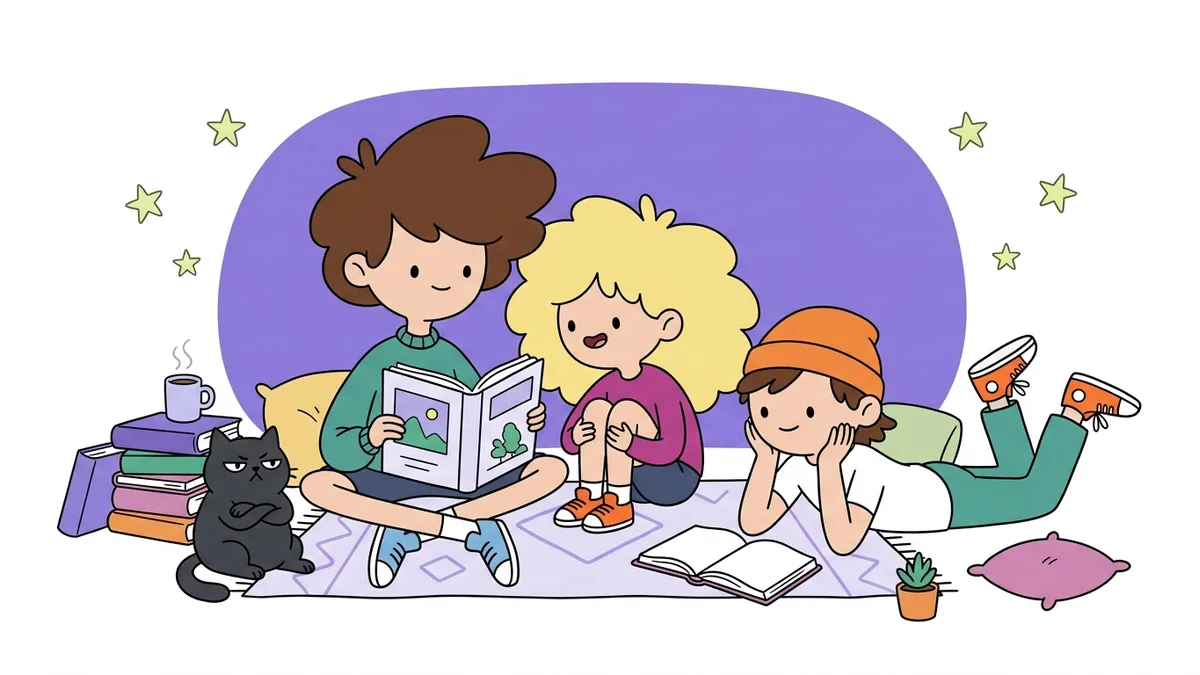
Storybooks improve your child's English pronunciation through natural exposure and repetition. Narrating high-quality children books english aloud provides a consistent model of correct sounds, rhythm, and intonation. This builds a strong auditory foundation, making it easier for children to replicate sounds when they speak. For young learners starting with English for toddlers, this immersion is a vital first step.
📥 Book Talk Phrase Cards for Kids
Useful English phrases to say before, during, and after reading a children’s book aloud.
Leave your email — we'll send the PDF to your inbox.No spam — the PDF plus one short reminder. Unsubscribe anytime.
Hearing the Rhythm and Melody of English
English pronunciation involves a distinct musicality called prosody, including sentence stress and timing. Reciting text aloud models where to place emphasis. In the phrase "The big red ball," stressing nouns and adjectives makes the meaning clear. Rhyming stories are excellent tools for teaching this rhythm. Predictable patterns in children books english help kids internalize the natural cadence required for strong English reading for kids.
Try "echo reading" with children aged 4 to 7. Speak a line with exaggerated intonation and have your child repeat it. This reinforces unstressed syllables that are often "reduced" in natural speech. Avoid focusing only on clear articulation of every letter, as this creates a robotic sound. Instead, highlight the contrast between long, stressed vowels and short, neutralized sounds like "the" or "to."
- Preschool kids: Use "clapping the beat" for sentences in books like Hop on Pop.
- Elementary kids: Practice character voices in The Bad Guys to hear emotional intonation.
- Ages 10-15: Read graphic novels like Amulet aloud to master conversational flow.
Mastering Individual Sounds (Phonemes)
Children's books expose learners to all 44 English phonemes in rich contexts. This exposure builds phonemic awareness—the ability to distinguish sounds like the short 'i' in 'ship' versus the long 'ee' in 'sheep.' Well-written children books english provide these contrasts naturally. This contextual learning is more effective than repetitive drills. Our English lessons for 5-year-old kids use stories to highlight these "minimal pairs" effectively.
From Single Words to Fluent Sentences
In real speech, words flow together through "connected speech" where sounds link or change. For example, "want to" often sounds like "wanna." Children books english with realistic dialogue model this flow perfectly. Hearing how words connect prepares your child for kids' English speaking practice. Engaging with stories bridges the gap between knowing vocabulary and using it fluently in conversation.
Use "3-step scaffolding" during your sessions. For ages 4–7, point to a noun, expand it into a phrase, then a full sentence. Don't correct every error immediately; instead, model the correct sound by repeating the sentence naturally. If a book says "an apple," emphasize the "n" sliding into the vowel. This helps kids internalize grammar and linking sounds without boring rote memorization. Pair this with basic English words review for younger age groups.
Read these phrases from popular children books english and practice sliding the words together:
- "An_elephant" (sounds like: a-nelephant)
- "Pick_it_up" (sounds like: pi-ki-tup)
- "Read_a_book" (sounds like: ree-da-book)
Task: Have your child find three phrases in their favorite book where a word ends in a consonant and the next starts with a vowel. Practice "sliding" them together.
British vs. American English: What Books Teach
Consistency is key when choosing between British or American English. Pick one accent and stick with it initially. Most children books english use standard forms of either accent, making core phonetic skills transferable. Supplementing with English podcasts for kids provides a steady accent model. The table below highlights common differences you might encounter in various titles.
Practical Tips for Using Books to Improve Pronunciation
To maximize benefits, go through the text slowly and enunciate complex words. Use character voices and sound effects to keep kids engaged. Incorporating fun games to learn English alongside your book time builds a positive association with the language. The goal with any children books english is pressure-free practice that feels like play rather than a school lesson. Structured interactive English lessons for kids can complement at-home reading sessions perfectly.
Practice with a Tongue Twister
This drill builds muscle memory for difficult sounds — perfect for 'sh' vs 's' contrasts. Start slow, then speed up.
🔤 sells seashells by the seashore."
Listen for the "sh" in "she" and "seashells" versus the "s" in "sells" and "seashore". Repeat five times with your child to improve clarity.
Summary and Next Steps
Follow these steps to improve your child's pronunciation using children books english:
- Narrate daily: Spend 10-15 minutes consistently exposing your child to spoken English.
- Use repetition: Choose rhyming books like Green Eggs and Ham and encourage your child to join in.
- Model linking: Show how words slide together in phrases like "put it on."
- Listen to natives: Use audiobooks to provide a consistent accent model.
- Play with sounds: Use tongue twisters to target difficult phonemes like 'th' or 'r'.
For reading and phonics support beyond the article examples, Scholastic Parents is a helpful independent resource for parents.
Frequently Asked Questions
Will My Non-native Accent Teach My Child Mistakes?
No. Your most valuable contribution is fostering a love for literature. Children are resilient learners. Supplement your sessions with audiobooks or videos featuring native speakers to provide diverse accent models while you focus on the bonding experience of storytime.
How Often Should We Use Children Books English for Practice?
Consistency beats duration. A short, 10-15 minute daily routine creates a habit without causing fatigue. Frequent, low-pressure exposure to English sounds and rhythms is the most effective way to build long-term speaking skills.
At What Age Can Children Focus on Specific English Sounds?
Phonemic awareness starts as early as age 3 or 4 through play. You can point out starting sounds of animals while looking at pictures. Structured practice for difficult sounds becomes more effective around age 6 or 7 as speech muscle control improves.
Why Parents Choose LearnLink
LearnLink supports 4,000+ families across 100+ countries. With 120+ specialized tutors, we help children master pronunciation through the very techniques discussed here. Our lessons turn children books english into interactive experiences that build real-world confidence.
Data current as of July 2026.
At LearnLink, our qualified tutors use engaging stories and games to build a strong pronunciation foundation for your child. Our 1-on-1 lessons are tailored to your child's pace, making learning to speak English clearly a fun and rewarding experience — book a trial lesson with LearnLink to see how we can help your child thrive.