Food Groups in English for Kids
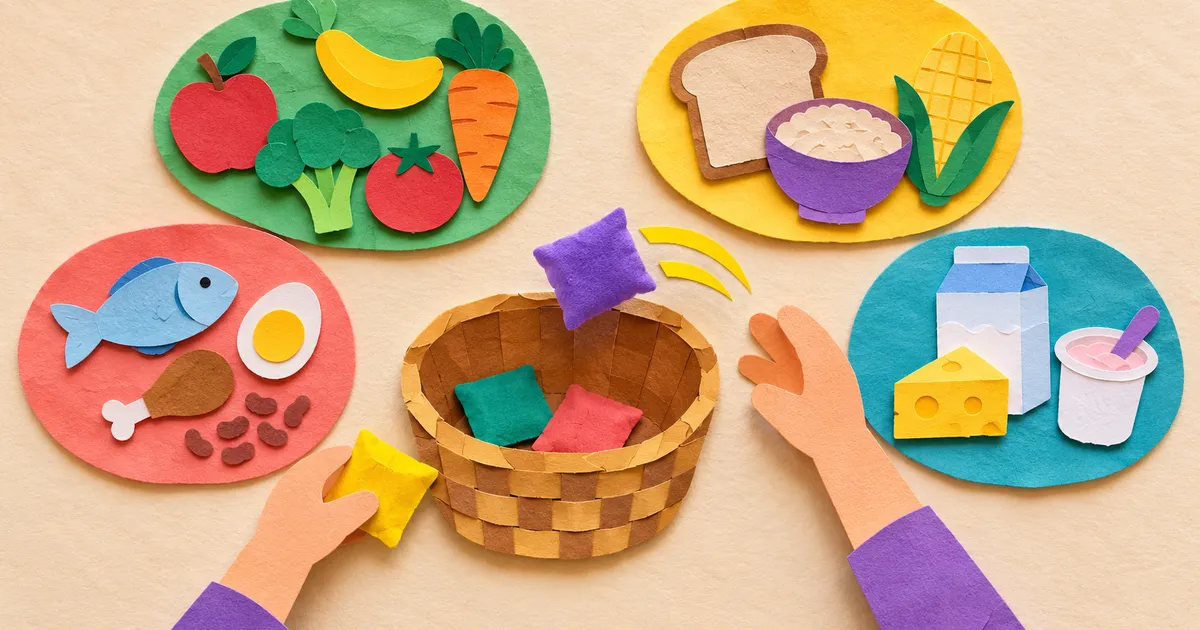
Six labels—fruit, vegetables, grains, protein foods, dairy and alternatives, and fats and oils—give children a framework for learning food groups in English for kids. Start with four familiar categories, then add the other two as vocabulary grows. Practise three sentence patterns: name a group, describe a meal, and state a preference. Food charts differ by country, but the language goal remains: recognise labels, name foods, and use both in phrases.
Build a Practical Food Vocabulary
When teaching food groups in English for kids, begin with foods the child knows. A mango, lentil dish, flatbread, or plate of noodles connects each English word to familiar food. Pictures can introduce foods rarely served at home.
Group names matter, but children need articles and quantity words. Teach “an apple” and “a carrot,” but “some bread” and “some milk.” Children can then request food and describe meals without treating every noun alike.
Explain mixed dishes directly. A sandwich, curry, soup, taco, or grain bowl may span multiple groups. Children need not force the whole dish into one box. Name its parts instead: “The soup has lentils, carrots, and oil.”
Put the Words into Useful Phrases
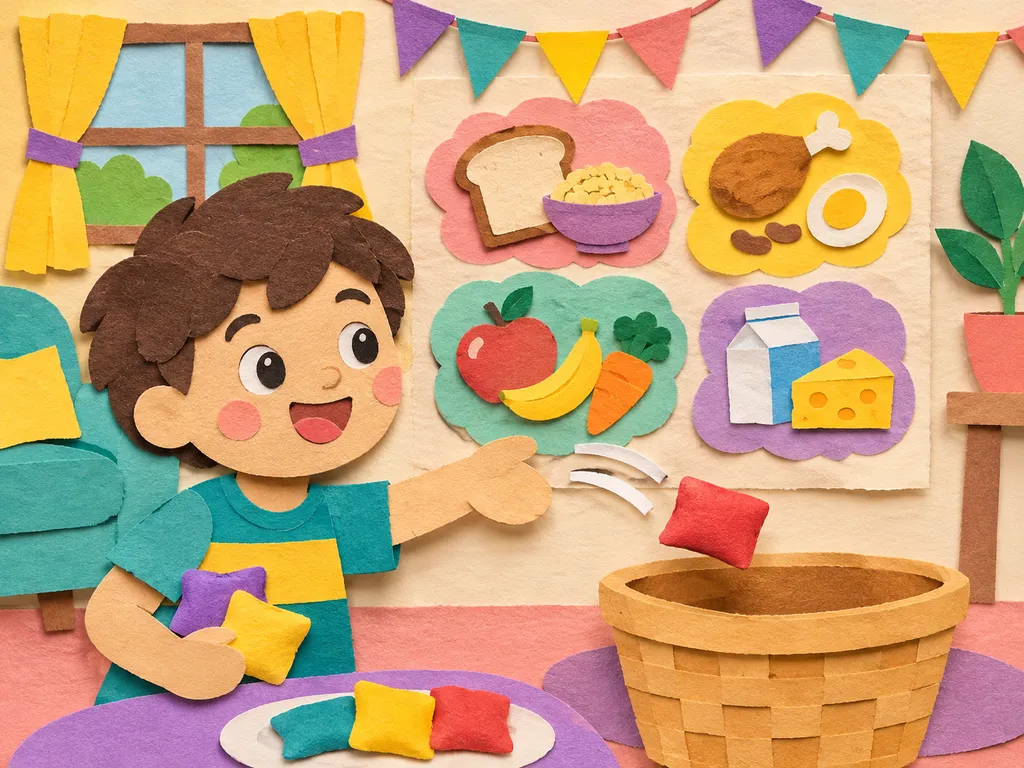
A word becomes easier to remember inside a short pattern. Practice with food groups in English for kids should progress from naming to describing and choosing. A child can say “banana,” then “a yellow banana,” and finally “I would like a banana.”
- It is a fruit.
- These are vegetables.
- Oats belong to the grains group.
- The salad has cucumber and pepper.
- I like beans, but I do not like peas.
- What food group does yogurt belong to?
Repeat each word across different tasks. “Milk” can appear in “some milk,” “a glass of milk,” “There is milk in the fridge,” and “Do we need milk?” Each sentence practises a distinct language skill.
Children can compare meals without calling them “good” or “bad.” Ask, “Which groups can you find?” or “What could we add?” A child might answer, “The meal has bread, fish, and vegetables,” combining categories with food nouns.
Choose Activities That Fit the Child’s Age
For food groups in English for kids, age shapes the task more than the vocabulary. Younger children need movement, objects, and short turns. Older learners can explain choices, read labels, and compare regional classifications.
School-age kids: sort toy foods or picture cards and say one word at a time. School-age kids: sort cards, name the group, and make a sentence such as “Carrots are vegetables.” Ages 10–12: plan a pretend meal and label its parts. School-age kids: compare two meal descriptions, explain mixed dishes, or discuss why national food charts use different terms.
Keep familiar family foods beside textbook examples. Ask for the English names of ingredients in couscous, dal, noodles, tortilla, stew, or another home dish. The activity stays culturally open and provides language for the next meal.
Turn Home Practice into a Short Routine
A short routine keeps food groups in English for kids active between lessons. Choose three breakfast or dinner foods. The child names each one, gives its group, and adds a detail: “The oats are warm,” “The apple is red,” or “The eggs are on the plate.”
A pretend shop develops speaking. Place six to ten food pictures on a table. One person asks, “Do you have any grapes?” or “Where are the protein foods?” The other answers and hands over the correct card. Change roles after a few turns.
Five-minute Meal Detective
Study one meal or food photo. Name three ingredients, assign each ingredient to a food group, and make one full sentence. For example: “This meal has rice, beans, and peppers. The grain is a starchy food, beans are protein foods, and peppers are vegetables.”
For reading, give the child a short shopping list and mark each group with a different symbol. For writing, create a three-line menu for breakfast, lunch, and dinner, then underline five food words and label their groups.
Correct Common Vocabulary Mistakes
Children may confuse a food with its group. “Apple” is a food; “fruit” is the category. Model the distinction: “An apple is a fruit. A carrot is a vegetable. Lentils are protein foods.” Repetition teaches the relationship without a long grammar lesson.
Countable and uncountable nouns create another hurdle. We say “an egg” and “two carrots,” but usually “some rice,” “some cheese,” and “some bread.” If a child says “a rice,” model the corrected phrase naturally: “Yes, some rice. We have rice here.”
Pronunciation can hide known vocabulary. Contrast “fruit” with “food,” and practise final sounds in “grapes,” “beans,” and “oats.” Correct one feature at a time. During LearnLink lessons, experienced tutors keep the task moving while offering a brief model for repetition.
- Choose five food pictures and ask your child to name each group.
- Sort ten food words into the groups already introduced in the article.
- Repeat the correct word once, then ask your child to say it.
- Compare two commonly confused spellings by circling their different letters.
- Review food groups in English for kids with a three-column word chart.
When a word has several meanings or pronunciations, Cambridge Dictionary is a useful check before turning it into child-friendly examples.
Frequently Asked Questions
These answers adapt food vocabulary practice to each child, home language, and school material.
How Many Food Groups Should My Child Learn First?
Start with four familiar labels: fruit, vegetables, grains or starchy foods, and protein foods. Add dairy and alternatives, then fats and oils after your child sorts the first set confidently. School and national charts may name or number groups differently. Compare the language; your child need not resolve the difference.
Should I Correct Every Grammar Mistake During Food Practice?
No. Choose one target per activity. During sorting, focus on food names and group labels. During sentence practice, correct one pattern, such as “an apple” or “some rice.” Model the form calmly, then invite another try. Excess corrections turn a speaking task into a grammar test.
What If Our Family Foods Are Missing from English Materials?
Add them. Photograph the dish, name its main ingredients in English, and identify each group. A mixed dish may cover multiple groups, so the whole meal may not fit one box. This respects familiar food while expanding vocabulary from books and lessons.
How Often Should We Practise Food Vocabulary?
Practise for five to ten minutes a few times a week. Food groups in English for kids become easier when words return at breakfast, while shopping, or during meal planning. Vary the task but retain familiar words: sort pictures, ask questions, then write a short menu.
For the next practice, choose six food pictures, sort them into four groups, and ask your child for three full sentences. Repeat for five minutes on three days this week.
A short one-to-one lesson can show what level and pace fit your child — book a trial English lesson.
Stay updated on our latest tips and resources by following us on Instagram LearnLink.