Butterfly Life Cycle Vocabulary for Kids
A butterfly has four life-cycle stages: egg, larva (caterpillar), pupa (chrysalis), and adult. Butterfly Life Cycle Vocabulary for Kids: Words and Activities in English helps a child name, order, and describe each stage with precise verbs. Start with caterpillar, then add larva. Teach pupa and chrysalis together. Pictures, gestures, and repeated sentences reinforce the sequence. The goal is to explain what happens first, next, and last.
The Four Stages and Their Key Words
Begin with four stage words and core actions. Nouns label each picture; verbs explain the process. Add life cycle for the repeating sequence and metamorphosis for the change from a young form into a mature butterfly.
When teaching Butterfly Life Cycle Vocabulary for Kids: Words and Activities in English, display the order. Arrange the four stages in a circle or line and point while speaking. Start with egg, caterpillar, chrysalis, butterfly. Then introduce larva, pupa, adult, and metamorphosis.
Putting the Words into Sentences
Butterfly Life Cycle Vocabulary for Kids: Words and Activities in English works best when children connect each noun to an action. Sequence words such as first, next, then, and finally turn facts into an explanation.
- First, a female butterfly lays an egg.
- Next, a caterpillar hatches from the egg.
- The caterpillar eats and grows.
- Then, it becomes a pupa.
- The pupa is also called a chrysalis.
- Inside the chrysalis, the body changes.
- After that, a butterfly emerges.
- Finally, the life cycle begins again.
Move from recognition to speech with questions: “What stage is this?”, “What happens after the egg?”, or “Which stage comes before the butterfly emerges?” A beginner can answer with one word; a confident child can say, “After the egg, the caterpillar hatches.” LearnLink tutors build longer answers from short, accurate responses.
Activities for Different Ages
Adapt Butterfly Life Cycle Vocabulary for Kids: Words and Activities in English without changing the science. Younger children need movement, pictures, and repetition. Older learners can explain the process, compare terms, and practise exact grammar.
- School-age kids: Show four pictures and say each stage together. Let your child curl up like an egg, crawl like a caterpillar, stand still like a chrysalis, and open both arms like butterfly wings.
- School-age kids: Fold paper into four panels. Your child draws one stage in each panel, adds its English label, and tells the cycle using first, next, then, and finally.
- Ages 10–12: Mix stage cards and ask your child to restore the order. Then add action cards such as hatch, grow, change, and emerge.
- School-age kids: Ask for a short process explanation using both everyday and scientific terms. The learner can write caterpillar (larva) and chrysalis (pupa), then explain why both forms are useful.
If your child knows the science in another language, match the stages, compare the labels, and practise the English sequence. Keep the other language available: the task is to attach English words to a familiar concept.
Simple Practice at Home
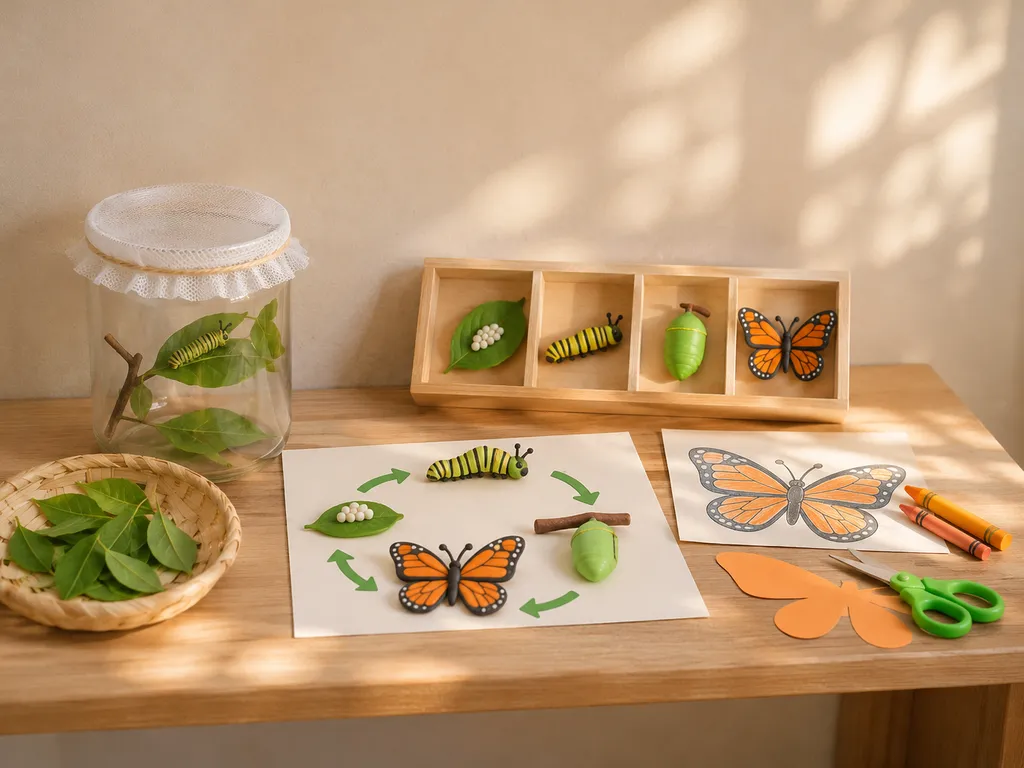
To practise Butterfly Life Cycle Vocabulary for Kids: Words and Activities in English at home, prepare four cards, one per stage. Hand-drawn pictures work. Short repeated practice is more effective than a long session packed with new terms.
- Point and name: Your child points to each card and says the stage.
- Mix and order: Shuffle the cards, then rebuild the life cycle.
- Say and expand: Start with “caterpillar,” then expand it to “The caterpillar eats and grows.”
- Ask and answer: Take turns asking what comes before or after a stage.
When answers become easy, remove the labels, require two action verbs, or begin at a different stage. Each change prompts recall instead of a memorised chant.
Four-corner Life Cycle Challenge
Place one stage card in each room corner. Name an action such as hatch, grow, change, or emerge. Your child moves to the matching stage and says a full sentence. Next, remove the labels and keep only the pictures.
Common Mistakes and Clear Corrections
Children may know the sequence but confuse two terms. Correct the meaning, then repeat the sentence naturally. A brief correction provides a model without interrupting the conversation.
- “The butterfly hatches.” A caterpillar hatches from an egg; a mature butterfly emerges from a chrysalis.
- “A chrysalis is an egg.” The egg is the first stage. The chrysalis is the pupal stage after the caterpillar.
- “A chrysalis and a cocoon are the same.” A chrysalis is a butterfly pupa. A cocoon is a silk covering made by the larvae of many moths.
- “The caterpillar is a worm.” It may look worm-like, but it is a larva and a stage in a butterfly’s life cycle.
Check the verbs: a butterfly lays an egg, a caterpillar hatches, and the mature butterfly emerges. If your child says, “The butterfly comes out,” accept the meaning and supply the exact verb: “Yes, the butterfly emerges.” The correction expands the sentence without making every answer a test.
- Name the four stages aloud: egg, caterpillar, chrysalis, and butterfly.
- Correct “cocoon” by explaining that butterflies usually form a chrysalis.
- Read one butterfly book and point to each life-cycle stage.
- Arrange four picture cards, then retell the cycle using sequence words.
- Ask three questions: What hatches, changes, and emerges during the cycle?
When a word has several meanings or pronunciations, Cambridge Dictionary is a useful check before turning it into child-friendly examples.
Frequently Asked Questions
Which Butterfly Life Cycle Words Should a Child Learn First?
For a first lesson on Butterfly Life Cycle Vocabulary for Kids: Words and Activities in English, teach egg, caterpillar, chrysalis, and butterfly. Add hatch, eat, grow, and emerge. After your child can order and describe the stages, introduce larva, pupa, adult, and metamorphosis.
Should My Child Say Larva or Caterpillar?
Both words are correct. Caterpillar is the familiar everyday word; larva is the broader science term for this developmental stage. Teach them together: “The butterfly larva is called a caterpillar.” Your child can then recognise either term in books and lessons.
Is a Chrysalis the Same as a Cocoon?
No. A chrysalis is a butterfly pupa. A cocoon is a silk covering made by the larvae of many moths around their pupae. Books sometimes call every similar-looking stage a cocoon, but use chrysalis for a butterfly. Comparing pictures helps separate the terms.
How Often Should We Practise These Words?
Practise for five minutes on three or four days each week. Order the four stages, name each one, and add an action verb. Finish with one complete sentence. Next time, ask for the words before revealing the labels. Recall shows which terms need another example.
Want to see how these ideas work in a real lesson — try a LearnLink trial lesson.
Stay updated on our latest tips and resources by following us on Instagram LearnLink.