My Room Flashcards in English for Kids
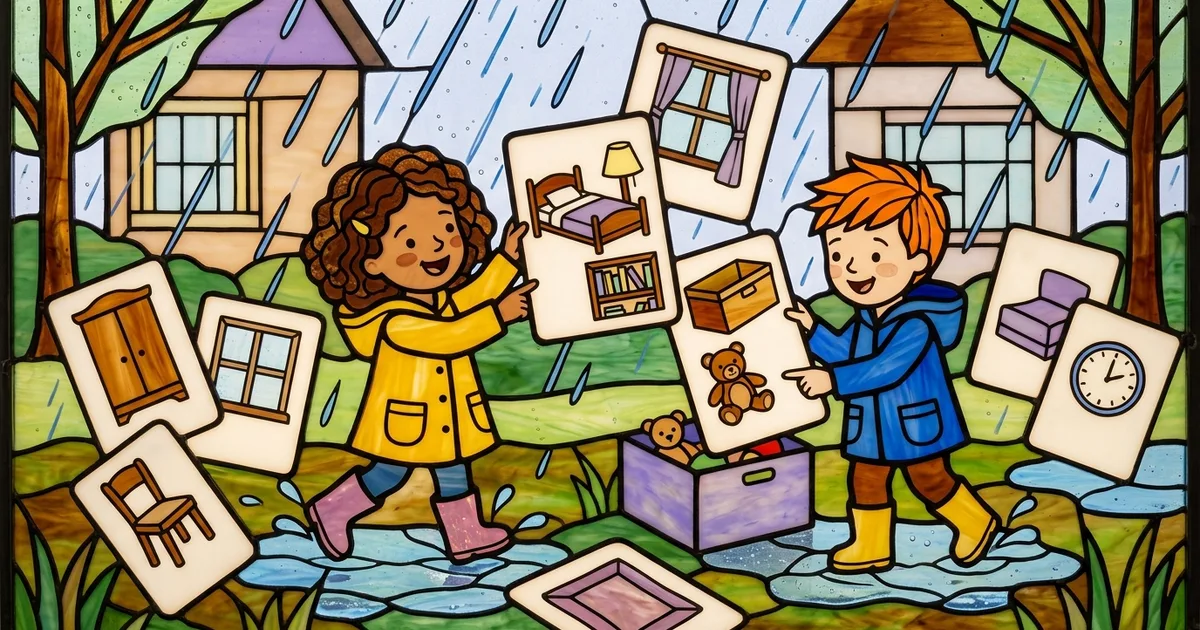
My Room Flashcards in English for Kids: Words and Activities is a practical card set for naming bedroom furniture, bedding, storage, and everyday objects. Build the deck from words your child can connect to a real room. Children name each object, then describe its place, owner, colour, or purpose. Parents can practise without turning the room into a classroom: point, ask, wait, and let the child answer. Keep rounds short, revisit difficult items, and accept regional terms such as wardrobe and closet.
📥 My Room Flashcards in English for Kids
Room vocabulary practice through matching, sentences, reading, and play
Leave your email — we'll send the PDF to your inbox.No spam — the PDF plus one short reminder. Unsubscribe anytime.
Build the Card Set Around a Real Room
To build My Room Flashcards in English for Kids: Words and Activities, begin with objects your child sees daily. Use the examples below as a starter deck. Show each word, cover it, then ask your child to recall it from the sentence or object.
I sleep in my bed.
My head is on the pillow.
The blanket keeps me warm.
The sheet is on the bed.
My clothes are inside.
I open the drawer.
The toy is on the shelf.
I draw at my desk.
I sit on the chair.
The lamp gives us light.
The rug is on the floor.
I can see my face.
Vocabulary Cards for Practice
Please close the door.
I look through the window.
They cover the window.
The blocks go in the toy box.
Books go in the bookcase.
It is next to the bed.
Do not teach the whole deck in one sitting. Start with a small group containing one known word, a few new words, and one phrase. A multilingual child may understand an object in another language before learning its English label. Treat that knowledge as an asset: give the English word, use a short sentence, and continue without testing every translation.
Move from Object Names to Useful Sentences
My Room Flashcards in English for Kids: Words and Activities become more effective when each noun prompts speech. After your child says lamp, ask, “Where is the lamp?” or “What does the lamp do?” The goal is flexible use of familiar words, not a longer list.
Model one complete answer before asking your child to produce it. Younger learners may reply with one word; expand it naturally: “Window—yes, the window is open.” Older learners can add reasons and contrasts: “I keep books on the top shelf because my little sister cannot reach it.” Across LearnLink lessons, our tutors use familiar words to bridge naming and connected speech.
Match Activities to Age and Reading Ability
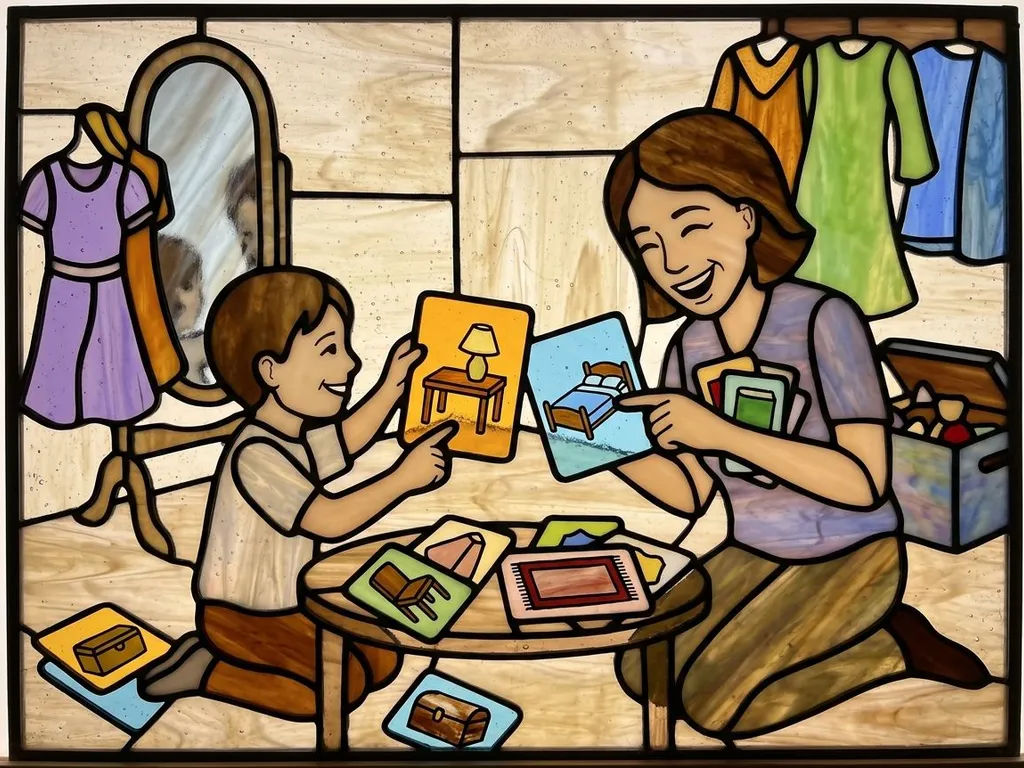
For school-age kids, make word prompts physical. Place three or four picture-word tiles on the floor. Say, “Touch the bed,” “Jump to the lamp,” or “Put the pillow card under the chair card.” Children who cannot read can follow your spoken prompt and the example on each card.
For school-age kids, turn My Room Flashcards in English for Kids: Words and Activities into a clue game. One player describes an object without naming it: “It has books on it” or “You look through it.” The other chooses the matching item and answers in a sentence. Add colour, size, and position after mastering the core nouns.
For school-age kids, avoid activities designed for small children. Ask learners to plan a room, compare two layouts, or rank objects by purpose. They can defend choices with because, but, and if: “I would put the desk near the window because it has natural light.” vocabulary now supports description, reasoning, and discussion.
Turn Short Practice into Purposeful Play
My Room Flashcards in English for Kids: Words and Activities should connect with the real room. Hide each word prompt beside its object, run a one-minute room hunt, or arrange picture-word tiles into a room plan. For a memory chain, begin with “In my room, there is a bed.” Each player repeats the sentence and adds one object.
The Mystery Room Challenge
Choose five room cards without showing them. Describe an imaginary room with one clue per card: “There is something soft on the bed” or “There are books near the desk.” Your child names the objects and draws the room from the clues. Swap roles so your child describes a new room.
Try a barrier game with siblings or a parent. Give both players the same cards and separate their layouts with a book. One player says, “Put the lamp next to the bed” and “Place the rug under the chair.” Remove the barrier and compare the rooms. Differences prompt players to repeat or repair the instruction.
Correcting Common Mistakes in Room Vocabulary
Teach nouns with their surrounding words. Say a bed when naming one object and the bed when both speakers know which bed they mean. Practise plurals through contrasts: “There is one pillow” and “There are two pillows.” This keeps the cards from becoming isolated labels.
Room vocabulary often causes preposition errors. We lie in bed when resting, but a book can be on the bed. Clothes are in the wardrobe; a mirror may be on the wall; a desk can stand by the window. Demonstrate these differences with objects and card positions.
Accept standard regional alternatives. British English uses wardrobe and bedside table, while American English often uses closet and nightstand. Some families use rug for a movable floor covering and carpet for material covering most of the floor. Choose one form for early practice, then introduce the alternative so your child recognises both.
- Try sorting 12 room flashcards with children ages five to seven.
- Practice saying bedroom, bathroom, and living room before pointing to each card.
- Use a picture book to contrast room names with furniture words.
- Correct one mistake gently, then ask your child to repeat the phrase twice.
- Play a five-minute matching game and review missed cards tomorrow.
When a word has several meanings or pronunciations, Cambridge Dictionary is a useful check before turning it into child-friendly examples.
Frequently Asked Questions
How Many Room Flashcards Should a Child Learn at Once?
Begin with four to six cards for a first-time learner. Add cards when your child can name most current objects without copying you. Keep two familiar cards in each new group to provide continuity. Older children may manage a larger set, but recall matters more than speed. If answers become random, reduce the deck and revisit the remaining cards later.
Should a Flashcard Show a Picture, a Word, or Both?
Introduce room vocabulary with a labelled picture. The picture conveys meaning, while the written word builds print familiarity. Later, cover one part: show the picture for speaking or the word for reading. For children who read another script, say the English word aloud before asking them to read it. Flashcards should support meaning and speech before testing spelling.
How Often Should We Practise Room Vocabulary?
Short sessions of five to ten minutes fit into the week. Revisit the cards on several days while changing the task: name objects, follow position instructions, solve clues, or describe a room plan. Use My Room Flashcards in English for Kids: Words and Activities until the words appear in spontaneous sentences. Then keep the cards in rotation while focusing on questions and descriptions.
What If My Child Mixes English with Another Language?
Mixed-language answers are natural when a child understands the idea but cannot retrieve every English word. Acknowledge the meaning and supply the missing form: “Yes, the blanket is on the bed.” Ask for the full sentence once without repeated drilling. Preserve home-language knowledge while building a reliable English label beside it.
Before the next practice round, use these steps:
- Start with four familiar room words and one new word.
- Practice one location sentence for each object, such as “The lamp is beside the bed.”
- Try a one-minute room hunt, then ask your child to describe where two objects are.
If your child needs steady speaking practice, start small — choose a trial lesson.
Stay updated on our latest tips and resources by following us on Instagram LearnLink.