Phrasal Verbs with up and Down for Kids
This guide teaches 12 phrasal verbs with up and down for kids, including wake up, pick up, sit down, and calm down. Each expression conveys movement or a new meaning. Teach complete phrases through actions, routines, and short sentences.
📥 Phrasal Verbs with up and Down for Kids
Everyday meaning, sentence practice, matching, and a weekly recall routine
Leave your email — we'll send the PDF to your inbox.No spam — the PDF plus one short reminder. Unsubscribe anytime.
What Families Need to Know
A phrasal verb combines a verb and particle to create a distinct meaning. Pick means to choose; pick up can mean to lift, collect, or learn through experience.
Up can suggest rising, starting, completing, or increasing: stand up, wake up, clean up, and turn up. Down can suggest lowering, resting, reducing, or recording: sit down, lie down, slow down, and write down. Treat these patterns as clues, not rules.
Present each phrase as one unit: “Please turn up the music.” Older learners can compare “turn up the music” with “turn the music up.” Pronouns go in the middle: “turn it up.”
A Practical Starter Set
Start with daily routines, linking each phrase to an action, object, or situation.
Demonstrate each meaning: use a gesture for stand up and a dictionary for look up. Visible results reinforce the complete verb construction.
Examples by Age
Across ages 4-15, match language to development. Pre-school-age learners benefit from movement and routine: wake up, get up, sit down, stand up, lie down, and clean up. Say each expression during the action; then let the child direct a parent, sibling, or toy.
School-age children can lift a pencil, put down a book, write down a word, or look up its meaning. Contrast the forms directly: “Turn the music up. Now turn it down.” The change clarifies each particle.
Experienced learners can explore non-literal expressions: give up, catch up, grow up, break down, and calm down. Compare “The bus broke down” with “She broke the problem down into smaller steps.” Context determines meaning.
How to Introduce the Phrases at Home
Choose four phrases from one routine. At breakfast, use wake up, get up, sit down, and clean up. During homework, use write down, look up, slow down, and check over. Practise one group for days before adding another.
Use three steps: model, choose, speak. Demonstrate the construction, then offer two options: “Do I collect the toy or put it down?” Finally, request a full sentence: “I put the toy down.”
Mistakes are part of learning phrasal verbs with up and down for kids. If your child says “turn down it,” answer, “Yes, turn it down.” Recasting supplies the correct form without stopping conversation. LearnLink tutors apply this technique while refining children’s grammar.
Practical Activities That Build Recall
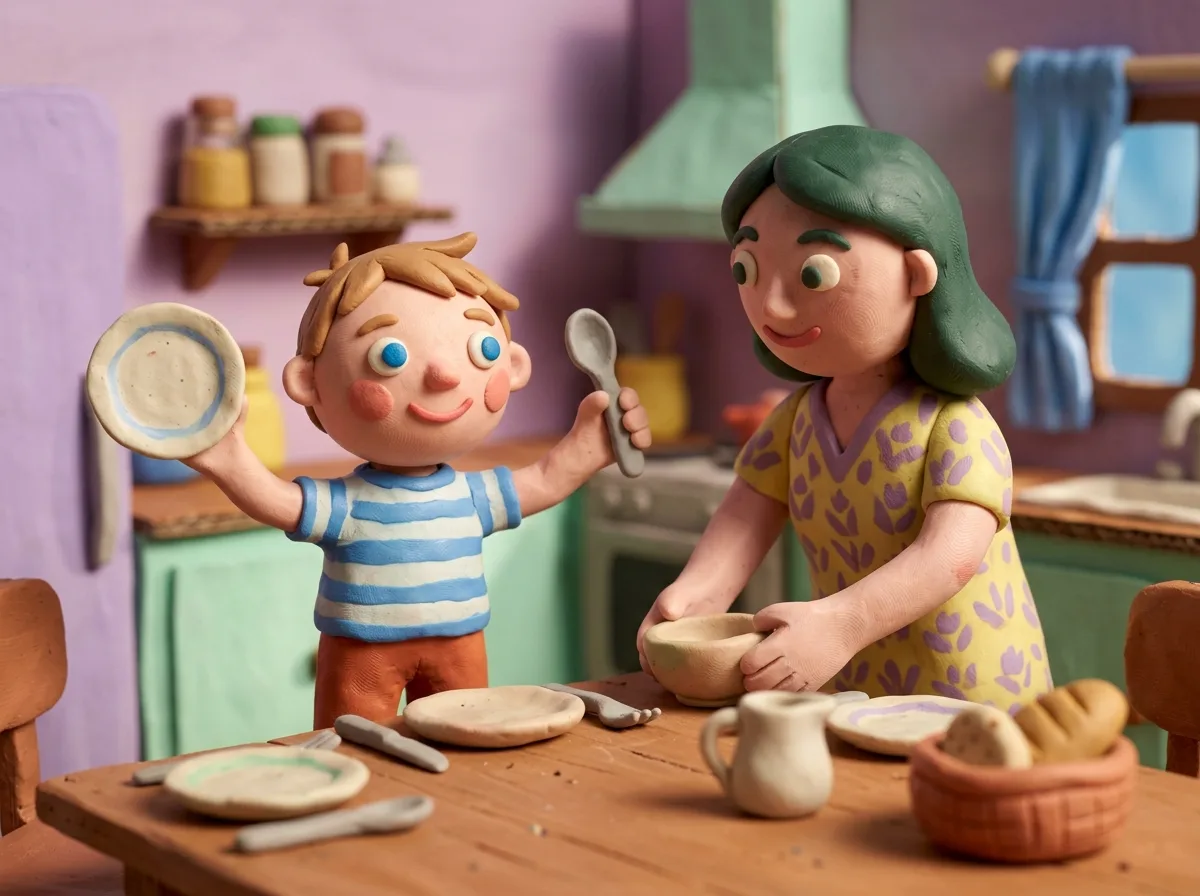
Choose one short game per session. Each activity connects an expression with an action.
- Action caller: Give commands such as “stand up,” “sit down,” and “turn around.” Let your child become the caller next.
- Toy director: Use a figure or soft toy to act out wake up, lie down, pick up, and put down.
- Volume control: Play quiet audio and practise turn up and turn down while keeping the sound at a safe level.
- Phrase hunt: Listen for one target form in a story, song, or family conversation. Pause and explain what it means there.
Older children can write one base verb on a card and test different particles. Compare look up, look down, and look after. Because meanings are unpredictable, check each complete construction in context.
Try It: Choose the Phrase
Complete each sentence with gather up, slow down, write down, or turn down.
1. Please ______ your name so we remember it.
2. The baby is sleeping, so ______ the music.
3. You are speaking too fast. Please ______.
4. Can you ______ the socks from the floor?
Answers: 1. write down; 2. turn down; 3. slow down; 4. gather up.
For the rule wording, Wikipedia — English Grammar is a useful reference while the practice examples here stay adapted for children.
Frequently Asked Questions
At What Age Can a Child Learn Phrasal Verbs?
Children ages 4-15 can learn age-appropriate phrasal verbs. Begin with visible actions such as stand up and sit down. As reading and reasoning develop, introduce word order, multiple meanings, and literal versus non-literal uses.
How Many Phrases Should We Introduce at One Time?
When introducing phrasal verbs with up and down for kids, start with three to five related expressions. Practise them in real situations for days, then add a group while reviewing the first. Using four combinations accurately beats reciting twenty unused definitions.
Does My Child Need to Learn Grammar Terms?
No. Younger learners can use put it down without knowing verb, particle, or pronoun. Labels help when children compare forms and word order. Introduce terminology after examples and conversation establish the pattern.
Should We Translate Phrasal Verbs into Our Home Language?
Translation can clarify meaning for multilingual children, but context comes first. Start with an action, image, object, or short situation; then compare the home-language expression if needed. Languages may use one verb where English uses a phrasal verb, making word-for-word translation unnatural.
Want to see how these ideas work in a real lesson — Try a trial lesson with LearnLink.
Stay updated on our latest tips and resources by following us on Instagram LearnLink.