Temperature Words in English for Kids
Begin with four contrasts: cold, cool, warm, and hot. Temperature Words in English for Kids: Vocabulary and Activities adds ten terms, from freezing to boiling, plus sentence patterns for home, outdoor activities, and lessons. After mastering the basic contrasts, learners add chilly, lukewarm, and scorching, then compare temperatures in Celsius or Fahrenheit. Connect each word to a safe observation, specific example, and complete sentence.
Core Temperature Words and Phrases
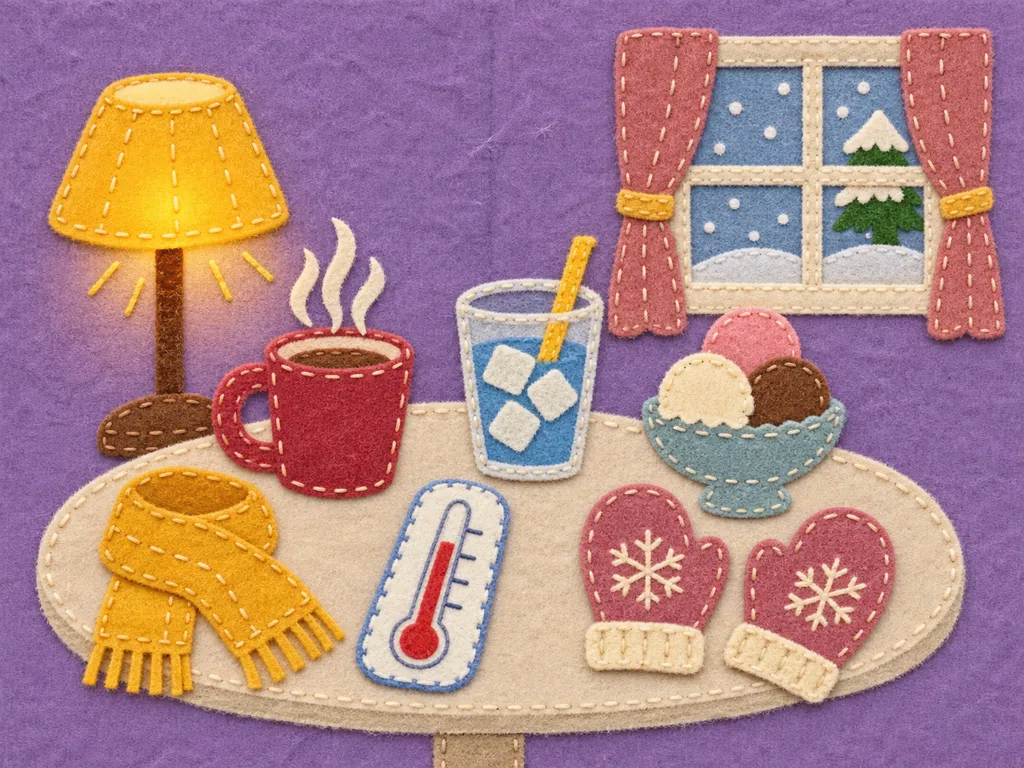
Start with contrasts your child can safely see or feel: cold and hot, then cool and warm. Add stronger terms after mastering these four. Freezing and boiling describe limits or extremes; chilly and scorching often describe weather.
Use Temperature Words in English for Kids: Vocabulary and Activities as a teaching sequence, not a single list. Introduce three or four words, practise sentences, and revisit them during meals, dressing, washing, or weather checks.
Middle terms depend on context. A cool drink may feel pleasant, while a cool bath may feel uncomfortable. Ask your child to explain the situation instead of assigning each word a fixed thermometer point.
Using the Words in Complete Sentences
Teach a small set of reusable patterns. For weather: “It is cold today” or “It was warmer yesterday.” For objects and food: “The plate is hot” and “The milk feels lukewarm.” For personal comfort, “I feel cold” stresses a temporary feeling more precisely than “I am cold.”
Questions activate vocabulary: “Is the water warm or cold?”, “How hot is it outside?”, and “Which cup is cooler?” Your child can answer with one word, then form a sentence: “Cold” becomes “The water is cold.” The expansion connects vocabulary with spoken grammar.
Temperature Words in English for Kids: Vocabulary and Activities should include comparison language. Practise “colder than,” “warmer than,” “the coldest,” and “the hottest.” A child might say, “The fridge is colder than the kitchen,” or “August is one of the hottest months here.” Use local examples because families experience different climates.
Activities for Different Ages
For school-age kids, use sorting and movement. Place picture cards showing snow, a cool drink, soup, and sunshine on a table. Say a word; your child points to the matching picture. Label opposite sides of a room “hot” and “cold,” then call an item for your child to classify by moving.
For school-age kids, turn Temperature Words in English for Kids: Vocabulary and Activities into an observation task. Choose five safe items or places: a window, shaded spot, jumper, tap water, and closed fridge. Your child labels each and explains why: “The shaded spot is cooler because it is away from the sun.” An adult must check water, cookware, and unfamiliar surfaces before touching.
For school-age kids, add measurement and nuance. Let your child record the temperature at three times of day using the local scale. They can report “It is 18 degrees Celsius” or “It is 64 degrees Fahrenheit,” then compare readings. During online English lessons with LearnLink tutors, the vocabulary can support longer explanations, predictions, and climate discussions.
Simple Ways to Practise at Home
Add temperature talk to daily routines instead of setting a long test. While choosing clothes, ask, “Is it warm enough for a light top?” At meals, request a description only after an adult confirms safety. During weather checks, compare today with yesterday.
- Draw a thermometer and place vocabulary from freezing at the bottom to scorching at the top.
- Play “odd one out” with groups such as cold, chilly, warm, and icy.
- Describe a mystery object using two clues: “It is cold, and we keep food inside it.”
- Keep a three-day weather log with a temperature, one adjective, and one full sentence.
- Mime feeling chilly, comfortably warm, or too hot while another person guesses the word.
Repeat words in new settings. Cold can describe air, water, food, hands, or a room. Varied contexts teach meaning more directly than copying the same sentence several times.
Quick Temperature Challenge
Choose three safe objects. Your child describes each, compares two, and asks one question: “The bottle is cool. The mug is warmer than the bottle. Is the window cold?” Older learners can add a prediction with “will”: “The drink will get warmer on the table.”
Common Mistakes and Clear Corrections
Children may say “I have cold” because another language uses “have” for physical sensations. English uses “I feel cold” for temperature. “I have a cold” means an illness. Practise both sentences with pictures to reinforce the contrast.
Another mix-up is using hot for spicy food. Hot can describe temperature or strong spice, so context matters. “The soup is hot” may describe high temperature; “The sauce is hot” may describe strong spices. Ask, “Do you mean hot to touch or spicy to taste?”
Children may confuse weather and object patterns. “Today is cold” is possible, but “It is cold today” is the everyday form. For measurements, teach: “It is 20 degrees Celsius,” not “It has 20 degrees.” Temperature Words in English for Kids: Vocabulary and Activities works when every correction supplies a natural replacement sentence.
When a word has several meanings or pronunciations, Cambridge Dictionary is a useful check before turning it into child-friendly examples.
Frequently Asked Questions
These answers address frequent family questions about introducing and reviewing temperature vocabulary.
Which Temperature Words Should My Child Learn First?
Begin with cold, cool, warm, and hot. These words contrast easily and fit daily routines. After your child identifies and uses them in sentences, add freezing, chilly, lukewarm, boiling, and scorching. Temperature Words in English for Kids: Vocabulary and Activities works best with small word groups, frequent review, and specific examples instead of a large memorisation task.
Should My Child Learn Celsius or Fahrenheit?
Teach the scale used at home and school first, then introduce the other name. The sentence pattern remains identical: a number followed by “degrees Celsius” or “degrees Fahrenheit.” Older children can compare both scales, but exact conversion is unnecessary for basic vocabulary practice. The goal is accurate understanding and reporting.
How Can Our Tutors Teach Temperature Words Without Touching Hot or Cold Objects?
Use photographs, weather reports, clothing, drawings, and pretend situations. Your child can sort pictures, act out feeling chilly, or place word cards on a drawn thermometer. A closed fridge, jumper, and window view provide safe prompts. Adults must manage hot food, boiling water, ice, cookware, and sun-warmed surfaces.
What If My Multilingual Child Mixes Temperature Words Between Languages?
Language mixing can occur while your child builds multiple word systems. Give a calm English model without stopping the conversation. If your child uses another language, reply with the English sentence: “Yes, the water is cold.” A small bilingual vocabulary list may help, but practise each English word in a full sentence to connect grammar and meaning.
If your child needs steady speaking practice, start small — choose a trial lesson.
Stay updated on our latest tips and resources by following us on Instagram LearnLink.