Volcano Vocabulary in English for Kids
Volcano Vocabulary in English: Words and Activities for Kids provides 18 core terms for a volcano, its parts, and eruptions. Children start with concrete words such as lava, ash, and crater, then add verbs and scientific contrasts. The goal is to point, sort, describe, and ask questions, not memorise a dictionary page. The activities use drawings, models, books, or safe videos and adapt to each child’s age, interests, and home languages.
Core Words for Talking About Volcanoes
Use this Volcano Vocabulary in English: Words and Activities for Kids list as a teaching bank, not a single spelling test. Begin with six visible nouns, then add processes, describing words, and one safety verb. Introduce the rest after your child can explain the first group.
The table distinguishes related ideas and gives a model sentence for each word. Children may change the sentences while preserving the science.
Examples That Put the Words in Context
The Volcano Vocabulary in English: Words and Activities for Kids set works best when terms form a sequence. Try: “Magma moves below the surface. It rises through a vent. When it reaches the surface, we call it lava.” Your child can draw three frames and write one sentence under each.
Combine nouns with action verbs: “The volcano erupts,” “ash rises,” “gas escapes,” and “lava flows.” Older children can add cause, contrast, or time: “Although the volcano looked quiet, scientists continued to record tremors.” These patterns develop general English and science language.
Teach count and non-count forms through examples. We can say a volcano, an eruption, and two craters. Treat lava, magma, and ash as material words: “Ash fell,” not “an ash fell.” For separate objects, say “pieces of volcanic rock.”
How to Introduce the Vocabulary
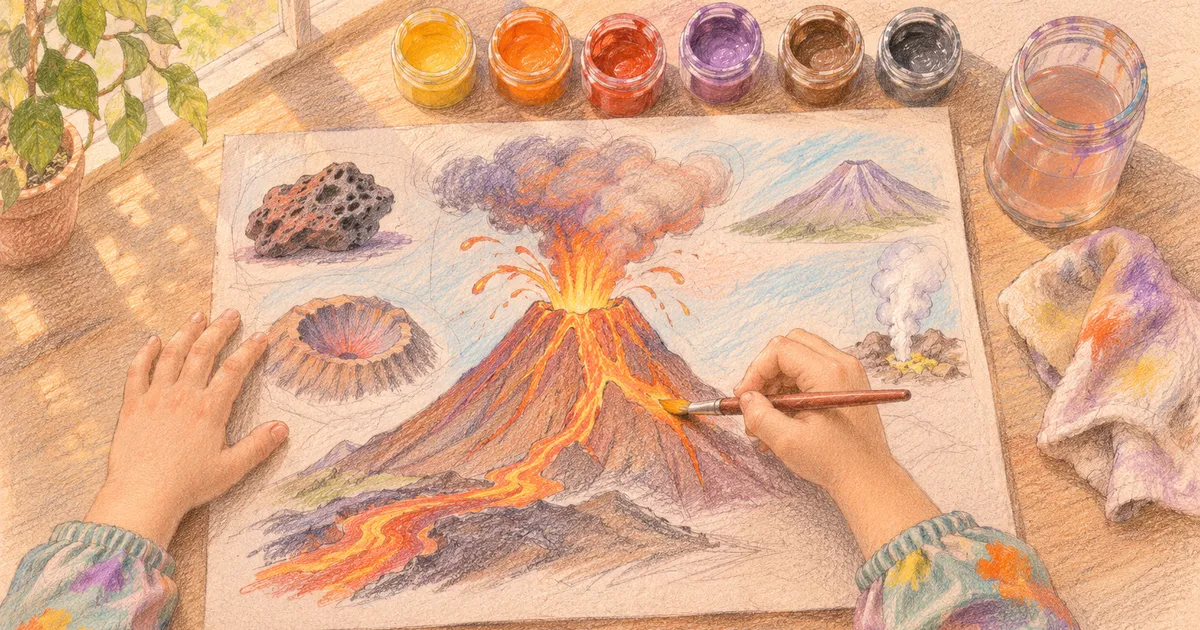
Treat Volcano Vocabulary in English: Words and Activities for Kids as an investigation. Show a volcano drawing and ask, “What can you see?” Accept a home-language answer when needed, then give the English word. Your child can point to the crater, trace the slope, and locate magma and lava.
Sort the words into four groups: parts, materials, actions, and safety. A word may change groups if your child explains why. For pronunciation, mark the stressed beat in longer words: vol-CAY-no, e-RUP-tion, and e-VAC-u-ate. After clapping each part, say the full word naturally.
Finish with retrieval, not copying. Hide the labels and ask your child to replace them on the drawing. Then point to one part and request its name, meaning, and a sentence. A multilingual child may compare each English term with known words in other languages.
Activities for Different Age Groups
The same Volcano Vocabulary in English: Words and Activities for Kids can grow with your child. For school-age kids, use movement and pictures. Make a cone with both hands, wiggle fingers upward for gas, and move red paper down a cardboard slope for a lava flow. Begin with one-word labels, then try lines such as “Hot lava flows.”
For school-age kids, label a cross-section and create sequence cards. Mix five cards showing magma, vent, eruption, ash cloud, and lava flow. Your child orders them and explains each choice. More than one sequence may work, so assess the explanation instead of requiring a fixed arrangement.
For school-age kids, compare two short volcano reports. Ask which words describe observation, risk, or uncertainty. The child can rewrite dramatic claims carefully: “The volcano will explode” becomes “The volcano is active, and specialists are monitoring signs of change.” This teaches the difference between evidence and prediction.
Practice Ideas and Common Mistakes

Keep practice brief and varied. Sort word cards one day, then describe a diagram without the list. Later, ask your child to give a 30-second weather-style report from an imaginary observation point. During LearnLink lessons, our tutors can reuse the vocabulary in drawing, reading, and speaking tasks.
Correct scientific contrasts before spelling slips. Magma is below the surface; lava is at the surface. Ash differs from ordinary smoke. Erupt is a verb, while eruption is a noun: “The volcano erupted,” or “An eruption began.” The plural of volcano is volcanoes.
Build a Four-sentence Volcano Report
Choose one word from each group: volcano or crater; magma, lava, or ash; rise, flow, erupt, or escape; active, dormant, or extinct. Make four linked sentences, then replace two words without changing the meaning. Explain why magma may become lava but lava does not become magma by moving downhill.
Do not present every eruption as an explosion. Eruptions may be explosive or produce steadier lava flows. A model is not the real event: a foaming classroom model may be memorable, but its bubbles cannot reproduce volcanic heat, rock, gas, or pressure.
When a word has several meanings or pronunciations, Cambridge Dictionary is a useful check before turning it into child-friendly examples.
Frequently Asked Questions About Volcano Words
How Many Volcano Words Should My Child Learn at Once?
Start with four to six words visible in one diagram, such as volcano, crater, magma, lava, ash, and eruption. A short Volcano Vocabulary in English: Words and Activities for Kids session needs speaking and pointing, not only reading. Add terms after your child recalls the first group and uses at least two in a sentence.
What Is the Simplest Way to Explain Magma and Lava?
Magma is melted rock below Earth’s surface. When the material reaches the surface, it becomes lava. On a cross-section drawing, place the two labels on opposite sides of the ground line. Then ask your child to complete two frames: “Below the ground, it is magma. At the surface, it is lava.”
Should My Child Learn Active, Dormant, and Extinct?
Yes, but teach them as evidence-based labels used by specialists, not guesses based on appearance. An active volcano may be quiet at a given moment, a dormant volcano may erupt again, and an extinct volcano is not expected to erupt again. Do not teach “quiet” as a synonym for “safe”; the ideas differ.
How Can a Multilingual Child Practise Volcano Vocabulary?
Connect the English words to concepts your child knows in other languages. Use one shared diagram and add removable English labels without replacing every home-language term. Request a short English sentence once the meaning is secure. Your child can compare word families, sounds, and sentence order across languages without treating any language as a problem.
If your child needs steady speaking practice, start small — choose a trial lesson.
Stay updated on our latest tips and resources by following us on Instagram LearnLink.