Arts and Crafts Vocabulary in English for Kids

Children remember craft words faster when they hear the word, touch the object, and act at once. Arts and Crafts Vocabulary in English for Kids: Words and Activities for Children covers materials, tools, actions, shapes, colors, and finished work, so a 10-minute activity teaches classroom language. Say "Fold the sheet," let the child fold it, then ask, "What did you fold?" A three-word answer is enough. The goal is English children can use while making, asking, choosing, fixing, and explaining.
📥 Arts and Crafts Vocabulary in English for Kids
Practice words, phrases, craft actions, and simple sentences for creative activities.
Leave your email — we'll send the PDF to your inbox.No spam — the PDF plus one short reminder. Unsubscribe anytime.
Core Arts and Crafts Words
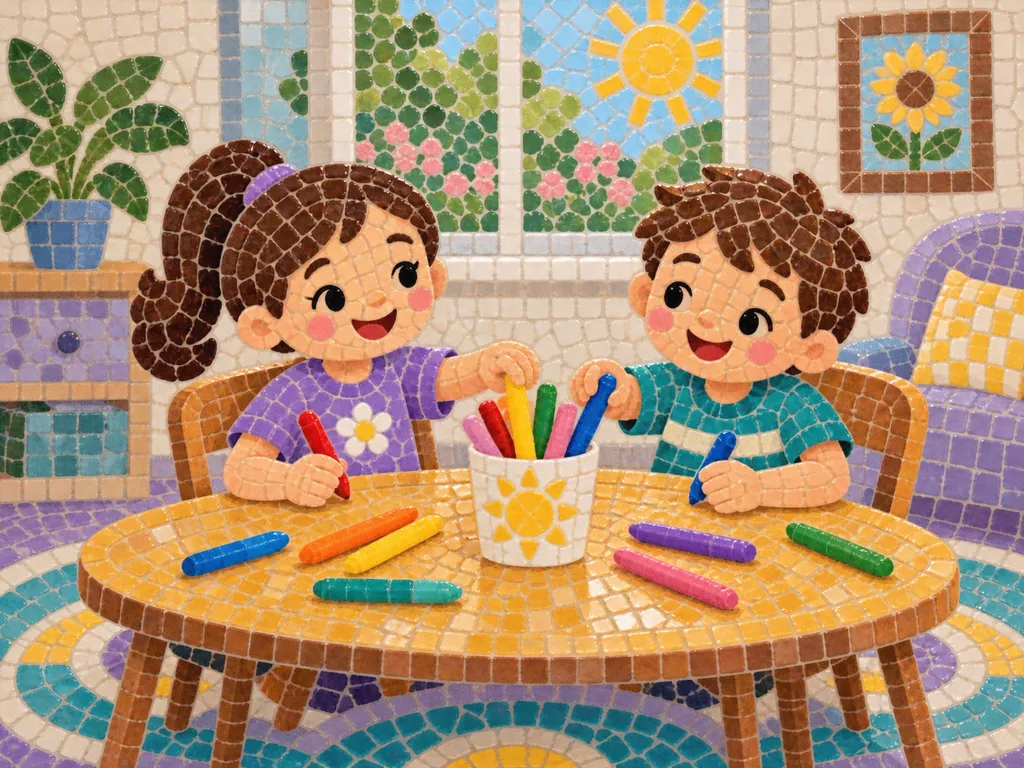
Start with touchable words. Materials come first: card, paint, brush, crayon, pencil, marker, glue, tape, clay, beads, string, fabric, ribbon, stickers, scissors, and ruler. For younger children, choose five or six. Put them on the table and say, "This is glue," "These are crayons," and "Here is the craft sheet."
Next add action words. Children need verbs to follow instructions and describe work: draw, color, paint, cut, fold, stick, paste, tear, press, roll, make, build, trace, decorate, and clean up. Arts and Crafts Vocabulary in English for Kids: Words and Activities for Children works best when nouns and verbs come together, not as a dry list.
"I need glue for the eyes."
"Use the scissors carefully."
"Wash the brush after painting."
"Fold the card in half."
"Cut a small star."
"Decorate the card with stickers."
"I made a red and blue pattern."
"The fabric has a soft texture."
Older children can use precise words: outline, shade, blend, sketch, design, pattern, texture, background, foreground, portrait, landscape, model, collage, and sculpture. These words help a 10- or 12-year-old describe work without sounding childish.
Useful Phrases Children Can Say
Children soon need sentences, not single words. Give them short frames to reuse. For school-age kids, try: "I need paste," "I want blue," "Can you help me?" "I made a house," and "Look at my picture." These phrases carry real classroom language.
For school-age kids, add choices and reasons: "I chose red because it is bright," "I am making a card for my friend," "Can I use the scissors?" and "The sheet is too small." The child can ask, explain, and solve a small problem in English.
For school-age kids, move toward process language: "First I sketched the shape," "Then I added details," "The background needs more color," and "I changed my design because the clay was too soft." Step-by-step talk connects vocabulary with thinking.
Words for Different Craft Activities
Different crafts need different language. Painting needs colors, brush strokes, and shapes. Card crafts need folding, cutting, edges, corners, and layers. Clay tasks need rolling, squeezing, flattening, and drying. When words match the activity, each word has a job.
Use this table to choose a small set before an activity. Eight words used well beat forty words on display. Treat it as a practical part of Arts and Crafts Vocabulary in English for Kids: Words and Activities for Children, not homework.
Examples in Context
Context matters more than translation. Instead of asking, "What is scissors in English?" hand the child the scissors safely and say, "Use the scissors to cut the card." Then ask, "What did you cut?" A child might answer, "I cut a star." That is English with tool, action, and object.
Arts and Crafts Vocabulary in English for Kids: Words and Activities for Children should include polite classroom language. Children need to say "Can I have the red marker?" "May I use the paste?" "I am not finished yet," and "I need more card." These short sentences help a child join a group task.
With older children, ask for short descriptions after the work is done. "Tell me three things about your picture." A strong answer might be: "It is a night sky. I used dark blue paint. The moon is in the corner." This builds vocabulary, grammar, and confidence without a formal speech.
Activities by Age
For school-age kids, keep the activity short and physical. Put three colors and two tools on the table. Say, "Take the red crayon," "Draw a line," and "Stick the star here." Young children learn through doing, so repeat the same words steadily. Do not correct every sound. Model the word again and let the child continue.
For school-age kids, give a small project with choices. A "make a robot" task can include body parts, shapes, and materials: square head, round eyes, long arms, silver card, buttons, adhesive. Ask planning questions: "What do you need first?" "Which shape will you use?" "Where will you put the eyes?"
For school-age kids, connect craft with design and opinion. Ask the child to make a poster, comic panel, room plan, bookmark, or model. They can use words such as layout, symbol, contrast, texture, detail, and message. This keeps the language age-appropriate for children beyond babyish craft talk.
Practice Task: Make and Explain
Ask your child to make a simple animal, card, or picture. Before starting, choose six words to use: card, fold, cut, glue, color, and decorate. During the task, your child says each word in a sentence: "I fold the card," "I cut the ears," "I paste the eyes." At the end, ask for three sentences about the finished work.
Practice Ideas for Home and Online Lessons
A practice routine can stay short: choose words, make something, talk about it, then clean up in English. Cleanup is often missed, but it gives phrases: "Put the markers away," "Cap the paste," "Wash the brush," and "Throw away the small pieces." These words belong to real life, not only art.
Arts and Crafts Vocabulary in English for Kids: Words and Activities for Children can be practised with picture prompts. Show a finished craft and ask, "What can you see?" "What colors are there?" "What materials did they use?" If your child is shy, offer two choices: "Is it card or clay?" "Did they cut it or fold it?"
For children who already speak two or three languages, do not worry if they mix languages at first. Say the English word and place it in a sentence. If the child says the home-language word for glue, answer, "Yes, that is paste. We need adhesive for the eyes." The aim is steady use, not pressure.
Common Mistakes and How to Fix Them
One mistake is teaching too many words before the child has a reason to use them. A long list may look complete, but children remember words tied to a task. Pick one craft and teach its words.
Another mistake is using only commands. "Cut," "paint," and "fold" matter, but children need social language too: "Can I try?" "I made a mistake," "It is okay," "Can we fix it?" Craft time brings small problems, and those problems create language moments.
Parents sometimes correct art and English at the same time. That can make the child quiet. Choose one focus. If the goal is English, accept the uneven star or strange-looking house. Praise the sentence: "You said, 'I need more card.' Good. Here is more card." This keeps Arts and Crafts Vocabulary in English for Kids: Words and Activities for Children tied to confidence, not pressure.
- Try five new craft words with school-age kids during paper collage time.
- Practice naming three tools before cutting, pasting, or painting together.
- Use one picture book to review colors, shapes, and textures.
- Ask your child to explain each finished craft in two sentences.
- Repeat tricky words daily with labels on scissors, paste, and paper.
When a word has several meanings or pronunciations, Cambridge Dictionary is a useful check before turning it into child-friendly examples.
Frequently Asked Questions
What Arts and Crafts Words Should a Beginner Learn First?
Start with words the child will use in almost every activity: card, pencil, crayon, marker, paint, brush, craft adhesive, tape, scissors, cut, draw, color, fold, stick, and make. Add colors and shapes if they are not secure yet. For a beginner, Arts and Crafts Vocabulary in English for Kids: Words and Activities for Children should feel practical, not like a spelling list.
Data current as of July 2026.
How Can Our Tutors Teach Craft Vocabulary If My Child Does Not Like Art?
Use building, cooking-style pretend play, stickers, blocks, or design tasks instead of traditional drawing. The same language appears: make, choose, put, stick, shape, color, small, big, soft, hard. Some children dislike painting but enjoy making a badge, a plane, a comic strip, or a model room. Follow the child's interest and keep the English practical.
Should I Translate Craft Words into My Child's First Language?
A quick translation can help if the child is stuck, but the English word needs to return at once in a sentence. For example: "Yes, that is glue. Apply the adhesive to the card." Children in multilingual homes often move between languages while learning. That is not failure. Over time, repeated English phrases during real actions become easier to recall.
How Often Should We Practise Arts and Crafts Vocabulary?
Ten minutes once or twice a week is enough for many families, especially with younger children. Reuse the same words across several activities before adding new ones. One week might focus on cut, fold, paste, and decorate. The next week can add pattern, edge, and corner. Regular short practice works better than one long session with too many new words.
- Start with six touchable words, then add verbs only when the child can use them in an action.
- Practise one short sentence during each step: ask, choose, make, fix, and describe.
- Try a 10-minute craft routine twice a week before adding harder words such as texture, layout, and contrast.
LearnLink teaches English to children ages 4-15 and works with 4,000+ families, so craft vocabulary can become part of steady speaking practice rather than a one-time word list.
If your child needs steady speaking practice, start small — Try a trial lesson with LearnLink.
Stay updated on our latest tips and resources by following us on Instagram LearnLink.