Desert Vocabulary Activities for Kids
Start with 6–10 connected desert words and practise for five minutes. Desert Vocabulary for Kids: Words and Activities covers land, weather, plants, animals, movement, and safety. Show nouns such as “dune,” then verbs such as “crawl” and phrases such as “under the rock.” Ask the child to point, sort, draw, and speak before producing three full sentences. Older learners can compare habitats, explain animal features, and write four-sentence descriptions.
Core Words for a Desert Scene
With Desert Vocabulary for Kids: Words and Activities, teach concrete words before ideas such as heat or survival. The groups below form a practical starting set. Choose three or four groups for a younger child, or the whole table for an older learner.
Deserts are dry places, not always hot places. Deserts can be cold, and temperatures may change between day and night. An oasis has water; a dune is a hill formed from sand. These distinctions build accurate meanings beyond matching each word to one picture.
Put Desert Words into Sentences
When practising Desert Vocabulary for Kids: Words and Activities, move from naming to describing. A child may name a desert plant. Expand this to “a green plant,” then “A green plant grows near the rocks.” The pattern retains the known idea while adding colour, place, and action.
Use sentence frames: “I can see a ___,” “The ___ is under the rock,” and “There are three ___ near the dune.” Ask: “Where is the lizard?” “What does the camel carry?” and “Why does the fox hide in the shade?” Accept a short answer, then model a full one.
Older children can link ideas with “because,” “but,” and “so”: “The desert is dry, but some plants can grow there.” They can compare two animals: “A snake has no legs, while a lizard has four.” For multilingual children, connect the known idea to the English word, then return to the English sentence.
Activities for Different Ages
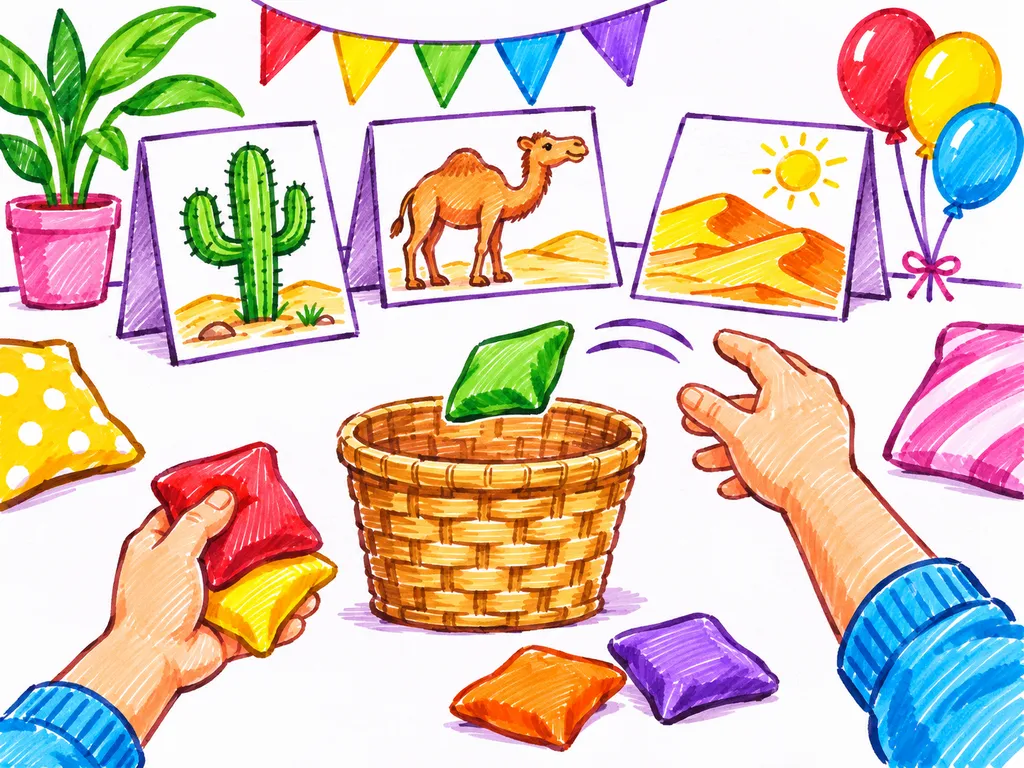
For school-age kids, use six to eight picture cards. Ask your child to find the desert plant, place the camel beside the dune, or move the snake under a rock. Add movement: crawl like a beetle, climb like a lizard, or shade your eyes from the sun. Keep rounds brief and repeat favourite instructions.
For school-age kids, turn Desert Vocabulary for Kids: Words and Activities into a map task. Draw a desert with an oasis, two dunes, rocks, and animal tracks. Say, “Go past the shrub and stop beside the oasis.” Swap roles so your child gives directions and checks your route.
For school-age kids, create a short desert field guide. The learner can group plants and animals, label features, and write three habitat sentences. During online lessons, LearnLink tutors can adapt the task by changing the word load, sentence frames, and explanation level.
Short Ways to Practise at Home
Follow a five-minute routine: review four known words, introduce two new ones, and finish with one sentence challenge. The next day, mix the cards so the child retrieves words instead of repeating a fixed order. Revisit difficult words through drawing, guessing, or spoken clues.
Build a Desert Scene
Draw a large dune, an oasis, two rocks, and one desert plant. Add three desert animals. Take turns giving instructions: “Put the lizard behind the rock” or “Draw footprints between the dune and the oasis.” Finish by describing the scene in four sentences.
A no-picture game suits travel. One person gives three clues: “It is an animal. It can crawl. It has a long body.” The other guesses “snake.” Older children can give harder clues without naming the word’s group. Record missed words and reuse them in the next game.
Common Mistakes with Desert Words
Children may confuse similar spellings, plural forms, and countable nouns. Model the correct sentence in full instead of stopping at the wrong word. For example, answer “two cactus” with “Yes, two cacti are near the rocks.” The table presents key contrasts.
Pronunciation matters. In the noun “desert,” the stronger beat comes first: “DEZ-ert.” In “dessert,” it comes second: “di-ZERT.” Let your child hear both in complete sentences, then ask which sentence describes a place. Meaning gives each sound a purpose.
- Compare desert and dessert aloud, then write one sentence for each word.
- Sort ten picture cards into desert animals, plants, landforms, and weather.
- Read one desert book and underline five unfamiliar words together.
- Describe a desert scene using three nouns, two adjectives, and one verb.
- Correct one mixed-up desert sentence and explain why each replacement fits.
When a word has several meanings or pronunciations, Cambridge Dictionary is a useful check before turning it into child-friendly examples.
Frequently Asked Questions About Desert Vocabulary
How Many Desert Words Should My Child Learn at Once?
For Desert Vocabulary for Kids: Words and Activities, start with six to ten words for school-age kids. Choose words from one scene: sand, dune, rock, camel, lizard, and oasis. Add two or three words after your child can recognise and use most of the first set. Older learners can handle a larger set grouped by meaning.
Should Our Tutors Teach Only Hot-desert Words?
No. Teach “dry” as the main idea and explain that deserts can be hot or cold. Begin with familiar pictures of sand, cacti, and camels, then include rocky ground, cold weather, and different plants or animals. The wider range prevents children from assuming every desert looks alike.
Can a Multilingual Child Use Another Language During Practice?
Yes. A known word in another language can connect the English label to an existing idea. After making the connection, return to English for the picture, action, or sentence. Other languages need not be banned. Check whether your child can later understand and use the English word without a prompt.
How Can We Practise Without Worksheets?
Use toys, drawings, household objects, or spoken clues. A folded towel can become a dune, a cup an oasis, and toy animals can move around the scene. Ask your child to follow directions, describe locations, or correct a silly sentence such as “The camel is swimming.” These tasks practise meaning, grammar, and speech without worksheets.
Try this today: choose six words, practise for five minutes, and request three full sentences. Revisit the set tomorrow, then add two new words when most answers are correct.
Start your child's English journey today — book a trial lesson with LearnLink.
Stay updated on our latest tips and resources by following us on Instagram LearnLink.