Fractions in English for Kids
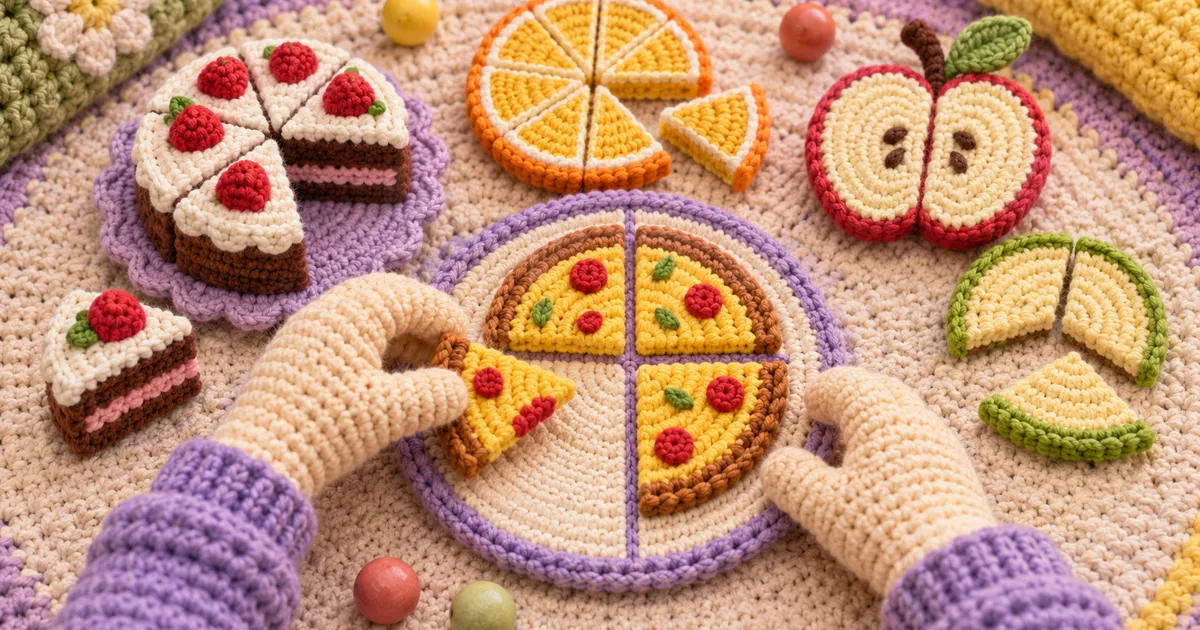
A fraction names equal parts of a whole, such as one half of an apple or three quarters of an hour. Fractions in English: Words and Activities for Kids covers the terms, sentence patterns, and games children need to describe those parts. Start with objects your child can see and move. Connect each object to spoken words, then symbols such as 1/2. This sequence builds understanding beyond memorising a fraction’s appearance.
📥 Fractions in English for Kids
Everyday fraction words, clear speaking patterns, independent activities, and a weekly practice tracker
Leave your email — we'll send the PDF to your inbox.No spam — the PDF plus one short reminder. Unsubscribe anytime.
Essential Vocabulary and Speaking Guidelines
Start with whole, part, equal, half, third, and quarter. Older children can add numerator for the top number and denominator for the bottom number. The denominator shows how many equal parts form the whole; the numerator shows how many parts are selected.
English uses an ordinal denominator: third, fourth, or fifth. With a numerator above one, use the plural: two thirds, three fifths, and seven tenths. The exception is half, whose plural is halves.
Use Fractions in English: Words and Activities for Kids as a speaking guide, not a recitation list. Ask your child to show a fraction, name it, and use it in a sentence. Meaning, pronunciation, and grammar develop together.
Fractions in Everyday Contexts
Food provides concrete examples when an adult handles cutting. Divide a sandwich into halves or a round flatbread into quarters. Focus on equal pieces: two unequal pieces do not form two mathematical halves.
Time provides another setting. Half an hour is 30 minutes, and a quarter of an hour is 15 minutes. Children can say, “The film is half finished,” or, “We spent three quarters of an hour at the park.” Fraction words then connect with daily plans.
Paper, building blocks, water, and distance work too. Try: “Fold the paper into thirds,” “Half of the blocks are red,” and “We have walked one quarter of the way.” Fractions can describe shapes, groups, amounts, or journeys.
A Clear Way to Introduce Fractions
Fractions in English: Words and Activities for Kids should begin with one whole object. Name it, divide it into equal parts, then reassemble it. Say: “This is one whole. These are two equal parts. Each part is one half.”
Next, pair each spoken phrase with its symbol. Show one third beside 1/3. Explain that the bottom number records the equal parts and the top number records the selected parts. Begin with halves, thirds, and quarters.
Finish with a choice: “Is this one half or one quarter?” When your child answers confidently, request an explanation: “It is one quarter because the whole has four equal parts and one part is shaded.” The explanation confirms understanding.
Activities for Different Ages
For school-age kids, try folding and sorting. Fold paper into two equal parts and colour one half. Make another sheet with unequal parts and ask which shows halves. Keep practice playful, brief, and spoken.
For school-age kids, make matching cards: one shows a symbol, another the words, and a third a shaded shape. Your child matches the three cards and says a sentence. For a fraction hunt, find something half full, a group divisible into thirds, or a shape divided into quarters.
For school-age kids, compare equivalent fractions or adjust a familiar recipe. Children can explain why 1/2 and 2/4 represent the same amount, then test other pairs. Fractions in English: Words and Activities for Kids can support debates: “Is 5/8 closer to one half or one whole? Explain your answer in English.”
Short Practice That Fits Home Life
Fit practice into routines instead of assigning long daily worksheets. At breakfast, ask what fraction of the fruit remains. While tidying, compare the books and toys already put away. At bedtime, shade the completed part of a reading chart.
Three-minute Fraction Challenge
Draw a rectangle and divide it into eight equal parts. Shade three parts. Ask your child to name the fraction, write the symbol, and complete: “Three eighths of the rectangle is shaded.” Shade one more part and describe the change.
In a multilingual family, your child may understand the maths in another language first. Let the child demonstrate the fraction with objects, then provide the English phrase. Repeat the full sentence once or twice without creating a translation test.
Common Mistakes and Simple Corrections
Never call unequal pieces halves, thirds, or quarters. Return to equal: each part must have the same size within that whole. Different shapes can represent the same fraction when their areas are equal.
Children may say “two third” instead of “two thirds,” or use “three” where English requires “third.” Model the correction naturally: “Yes, two thirds are shaded.” The conversation continues while the child hears the correct form.
Children may read 1/2 as “one second.” A second describes order or time; the fraction is one half. For mixed numbers, say and: 2 1/4 is “two and one quarter.” Do not teach “one over two” as the main form; everyday conversation requires one half.
When a word has several meanings or pronunciations, Cambridge Dictionary is a useful check before turning it into child-friendly examples.
Frequently Asked Questions
When Should a Child Learn Fraction Words in English?
Fractions in English: Words and Activities for Kids works best after your child understands sharing or equal parts through objects. Young children can begin with whole, half, and quarter. Older children can add numerator, denominator, and equivalent fraction. Match the vocabulary to maths your child can demonstrate.
What Is the Difference Between “Half” and “One Half”?
Both forms name 1/2. “One half” is precise and follows patterns such as “one third” and “one fifth,” helping children read written fractions. “A half” and “half” occur in daily speech: “I ate half,” or, “Please give me a half.” Teach both for classroom and everyday English.
Should Children Say “One Fourth” or “One Quarter”?
Both are correct for 1/4. “One quarter” appears in contexts such as time, food, and amounts. “One fourth” follows the regular mathematical sequence. Teach both as equal in meaning, then use one form consistently within an explanation. The plurals are “quarters” and “fourths.”
How Can a Multilingual Child Practise Without Translating Every Word?
Use actions, objects, and drawings to convey meaning. Ask your child to divide, shade, point, or match before speaking. Then model a short sentence such as “Two fifths are blue.” Translate when needed, but direct links between the object, fraction, and English phrase strengthen recall.
A short one-to-one lesson can show what level and pace fit your child — book a trial English lesson.
Stay updated on our latest tips and resources by following us on Instagram LearnLink.