The -Ink Word Family for Kids

The -ink Word Family: Words and Activities for Kids teaches words sharing the spelling and sound pattern -ink, including pink, sink, and think. Children keep the ending steady while changing the first sound. This builds pattern-based reading, spelling, and rhyme recognition. Start with six words, then introduce the harder openings in drink, think, and shrink. Short games, sentences, and reviews beat one long worksheet.
How the -Ink Pattern Works
The -ink Word Family: Words and Activities for Kids treats ink as one sound unit called a rime. Adding a starting sound creates a word: p + ink makes pink; s + ink makes sink. In speech, the ending matches the final sound in think, not in followed by a sharp k.
Say the words before showing their spelling. Ask whether pink and wink end alike. Then display both words and mark the shared letters. This sequence connects sound with print and lets multilingual children begin through listening before tackling English spelling.
Core Words and Useful Phrases
The teachable set in The -ink Word Family: Words and Activities for Kids starts with concrete words children can draw, point to, or act out. Add rarer words after your child reads the core pattern without relying on pictures.
After mastering single words, practise phrases: a pink drink, at the rink, in the sink, stop and think, and wink and blink. Phrases show meaning and prepare children for full sentences without testing memory alone.
Examples Children Can Use
Place two or three -ink words in a natural sentence: “At the rink, I drink water from a pink cup.” Read it, then ask your child to mark the repeated ending. Ask which words rhyme and which word falls outside the family. The task checks listening and letter recognition.
Question-and-answer patterns bring the words into speech. Try: “What do you think?” “I think the bag is heavy.” Ask, “Where is the spoon?” and answer, “It is in the sink.” For blink and wink, have the child perform each action before describing the difference.
Older learners can study meaning beyond rhyme. Link can describe joined objects, connected ideas, or a web link. Compare “The wet shirt may shrink” with “The picture shrank when we changed its size.” Focus first on -ink; introduce changed verb forms after children master the base words.
Teaching tip
Cover the first letters in pink, sink, and wink. Reveal each start while your child repeats the unchanged ending.
Activities by Age and Reading Stage
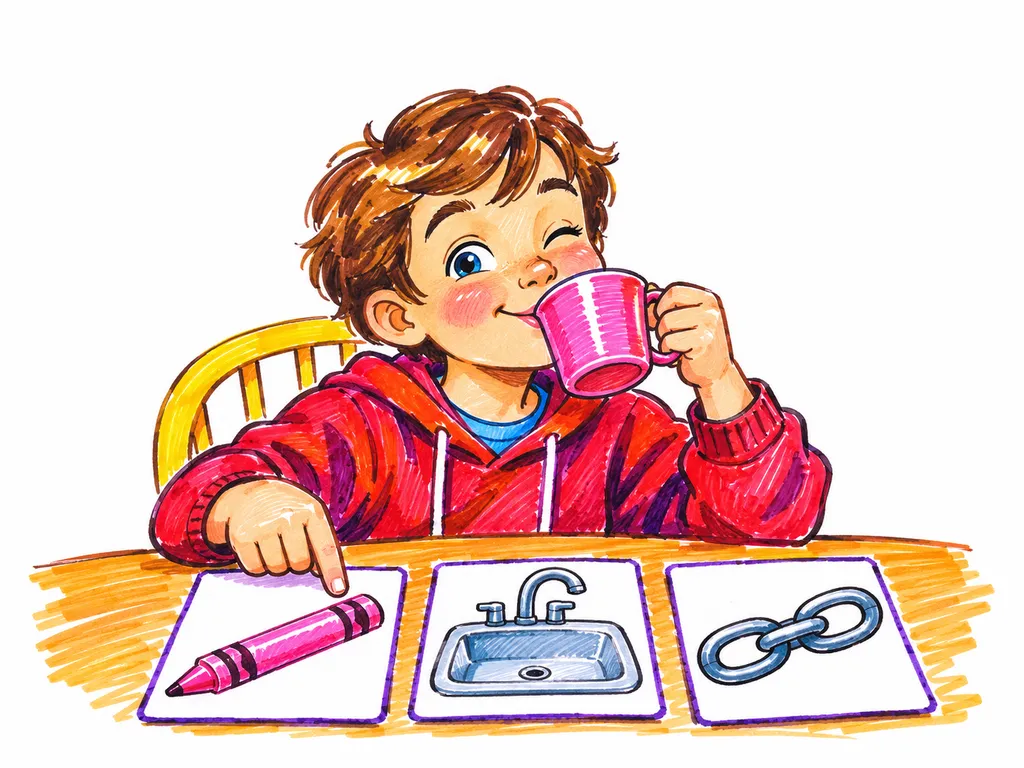
When using The -ink Word Family: Words and Activities for Kids with school-age kids, make the pattern physical. Put picture cards for pink, sink, drink, and wink on a table. Say each word for your child to match. Then act out drink, think, blink, and wink.
For school-age kids, build a word ladder. Write ink, then change the beginning to form pink, sink, wink, and link. Add a false choice such as king or bike. Ask why it lacks the matching spelling or ending sound.
For school-age kids, reuse the words in a six-line dialogue, caption, or comic. Set one challenge: include five -ink words correctly without forced rhyme. Older learners can sort literal and broader meanings, including a metal link, a link between ideas, and a web link.
Myths and facts about word-family practice
Myth: A child must copy every word before saying it.
Fact: Hearing, saying, and blending the pattern gives written letters a familiar sound.
Myth: All -ink words have the same level of difficulty.
Fact: Think, drink, and shrink have harder starting sounds than pink or sink.
Practice and Common Mistakes
Keep practice brief and focused. Review four known words, teach one new word, and finish with a sentence. Revisit missed words next time instead of repeating the full table. A child who reads pink in a list should encounter it in a phrase, question, and passage.
Watch for a long vowel in ink; it does not rhyme with bike. Children may confuse think with thing, or sink with sing, because the final k is quiet but meaningful. Ask children to hold the ending, then release the k. Never spell think as “thingk.”
Meaning matters. Rhyming words are not interchangeable: a person can drink water but cannot “sink water.” Use stink for a bad smell, not as a label for a person. Brief corrections develop accurate reading and respectful speech.
Five-minute practice checklist
- Say three -ink words before showing them.
- Ask your child to identify the shared ending.
- Build one new word by changing the start.
- Use two words in spoken sentences.
- Review one word that caused hesitation.
Change-the-start Challenge
Write _ink on a card. Give your child p, s, w, and l to build four words. Then offer bl, dr, th, and shr for a harder round. Read each word aloud and choose two for one sentence.
- Sort six -ink words by initial consonant, then read each word aloud.
- Build four words with letter cards, changing only the initial consonant.
- Read one familiar book, pausing to identify every -ink word together.
- Contrast sink and sing, checking the final sound before saying each word.
- Write three -ink sentences, then circle the shared spelling pattern.
When a word has several meanings or pronunciations, Cambridge Dictionary is a useful check before turning it into child-friendly examples.
Frequently Asked Questions
Which -Ink Word Should a Child Learn First?
Start with a word your child understands and can picture or act out. Pink, sink, drink, and wink work well. Introduce two or three together so children hear the shared ending. Add think, blink, and shrink after simple starts become fluent.
Why Does the N in -Ink Sound Different?
Before the final k, the tongue moves towards the back of the mouth, giving n the sound heard in sing. The k closes the word. Children need no lengthy explanation. Model the whole ending, invite repetition, and contrast sink with sing to highlight the final k.
Should a Child Read or Spell the Words First?
Let your child hear and say the pattern before independent spelling. Progress through listening, blending, reading, then spelling. Children may spell a memorised list yet miss the words in sentences. Oral practice, word cards, and short sentences reveal whether they can apply the pattern beyond memorisation.
How Often Should We Practise the -Ink Word Family?
Use The -ink Word Family: Words and Activities for Kids for five to ten minutes at a time across the week. Stop while your child remains attentive. Vary review: read cards one day, play a movement game the next, and write a sentence later. Reduce practice after the words become fluent in ordinary text.
A short one-to-one lesson can show what level and pace fit your child — book a trial English lesson.
Stay updated on our latest tips and resources by following us on Instagram LearnLink.