English Restaurant Vocabulary for Kids
English Restaurant Vocabulary for Kids: Words and Activities covers menu words, polite phrases, and role-play tasks for ordering a meal. Begin with visible items such as menu, table, water, soup, and bill, then add requests such as “I’d like pasta.” Link each English word to an object, picture, or action instead of relying on translation.
📥 English Restaurant Vocabulary Practice
Useful words, polite phrases, and short conversations for eating out
Leave your email — we'll send the PDF to your inbox.No spam — the PDF plus one short reminder. Unsubscribe anytime.
Build a Useful Core Vocabulary
Group restaurant words by purpose so children learn how they work together. English Restaurant Vocabulary for Kids: Words and Activities should cover people, objects, food, meal stages, and actions. Younger learners can start with visible nouns; older children can add verbs and choice-making phrases.
Teach regional forms without presenting one as the only correct choice. Families may ask for the bill in Britain and other countries, while check is standard in the United States. Takeaway and takeout express the same idea. Children need not learn every variant at once, but should recognise terms heard while travelling or watching English-language media.
Teach Phrases Children Can Use
Words name things; phrases let children participate. Start with a stable frame and change one part: “I’d like soup, please,” “I’ll have rice,” or “Could I have water?” Predictable grammar supports a growing restaurant vocabulary.
Politeness belongs in the lesson. Please, thank you, excuse me, and could I have make requests calm and precise. Teach allergy questions, but an adult must manage real food allergies and confirm ingredients with restaurant staff.
Put the Words into Short Conversations
The examples in English Restaurant Vocabulary for Kids: Words and Activities progress from recognition to speech. A beginner might practise: “Menu, please.” “Here you are.” “Thank you.” A sentence-builder might say: “I’d like tomato soup and bread, please.” Add one question: “Would you like water or juice?”
Older learners can practise choice, clarification, and correction: “Does the sandwich come with a side dish?” “Yes, it comes with salad.” “Could I have vegetables instead?” Unscripted replies prepare children for real conversations. Encourage careful listening, a pause, and a relevant response.
Choose Activities That Fit the Child’s Age
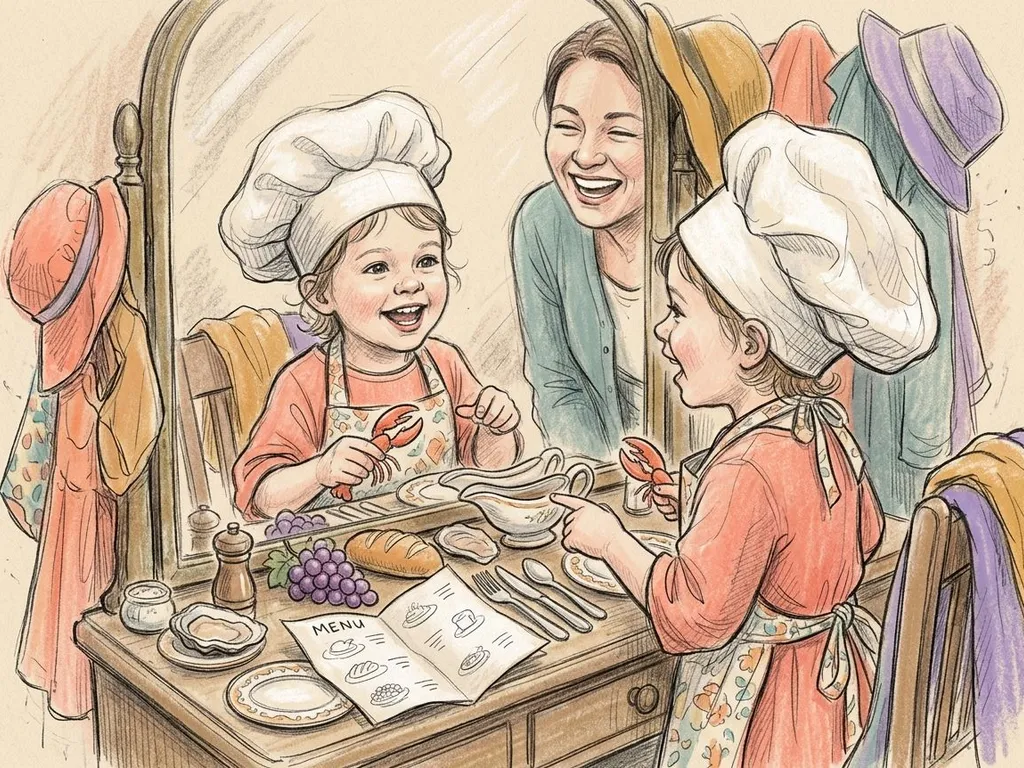
For school-age kids, use toy food, safe kitchen items, or picture cards. One player is the customer; another is the server. The customer points and says, “Juice, please.” Add menu, plate, spoon, and thank you after the first exchange. Repeat the brief pattern with different foods.
For school-age kids, create a menu with familiar foods. The child sorts items into drinks, main courses, side dishes, and desserts, then orders a meal. Swap roles so the child asks, “Are you ready to order?” A pretend bill adds number practice without creating a long maths exercise.
For school-age kids, expand the role-play with a missing item, unfamiliar dish, dietary request, or choice between eating in and taking food away. The learner stays polite while solving the problem. Afterwards, review one successful phrase and one sentence needing improvement.
Practise at Home Without Worksheets
A short routine turns English Restaurant Vocabulary for Kids: Words and Activities into speech. Before a family meal, ask your child to name three table objects. During the meal, practise one request. Afterwards, recall what each person ate or drank. These retrieval steps build stronger recall than rereading a long word list.
Change the setting but retain the language frame. A toy café, picnic, bakery, food stall, or family kitchen supports “I’d like…,” “Could I have…?” and “How much is…?” LearnLink tutors can adapt prompts to each child’s age, interests, and speaking confidence.
Try the Mixed-up Order
Write a drink, a main course, and a dessert on separate paper slips. Your child chooses one from each group and orders a complete meal. Remove one item and let the “server” explain: “Sorry, we don’t have ice cream today.” The customer chooses an alternative and thanks the server.
Correct Common Restaurant-language Mistakes
Avoid correcting every role-play error. If the meaning is clear, finish the exchange and review one point afterwards. Constant interruption shifts attention from communication to mistake avoidance. Choose one target, such as adding please or replacing “I want” with “I’d like.”
Distinguish menu, order, meal, and bill. A menu shows the choices; an order tells the restaurant what the customer wants; a meal is the food and drink; a bill or check shows the amount owed. Acting out the sequence reinforces each meaning.
Children may say “a water” or “two breads” after learning food nouns. Model natural forms: “a glass of water,” “two bottles of water,” and “some bread.” A server may understand the informal “two waters,” but fuller forms provide a reusable pattern.
- Practice ordering with children ages six to nine using five illustrated menu cards.
- Correct “I want” by modeling “I’d like” during three pretend restaurant turns.
- Use gentle recasts when children confuse meal, dish, menu, and order.
- Try a picture-book role-play, switching server and customer roles after each page.
- Review English Restaurant Vocabulary for Kids: Words and Activities before your next meal.
When a word has several meanings or pronunciations, Cambridge Dictionary is a useful check before turning it into child-friendly examples.
Frequently Asked Questions
How Many Restaurant Words Should a Child Learn at Once?
For a young beginner, start with words used in one exchange: menu, table, water, food, please, and thank you may be enough. Add vocabulary after the child understands and uses the first group without prompting. Older learners can handle larger sets when words are grouped by purpose.
Should Children Learn British or American Restaurant Words?
Teach the form your child will hear most, then introduce alternatives. Bill and check, takeaway and takeout, and main course and entrée vary by region and setting. English Restaurant Vocabulary for Kids: Words and Activities helps children recognise these differences without labelling a widely used form wrong.
Can a Multilingual Child Learn These Words Without Translation?
Yes. Use pictures, objects, gestures, and short scenes to connect each English word directly to its meaning. Translation can resolve an unclear concept but need not lead the activity. Multilingual children may already understand that languages use different labels for the same object.
When Is a Child Ready for a Full Restaurant Role-play?
A child is ready after making a request, understanding a basic question, and giving a short supported reply. Start with arriving, ordering one item, and saying thank you. Add choices, problems, dietary needs, and payment language as confidence grows.
- Start with six to eight words your child can see or act out.
- Practise one request pattern with several foods and drinks.
- Switch customer and server roles so the child asks and answers.
- Review one successful phrase and one correction after each role-play.
Want to see how these ideas work in a real lesson — try a LearnLink trial lesson.
Stay updated on our latest tips and resources by following us on Instagram LearnLink.