Taste Vocabulary in English for Kids
English taste vocabulary starts with five core words: sweet, sour, salty, bitter, and umami. Children can add words for flavour strength and texture, such as mild, spicy, creamy, and crunchy. English Taste Vocabulary and Activities for Kids should teach more than food names. Children learn to describe sensations, compare foods, and express preferences. Start with familiar household dishes from the child’s language or culture. Teach the English label alongside the food’s original name.
Core Vocabulary for Taste and Texture
Teach one contrast first: sugary versus sharp, or mild versus spicy. Let your child smell and inspect the food before choosing a word. Taste adjectives can follow is, tastes, or seems: “The mango tastes honeyed,” “The yogurt tastes tart,” or “The sauce seems spicy.”
English Taste Vocabulary and Activities for Kids works when taste, flavour, and texture remain distinct. Sweet names a taste; creamy and crunchy describe texture. Spicy describes heat or seasoning, not one of the five core tastes. Children can combine terms: “The apple has a sugary taste and is juicy and crunchy.”
Useful Sentences for Real Conversations
English Taste Vocabulary and Activities for Kids becomes practical through complete sentences. Begin with three frames: “It tastes…,” “It is…,” and “I think it is….” Then introduce preferences: “I like it because it has a dessert-like flavour,” “I do not like bitter food yet,” and “I prefer the milder sauce.”
Questions give vocabulary a purpose. Ask, “How does it taste?”, “Is it sugary or sharp?”, “Which one is saltier?”, and “What does the soup taste like?” Start with one adjective, then add a reason: “It is tangy because it has lemon in it.” Do not demand one opinion; children may describe the same food differently.
Try a Three-word Tasting Sentence
Choose a familiar food and complete: “The _____ is _____, _____, and _____.” For example: “The peach is luscious, soft, and juicy.” Use foods already safe for your child and follow household dietary rules.
Older learners can compare strength and preference: “The green apple is more tart than the red apple,” or “I prefer the lentil soup because its flavour is richer.” The activity develops opinions supported by evidence.
Activities for Different Ages
For school-age kids, use two choices and pointing. Place pictures of familiar foods under two labels, such as sweet and salty. Say each word, invite repetition, then ask for a choice. Pretend food, drawings, or package pictures work when tasting is unsuitable.
For school-age kids, make a taste chart with four columns: food, taste, texture, and opinion. A child might record “flatbread — mild — soft — I like it.” For a guessing game, give two clues: “It is acidic and juicy.” The other player names a food and explains the guess.
For school-age kids, English Taste Vocabulary and Activities for Kids can include menus, reviews, and comparisons. Ask your child to describe a family dish without calling it simply good or bad: “The stew has a rich, savoury flavour, while the herbs add a fresh smell.” Preserve the dish’s original name and cultural setting.
Practice at Meals and Away from the Table
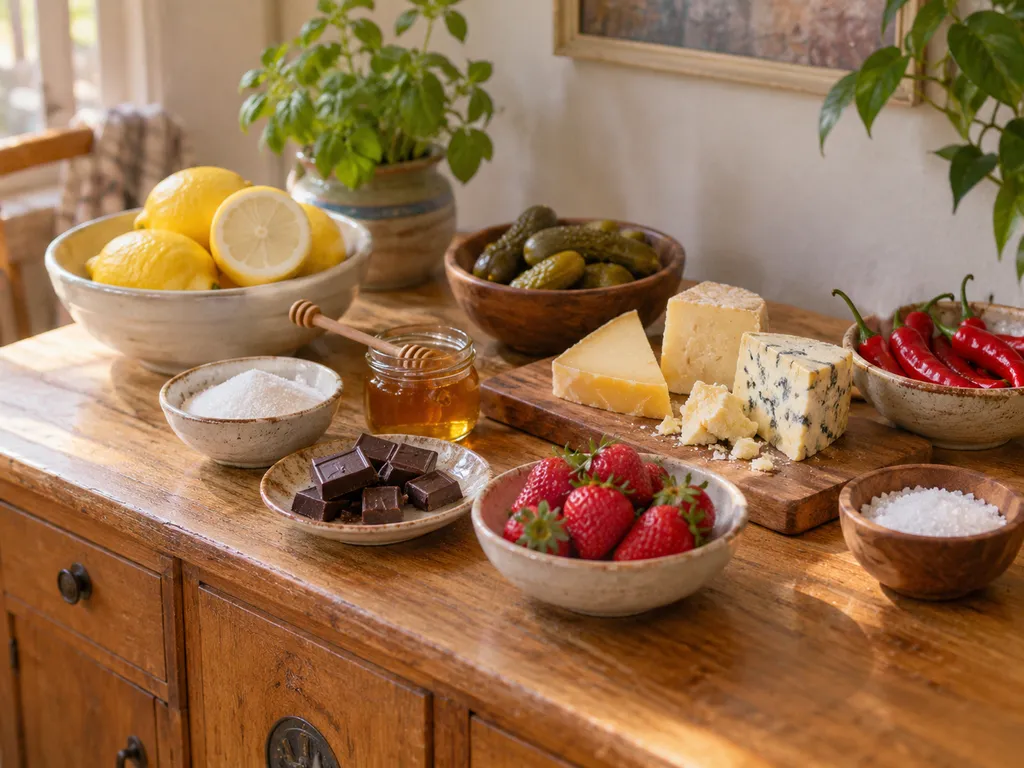
Set one language goal at a time. During a meal, ask: “Which word describes the sauce?” At the next meal, compare two items. English Taste Vocabulary and Activities for Kids should support conversation, not make each meal a test. Stop after one thoughtful answer.
Make a Taste Detective Card
Write five clues: sweet, sour, salty, bitter, and umami. Your child chooses a safe, familiar food, circles one clue, and adds a texture word. Finish with: “I chose these words because….” A picture or memory can replace tasting.
Practise away from food by sorting supermarket leaflets, designing a café menu, or pausing when a story character eats. Ask how the food might taste and what clue supports the prediction. Use phrases such as “It might be…” and “I imagine it tastes….”
Review through varied usage instead of repetition. Keep four or five current words on a card for a week. Put each word in a question, comparison, and opinion. Introduce new words after your child recalls the current set without prompts.
Common Mistakes and Clear Corrections
Children may say “It tastes sourly,” but taste descriptions need adjectives: “It tastes sour.” The adverb sourly describes an action or manner, as in “He replied sourly.” Model the correct sentence once, then ask your child to repeat the full phrase.
Sour, bitter, and spicy are not interchangeable. Lemon is acidic, unsweetened cocoa can be bitter, and chilli can be spicy. Another mix-up is tasty versus taste: “The noodles are tasty,” but “The noodles taste salty.”
Do not treat preferences as errors. “This is too salty for me” describes the speaker’s experience, not a universal fact. Teach too as “more than I want” and enough as “the amount I want”: “The soup is too spicy for me,” or “This sauce is mild enough.”
- Practice five taste words with ages six to nine during snack time.
- Use picture cards to sort sugary, sour, salty, bitter, and umami foods.
- Read one food-themed book aloud, then ask three taste comparison questions.
- Correct mistakes gently by modeling the full sentence before your child repeats.
- Try a blind taste test with four safe foods and clear clues.
When a word has several meanings or pronunciations, Cambridge Dictionary is a useful check before turning it into child-friendly examples.
Frequently Asked Questions
How Many Taste Words Should a Child Learn at Once?
Begin with two contrasting words, such as sugary and tangy. Add one or two after your child recognises and uses the first pair in a sentence. Four or five active words are enough for one week. A smaller set strengthens recall through questions, comparisons, and conversations.
Does My Child Need to Taste Food During These Activities?
No. Pictures, toy food, menus, drawings, and remembered meals support English Taste Vocabulary and Activities for Kids. Picture-based practice suits children with allergies, sensory needs, dietary limits, or little interest in unfamiliar food. A child can predict flavour, sort pictures, or describe a family dish without tasting during the lesson.
What Is the Difference Between Taste and Flavour?
Taste refers to the core sensations sweet, sour, salty, bitter, and umami. Flavour also includes smell, temperature, seasoning, and other features of eating. Everyday English often uses both terms loosely. For children, the distinction is simple: sugary describes a taste, while minty, smoky, or lemony describes a broader flavour.
How Can I Help If My Child Answers with Only “Good” or “Bad”?
Offer two specific choices: “Is it mild or spicy?” Then request one texture detail: “Is it soft or crunchy?” Build a sentence frame: “I like it because it is _____.” Gradually reduce the prompts. The goal is a precise word supported by a reason, not a long answer.
- Start with two contrasting taste words and practise them with familiar foods or pictures.
- Ask your child to use each word in a complete sentence, comparison, or reason.
- Review four or five words during the week, then add new vocabulary after recall becomes easy.
A short one-to-one lesson can show what level and pace fit your child — book a trial English lesson.
Stay updated on our latest tips and resources by following us on Instagram LearnLink.