CEFR for Parents: Levels, Ages, and Your Child
As a parent, you want to provide your child with the best educational opportunities. If your child is learning a new language, particularly English, you may have heard about the Common European Framework of Reference for Languages (CEFR). But what does it mean, and how can it help your child's language learning journey?
📥 CEFR Starter Phrase Cards for Young English Learners
A parent-friendly printable set of everyday English phrases grouped by CEFR skill goals.
Leave your email — we'll send the PDF to your inbox.No spam — the PDF plus one short reminder. Unsubscribe anytime.
CEFR Levels at a Glance: A1 to C2
The Common European Framework of Reference for Languages defines six proficiency levels. The table below summarises what learners can typically do at each level, with a recommended starting age band for children learning English as a foreign language. Age bands are guidance — actual placement depends on exposure and individual pace.
Data current as of July 2026.
Source: descriptors based on the Council of Europe's CEFR companion volume and the child English level summaries. Age bands are LearnLink's own guidance for children learning English as a foreign language.
1. What Is the CEFR?
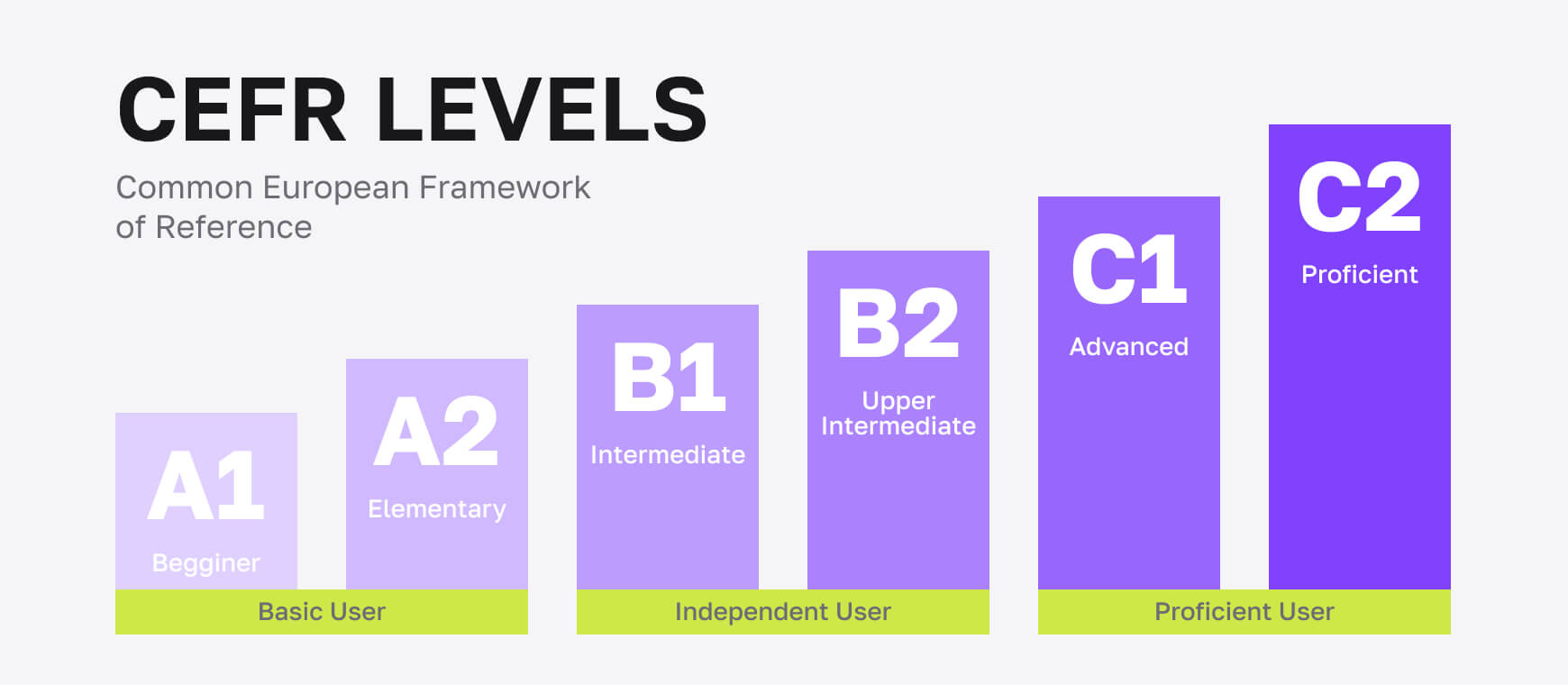
The Common European Framework of Reference for Languages (CEFR) is an internationally recognized standard used to assess and describe language proficiency. Developed by the Council of Europe, the CEFR framework categorizes language ability into six levels, making it easier for schools, teachers, and parents to understand and track a learner's progress.
The Six Levels of CEFR:
- A1 (Beginner): Basic understanding of everyday expressions and phrases.
- A2 (Elementary): Ability to communicate in simple and routine tasks.
- B1 (Intermediate): Can handle more complex conversations and situations.
- B2 (Upper Intermediate): Can express ideas fluently and engage in detailed discussions.
- C1 (Advanced): Able to understand and use more sophisticated language with ease.
- C2 (Proficient): Mastery of the language, with near-native fluency.
The CEFR is widely used in Europe and around the world, making it a universal benchmark for measuring language skills.
2. How Does the CEFR Benefit Your Child's Language Learning?
For parents, understanding the CEFR can help you gauge where your child is in their language journey and what they need to focus on next. The framework provides clear goals at each level, ensuring that your child builds a strong foundation before moving on to more advanced skills.
Key Benefits of CEFR:
- Clarity on Progress: CEFR helps you understand exactly where your child stands in terms of their language skills. If your child is at level A1, for instance, you know they are learning basic phrases and expressions.
- Structured Learning: Each level of CEFR is designed to build on the previous one, offering a clear path for language progression. This allows for structured learning, ensuring that your child doesn't skip crucial steps.
- International Standard: Whether your child is learning English in your home country or abroad, the CEFR provides a consistent measurement. This makes it easier for you to track their progress across different schools or programs.
3. What Should Parents Look for in CEFR-Aligned Programs?
When choosing an English course or tutor for your child, it's important to ensure that the curriculum aligns with the CEFR levels. Many reputable language courses for kids use the CEFR framework to develop lesson plans, assess progress, and set goals for their learners.
Things to Look for in a CEFR-Aligned Program:
- Level-Based Learning: The program should assess your child's current level (A1, A2, etc.) and provide lessons suited to their abilities.
- Clear Progression Path: Look for programs that offer a clear learning path, with regular assessments and updates on your child's progress through the CEFR levels.
- Age-Appropriate Lessons: Ensure that the materials and methods used in the program are designed for young learners and are engaging and interactive.
4. CEFR and English Language Learning for Kids
For children learning English as a second language, the CEFR framework ensures that they develop skills at a pace suited to their age and abilities. The framework covers all aspects of language—listening, speaking, reading, and writing—so that children become well-rounded learners.
How CEFR Helps Kids Learn English:
- Listening and Speaking: At the A1 and A2 levels, your child will focus on understanding basic phrases, responding to simple questions, and engaging in everyday conversations.
- Reading and Writing: As they progress, they will learn to read simple texts and write basic sentences. By B1 and B2 levels, they'll be able to engage with more complex reading materials and express ideas in writing.
- Practical Applications: The CEFR encourages real-world language use, so children practice skills they can use in everyday situations, from introducing themselves to discussing their favorite hobbies
5. CEFR for Young Learners: The Path to Fluency.
Starting your child on a language journey early provides significant long-term benefits, and the CEFR framework can help guide them to fluency step by step. By breaking down the language-learning process into manageable levels, CEFR ensures that your child can learn at their own pace and develop confidence as they move forward.
How to Support Your Child's CEFR Journey:
- Set Realistic Goals: Work with your child's tutor or teacher to set goals that align with their current CEFR level. This can include mastering a certain number of words, phrases, or grammar rules by a specific date.
- Track Progress: Regular assessments or progress reports based on the CEFR levels will help you track your child's achievements and know when they're ready to move on to the next level.
- Celebrate Milestones: Moving up in CEFR levels is a big achievement. Celebrate when your child reaches a new level — it's a sign of their hard work and progress. Parents looking for extra structure can review how to help your child learn English at home.
CEFR for Kids: Levels by Age Band

For children learning English as a foreign language, the Common European Framework gives parents a steady map for progress at home. Below is how the levels typically pair with age and the kind of practice that fits each stage. For an A1-friendly word list, see our guide to the 100 most common English vocabulary words for kids.
School-age Kids: Pre-A1 to Early A1
At this stage, children build a small core of high-frequency words: colours, family members, greetings, and numbers up to ten. Listening leads, speaking follows. Songs, picture books, and short games (10-15 minutes) work better than formal lessons. Parents often pair short lessons with the best TV shows to learn English for kids to extend listening exposure between sessions. Look for play-based 25-minute trial lesson formats with a tutor who speaks slowly and uses lots of visuals — useful resources include guided English lessons for 5-year-olds.
School-age Kids: A1 to A2
Young learners at A1 can introduce themselves and answer questions about hobbies, school, and family. By A2 they handle short narratives in the past tense and describe daily routines. Reading short stories and writing two-three-sentence captions builds the bridge between levels. Parents can support written practice with printable English worksheets for beginners. Twice-weekly 25 or 50 minute lessons help maintain pace.
Teens: A2 to B1 (and Beyond)
This is where many children make the jump from "I can answer questions" to "I can hold a conversation." B1 learners discuss opinions, summarise stories, and write connected paragraphs. Project-based work — making a short video, writing a review, presenting a hobby — keeps motivation high and gives the tutor concrete output to grade against CEFR descriptors.
Read each statement aloud to your child. If they can do it confidently, tick the box. The level with most ticks shows roughly where they are on the CEFR scale.
A1 — Beginner (school-age kids typical)
- Can say hello, my name, and my age.
- Can name five colors, five animals, and five family members.
- Can answer "How old are you?" and "What's your favorite color?"
A2 — Elementary (school-age kids typical)
- Can describe my school day in 3-4 sentences.
- Can ask simple questions: "Where is.?" "Do you have.?"
- Can talk about likes, dislikes, and weekend plans.
B1 — Pre-intermediate (school-age kids+ typical)
- Can tell a short story about something that happened last weekend.
- Can explain why I like or dislike something with reasons.
- Can understand the main idea of a kid's cartoon episode without subtitles.
Tip: re-do this checklist every 3 months — you'll see real movement, even if the school report card doesn't capture it.
6. What Challenges Should Parents Be Aware Of?
While the CEFR is an excellent framework for language learning, parents should be aware of potential challenges their child may face along the way. Not every child progresses at the same speed, and it's important to remain patient and supportive throughout the process.
Common Challenges:
- Pacing Issues: Some children may take longer to progress through certain levels, especially as they move from A1 to B1, where more complex language structures are introduced.
- Language Gaps: If your child has gaps in their learning (e.g., skipped a level or didn't master certain skills), it may slow down their progress later. Regular assessments help prevent this.
By understanding the CEFR framework and working closely with your child's tutor, you can ensure that these challenges are addressed early.
For reading and phonics support beyond the article examples, Scholastic Parents is a helpful independent resource for parents.
- Ask your 8-year-old to describe one CEFR goal after each lesson.
- Compare two age-appropriate readers at adjacent CEFR levels before buying either.
- Track one listening, speaking, reading, and writing example in a weekly notebook.
- Use a ten-minute game to practice skills without turning CEFR into pressure.
- Discuss uneven progress with teachers and revise monthly targets instead of chasing labels.
Frequently Asked Questions About CEFR for Kids
Which CEFR Level Should My Child Start At?
Children with no prior English exposure start at Pre-A1, even if they are 10 or 12 years old. Age does not set the starting level — exposure does. A 5-year-old who has watched English cartoons for two years may sit at low A1; a 10-year-old beginner sits at Pre-A1. A trial lesson is the fastest way to place a child correctly: the tutor checks listening, speaking, and basic recall within the first 25 minutes. Parents who want a head start can review common English phrases and expressions for everyday life together with the child before the trial.
How Long Does It Take to Move from A1 to A2?
Council of Europe guidance suggests roughly 180-200 guided learning hours between A1 and A2 for adults. Children typically need longer per hour but reach the same descriptors with steady exposure — most kids who attend two 50-minute lessons per week plus 10-15 minutes of daily home practice move from A1 to A2 in eight to twelve months.
Is the CEFR the Same as TOEFL, the Child, or IELTS?
No — CEFR is a framework; TOEFL, IELTS, and the child tests are exams that map their scores onto CEFR levels. For example, the child YLE Starters aligns with Pre-A1, Movers with A1, Flyers with A2. the child B1 Preliminary for Schools targets B1. Parents who want a certificate alongside CEFR-aligned learning usually pick the child YLE for upper elementary kids.
Can I Assess My Child's CEFR Level at Home?
You can get a rough estimate using free online placement tests (the child English offers one for ages 7+ and another for teens). For an accurate placement, The trial lesson at LearnLink lasts 25 minutes and includes a placement summary.
Does LearnLink Follow CEFR?
Yes. LearnLink lessons for children cover Pre-A1, A1, A2, and B1 — the four levels most relevant for kids aged 4-15. Each level has its own lesson plan structure, vocabulary set, and grammar focus mapped to the CEFR companion volume. LearnLink connects more than 4,000 families with 200+ tutors across 100+ countries, and parents see a progress report after each block of lessons showing which descriptors the child has mastered and which are next.
Stay updated on our latest tips and resources by following us on Instagram LearnLink.