Easter Words in English for Kids
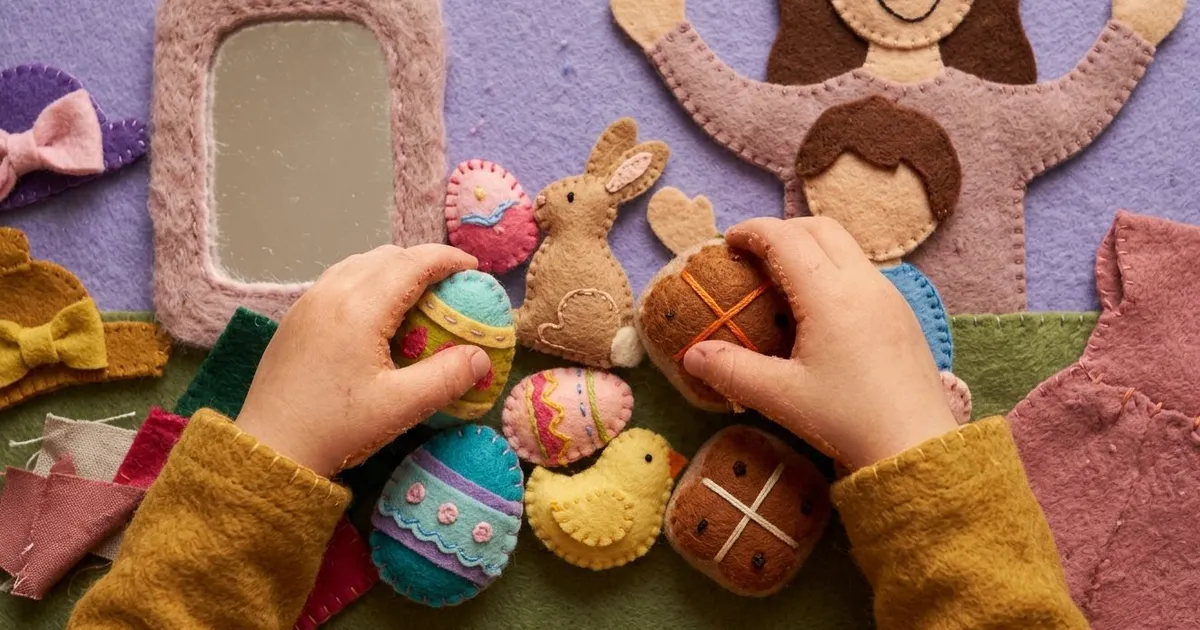
Easter Words in English for Kids: Vocabulary and Activities is a practical set of seasonal nouns, verbs, adjectives, and short phrases for conversation. Younger learners can start with concrete words such as “egg,” “bunny,” and “basket.” Older children can use phrases, instructions, and descriptions. Easter traditions vary across countries and families, so choose words matching your child’s experience. Children need not celebrate Easter to understand references to the spring holiday in class, books, and media.
📥 Easter Words in English for Kids
Learn, understand, and use cheerful Easter vocabulary.
Leave your email — we'll send the PDF to your inbox.No spam — the PDF plus one short reminder. Unsubscribe anytime.
Core Easter Words and Phrases
Begin with objects and animals your child can see in pictures or handle during play. Add verbs after the nouns become familiar. Then introduce describing words to build fuller sentences: “a spotted egg,” “a full basket,” or “a small yellow chick.”
Treat Easter Words in English for Kids: Vocabulary and Activities as a menu, not a test. A 5-year-old may learn six familiar nouns; an older learner can sort words by grammar, compare traditions, and use them in a short story.
Using Easter Vocabulary in Context
Teach each word inside a short sentence. Instead of showing “basket” alone, say, “This is a basket,” followed by, “The blue egg is in the basket.” Children hear the article, word order, and location phrase without a grammar lecture. Change one element at a time: “The red egg is under the basket.”
Short exchanges put vocabulary into practice. Ask, “What can you see?” The child can answer, “I can see three eggs.” Try “Where is the bunny?” with “The bunny is behind the box,” or “Which egg do you like?” with “I like the green spotted egg.” Older children can explain a sequence: “First we decorated the eggs. Then we hid them in the garden.”
- “Can you find the yellow egg?” — “Yes, it is under the chair.”
- “What is in your basket?” — “Two eggs and a card.”
- “What is the chick doing?” — “It is coming out of the egg.”
- “How does your family mark Easter?” — “We have lunch with our relatives.”
Activities for Different Ages
Choose tasks by language level and age. A multilingual 7-year-old may understand complex ideas but need short English sentence frames. A first-time online learner may benefit from movement and real objects before reading or writing. To adapt Easter Words in English for Kids: Vocabulary and Activities, keep the language goal steady while adjusting the support.
Across LearnLink lessons, our tutors can use pictures, gestures, guided questions, and sentence frames. At home, follow the same pattern: show the meaning, model the phrase, let the child try, and revisit it later instead of correcting every detail.
Simple Practice at Home
A short routine turns Easter Words in English for Kids: Vocabulary and Activities into language your child can recall. Practise for five to ten minutes, then reuse the words while drawing, cooking, walking, or playing. Repetition in new settings strengthens recall more than repeatedly copying one word.
Try a picture sort with the headings “animal,” “object,” “action,” and “describing word.” Play “odd one out”: “egg, basket, chick, run.” Different answers work if the child explains the choice. For example, “Run is different because it is an action” demonstrates vocabulary knowledge and reasoning.
Make an Easter Clue Trail
Hide three paper eggs and give one English clue for each location: “Look under something soft,” “Find a place near a window,” or “Look behind a book.” The child must say, “I found the egg…” and name its location. Older learners can write clues for another family member.
Common Mistakes and Useful Corrections
Children may confuse “bunny” and “rabbit.” Both name the animal, but “bunny” is informal and child-friendly. A chick is a young chicken, not every small bird. Teach the differences through paired pictures instead of dictionary definitions.
Watch singular and plural forms: “one egg” but “two eggs,” and “one child” but “two children.” Practise location phrases too: an egg can be “in the basket,” “under the table,” or “behind the plant.” If your child says, “Egg under table,” respond with the full form—“Yes, the egg is under the table”—without stopping the game.
Write “Easter” with a capital letter because it names a holiday. “Easter Sunday” and “Good Friday” also take capitals. Cultural meaning needs care. Some families treat Easter mainly as a Christian observance; others focus on spring activities, food, or time together. Teach words your child will encounter while respecting your family’s beliefs and customs.
- Practice five Easter words with ages four to seven using picture cards.
- Use one storybook and pause twice to correct pronunciation gently.
- Try a three-minute egg hunt, naming each discovered object aloud.
- Model complete sentences before asking your child to repeat them independently.
- Review mistakes tomorrow with six cards, praising accurate words immediately.
When a word has several meanings or pronunciations, Cambridge Dictionary is a useful check before turning it into child-friendly examples.
Frequently Asked Questions
How Many Easter Words Should a Child Learn at Once?
For beginner school-age children, start with four to six words and reuse them in short games. Children may manage eight to twelve familiar words with pictures and sentence frames. Older learners can study a larger set, but recall matters more than list size. Add words after your child understands and uses most of the current set.
Can We Use Easter Vocabulary If Our Family Does Not Celebrate Easter?
Yes. Easter appears in school calendars, stories, shops, films, and conversations worldwide. Children can learn the words without joining a religious or cultural practice. Present the vocabulary as cultural knowledge, compare it with holidays your family observes, and ask your child to describe similarities and differences in English.
What Is the Best Way to Remember Easter Words?
Combine seeing, hearing, saying, and using each word. Easter Words in English for Kids: Vocabulary and Activities works when a child encounters the language in pictures, movement games, questions, and short sentences. Review after a day and later in the week. Mix old and new words so the child recalls meaning instead of following a fixed order.
Should I Correct Every Vocabulary or Grammar Mistake?
No. Correct errors that block meaning or involve the target language. During a fast game, repeat the child’s idea correctly: if they say, “Two yellow egg,” answer, “Yes, two yellow eggs.” Request repetition only when the target form needs focused practice. Frequent interruptions can discourage a hesitant learner, so keep feedback brief and calm.
Start your child's English journey today — book a trial lesson with LearnLink.
Stay updated on our latest tips and resources by following us on Instagram LearnLink.