Folk Song in English for Kids
A folk song in english for kids is one of the oldest and most effective tools for language learning — and it works precisely because it was never designed as a lesson. Folk songs carry rhythm, repetition, and real everyday vocabulary in a package children absorb without noticing they are studying. Across LearnLink lessons, our tutors consistently see that children who sing regularly pick up pronunciation patterns and sentence structures faster than those who rely on textbooks alone. Whether your child is four or fourteen, there is a song that matches exactly where they are right now.
📥 Folk Song Phrase Cards for Kids
A printable word-and-action set for learning English through traditional children’s songs.
Leave your email — we'll send the PDF to your inbox.No spam — the PDF plus one short reminder. Unsubscribe anytime.
Why Folk Songs Speed up English Learning
Children's brains process music and language through overlapping pathways. When a child hears and repeats a folk song in english for kids, they are not just memorising lyrics — they are internalising stress patterns, vowel sounds, and natural sentence rhythm. This happens long before they can explain what any of it means.
Repetition is the key mechanism. A child who hears "Old MacDonald Had a Farm" twenty times in a week will know, without being told, that "had" is past tense and that animal names in English rarely carry an article. The song teaches grammar the way native speakers absorb it: through exposure, not rules.
Our tutors use folk songs precisely because they lower the stakes. A child who freezes during a speaking exercise will often sing without hesitation. The melody acts as a scaffold — it carries the words until the child is ready to own them independently.
Choosing the Right Folk Song by Age
Age matters more than most parents realise. A folk song in english for kids aged four to six should be short (under two minutes), built on a single repeating structure, and packed with concrete nouns — animals, colours, body parts. "Head, Shoulders, Knees and Toes" and "The Wheels on the Bus" fit perfectly because a child can act out the meaning physically while singing, linking word to action.
For ages seven to ten, slightly more complex narratives work well. Songs like "She'll Be Coming Round the Mountain" or "This Land Is Your Land" introduce place names, simple verb tenses, and a broader emotional range without losing the musical hook that keeps children engaged.
Older children — eleven and up — benefit from folk songs with story arcs. Ballads and sea shanties that carry a plot give teenagers something to think about beyond the melody, and they open doors to cultural conversations about English-speaking history, geography, and social themes.
A Practical Guide to Well-Known English Folk Songs for Children
Some folk songs have survived for generations because they do something right for young listeners. The table below groups a selection by age and language focus, so you can match a song to what your child needs most right now.
No single song fits every child. Pay attention to which songs your child returns to voluntarily — that unprompted repetition is where the real language acquisition happens.
How to Use Folk Songs at Home Without Running a Formal Lesson
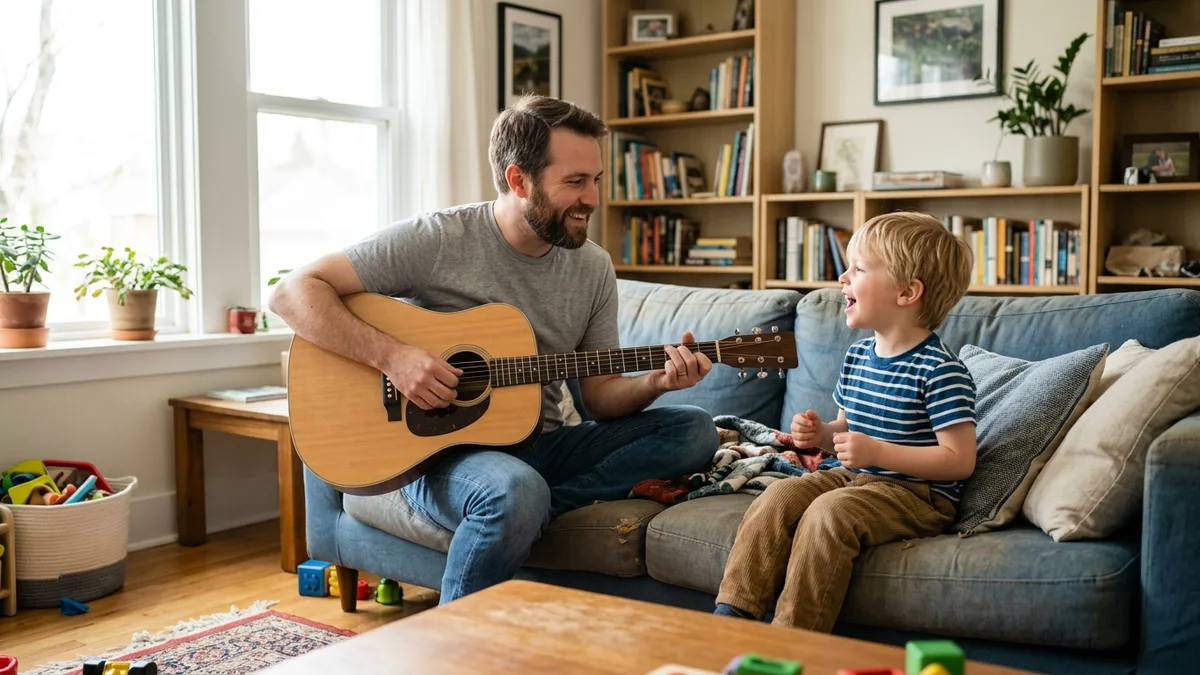
You do not need to set up a classroom. The most effective use of a folk song in english for kids at home is casual and consistent. Play a song at breakfast, in the car, or before bed. Do not test your child on the lyrics. Let the song be part of the background until your child starts singing along without being prompted.
Once they know the melody, add one small step: point to the objects named in the song. If your child is singing about a farm, gather pictures or toy animals and name them in English as they come up in the lyrics. This connects sound to meaning — exactly how our tutors structure early vocabulary work across LearnLink lessons.
For older children, try a listening retell: play the song once, then ask your child to tell you what it is about in their own words — in English if they can, or mixing languages if they need to. Do not correct their grammar. Just let them produce language around a topic they already understand musically. That act of retelling stretches vocabulary range in a low-pressure way.
Three Features That Make a Folk Song Work for Language Learning
Not every folk song in english for kids is equally useful for language development. Three features predict how well a song will serve a young learner.
First, clear diction. Songs with very fast tempos or heavy regional accents can confuse children who are still building their phonics awareness. Choose recordings where individual words are easy to hear. A clean arrangement — voice and one instrument — usually beats a dense production.
Second, repetition with variation. Songs that repeat a chorus but change one element per verse (different animals in "Old MacDonald", different parts of the bus in "Wheels on the Bus") train children to hold a sentence frame stable while swapping vocabulary. That is a core skill in early language acquisition — and it transfers directly to speaking.
Third, a singable pulse. If a child cannot feel the beat, they cannot lock onto the words. Most traditional folk songs have a strong, predictable rhythm precisely because they were passed down orally — and that quality, developed long before anyone thought about language pedagogy, turns out to be ideal for young learners.
Try This at Home: The Swap Game
Pick a folk song your child already knows well — one with a repeating verse where a single word changes each round. Sing it through once normally together. On the second round, swap one key word for a silly alternative ("Old MacDonald had a spaceship") and see if your child catches the change. Once they do, let them be the one who swaps the word. This game builds vocabulary range, sharpens listening attention, and — most importantly — gives your child a reason to sing the same song another ten times.
When a word has several meanings or pronunciations, Cambridge Dictionary is a useful check before turning it into child-friendly examples.
Frequently Asked Questions
At What Age Should My Child Start Listening to Folk Songs in English?
Any age is fine, but the earlier the better. Babies and toddlers respond to melody long before they understand words, so casual exposure from infancy is natural and harmless. For intentional language learning, ages three to five is when children begin connecting song lyrics to meaning. A folk song in english for kids at this stage should be short, highly repetitive, and ideally paired with movement or pictures so the words gain concrete meaning.
How Many Songs Should My Child Be Working on at One Time?
One or two at a time is enough. Depth matters more than breadth here. A child who knows three songs very well — who can sing them from memory, understands what the words mean, and can use some of that vocabulary in conversation — has made more genuine progress than a child who has listened to thirty songs once each. Across LearnLink lessons, our tutors typically introduce a new song every two to three weeks for this reason.
Do Folk Songs Work for Children Who Already Speak Two or Three Languages?
They often work even better. Multilingual children are already comfortable with the idea that the same object has different names in different languages, and they are naturally attuned to new sound systems. A folk song in english for kids who already speak, for example, French and Hebrew gives them a melodic entry point that sidesteps translation entirely — the tune carries meaning before the words are fully decoded, which is a skill multilingual children have already practised.
My Child Only Wants to Listen and Will Not Sing. Should I Be Concerned?
Not at all. Silent listening is still active processing. Most children move naturally from listening to humming to partial singing to full, confident singing — the timeline varies, but the sequence is consistent. Do not push your child to perform. The song will come on its own, usually when you least expect it.
Can Folk Songs Replace a Structured English Programme?
Songs build phonics awareness, vocabulary, and an ear for English rhythm — but they do not replace structured conversation practice or reading. Think of them as a daily supplement, not a full curriculum. Across LearnLink lessons, our tutors use songs as warm-up and reinforcement activities alongside speaking, listening, and reading work. The two approaches support each other.
Start your child's English journey today — book a trial lesson with LearnLink.
Stay updated on our latest tips and resources by following us on Instagram LearnLink.