Materials Vocabulary for Kids
Materials in English for Kids: Words and Activities teaches material names, properties, sentence patterns, and games for describing objects. Children start with familiar items such as a wooden table, metal spoon, or cotton shirt, then compare texture, weight, strength, and flexibility. Instead of memorising lists, they handle safe objects and use each word in a sentence.
📥 Materials Vocabulary Practice Pack
Learn, describe, and use everyday materials in context
Leave your email — we'll send the PDF to your inbox.No spam — the PDF plus one short reminder. Unsubscribe anytime.
Core Materials Vocabulary
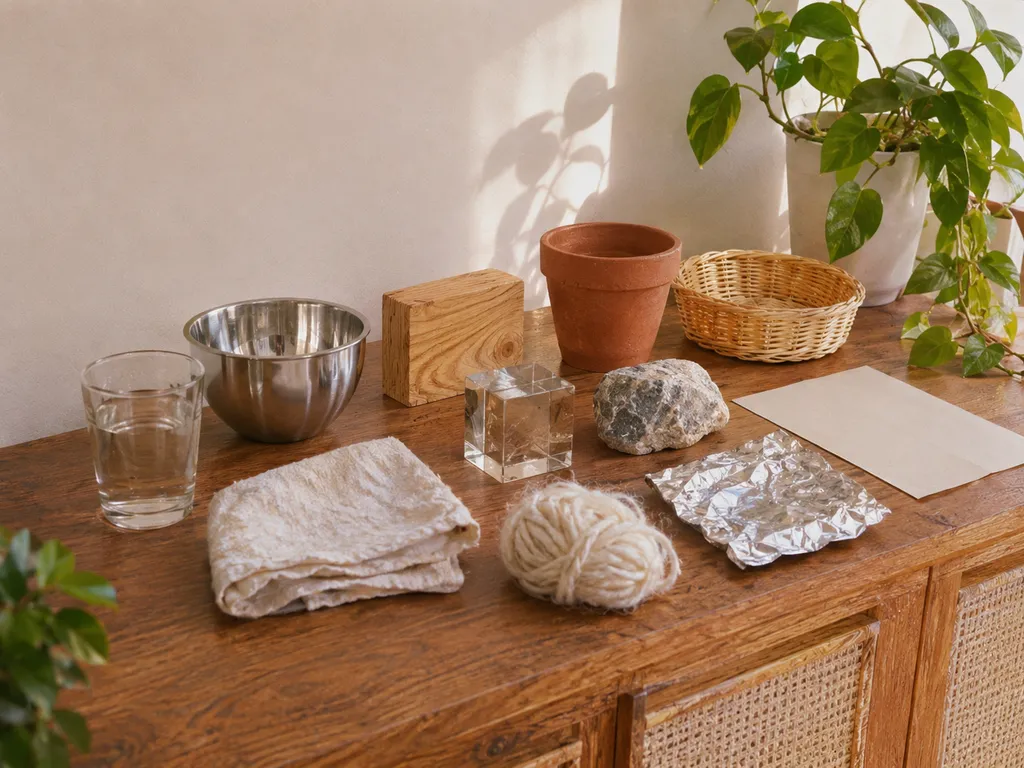
Materials in English for Kids: Words and Activities should begin with objects your child can see and touch. Start with four to six materials, adding more after your child names them without prompts. First words include wood, metal, plastic, glass, paper, fabric, rubber, stone, and clay.
Older or more confident learners can add cardboard, cotton, wool, leather, ceramic, and concrete. Property words expand each noun: hard, soft, smooth, rough, heavy, light, strong, weak, stiff, flexible, transparent, opaque, waterproof, and absorbent.
Properties depend on the object and its production. Plastic may be stiff in a ruler but flexible in a bag. Glass is hard yet breakable. Encourage careful comparisons, not fixed rules.
Useful Phrases and Examples in Context
Materials in English for Kids: Words and Activities works best when each noun enters a short sentence frame. Begin with “It is made of…”, “They are made of…”, and “This feels…”. Children can point and speak: “The spoon is made of metal.” “The box is made of cardboard.” “This blanket feels soft.”
Add questions that demand observation: “What is it made of?”, “Is it smooth or rough?”, “Can it bend?”, and “Is it heavy or light?” A child might answer, “The window is made of glass. It is hard, smooth, and transparent.” For comparison: “Rubber is more flexible than wood.”
Children aged 9 and above can explain suitability: “The raincoat is made of waterproof fabric, so it keeps water out.” They can discuss mixed objects: “The scissors have metal blades and plastic handles.” This corrects the idea that every object contains one material.
Quick tip Request one noun and one property per answer. “It is plastic” names the material; “It is light and flexible” demonstrates understanding.
Activities for Different Ages
For school-age kids, place four safe household objects on a table. Name each material, ask your child to repeat it, and sort objects into groups such as hard and soft. Avoid sharp, hot, or breakable items. Finish with two frames: “It is made of…” and “It feels…”.
For school-age kids, try a mystery-object game. Hide an object in a bag and give property clues: “It is soft, flexible, and made of cotton.” Your child guesses, then creates clues. For a materials hunt, find one wooden object, two plastic objects, and something containing more than one material.
For school-age kids, assign a design task. Ask your child to select materials for a lunch box, sports bag, or model shelter and defend each choice. They can compare strength, weight, cost, comfort, and likely use without declaring one material superior. LearnLink tutors can adapt the task through sentence length and explanation depth.
Simple Ways to Practise During the Week
A Materials in English for Kids: Words and Activities routine needs five minutes. Revisit the words across different days while changing the task. First name objects, then compare properties. Later, describe an unseen object.
In a multilingual home, your child may know the concept in another language. Let them confirm meaning in their strongest language, then return to a short English frame. The goal is an accurate English sentence, not excluding other languages.
Weekly materials checklist
- Choose four to six material words.
- Find one safe object for each material.
- Practise “made of” with singular and plural objects.
- Add at least two property words.
- Compare two objects in a complete sentence.
- Review the words again after a short gap.
Keep a word card for any hard-to-recall material. Write the material on one side and a sentence on the other. Pictures can support younger learners, but speaking remains the main practice.
Try a One-minute Material Challenge
Choose one room. Your child finds three objects, names each material, and adds one property: “The door is made of wood. It is hard and smooth.” Award one point for each complete, accurate sentence.
Common Mistakes and How to Correct Them
Children may confuse an object with its material. A bottle is an object; plastic or glass is its material. Model both: “This is a bottle. It is made of glass.” Children may say “made from metal” for a spoon. Start with “made of” when the material remains recognisable.
Use “made from” when the original substance changes: “Paper is made from wood.” Children may mix noun and adjective forms. We say “It is made of wood” but “It is a wooden box.” In adjective order, the material stays near the noun: “a small round wooden table.”
Materials myths and facts
Myth: Every object is made of one material.
Fact: Objects can combine materials, such as scissors with metal blades and plastic handles.
Myth: One property always describes every form of a material.
Fact: The same material may be stiff, flexible, smooth, or rough depending on production.
Children may confuse glass as a material with a glass as a container. Compare “The window is made of glass” and “There is a glass on the table.” These contrasts teach meaning and grammar together.
- Choose five material words and label matching household objects together.
- Read one picture book, pausing to identify wood, metal, plastic, and fabric.
- Sort six objects by material, then say each complete sentence aloud.
- Correct one mistake gently by modeling the word instead of demanding repetition.
- Review yesterday’s cards, mixing familiar materials with two newer words.
When a word has several meanings or pronunciations, Cambridge Dictionary is a useful check before turning it into child-friendly examples.
Frequently Asked Questions
How Many Material Words Should My Child Learn at One Time?
Start with four to six words for a younger or first-time learner. Choose materials in familiar objects, such as wood, metal, plastic, paper, cotton, and glass. An older child may handle a larger set, but recall matters more than list size. Materials in English for Kids: Words and Activities should progress from naming to describing, comparing, and explaining. Add words after your child uses the earlier ones in sentences.
What Is the Difference Between “Made of” and “Made From”?
Use “made of” when the finished object retains a recognisable material: “The chair is made of wood.” Use “made from” after greater transformation: “Paper is made from wood.” Young learners can start with “made of” for everyday descriptions. Introduce “made from” through short contrasts instead of a long grammar explanation.
Can My Child Use Another Language While Learning Material Words?
Yes. A child who understands a material or property in another language already knows the concept. A quick translation or comparison can confirm meaning. Then request an English response such as “The towel is made of cotton” or “Metal is heavier than paper.” This respects multilingual knowledge while maintaining the speaking goal.
How Can We Practise Materials Without Worksheets?
Use household objects. Sort safe items by material, play a mystery-object game, compare two surfaces, or find something soft, waterproof, or transparent. During a walk, notice stone walls, metal gates, wooden benches, and concrete paths. Ask one focused question at a time. Short spoken tasks require no printing or special equipment.
A short one-to-one lesson can show what level and pace fit your child — book a trial English lesson.
Stay updated on our latest tips and resources by following us on Instagram LearnLink.