Measurement Words in English for Kids
Measurement Words in English for Kids: Vocabulary and Activities covers vocabulary for length, height, weight, capacity, temperature, and time. Children start with questions such as “What is its length?”, “How heavy is it?”, and “How much does it hold?” They then learn centimetres, metres, grams, kilograms, millilitres, litres, and degrees. Instead of memorising every unit, connect each term with an object, comparison, and measuring tool.
📥 Measure It! Words, Questions, and Units
A practical measurement worksheet for young English learners
Leave your email — we'll send the PDF to your inbox.No spam — the PDF plus one short reminder. Unsubscribe anytime.
Core Words and Phrases
Begin with six concepts: length, height, weight, capacity, temperature, and time. Children need describing words too: long, short, tall, heavy, light, full, empty, hot, cold, fast, and slow. Young learners can compare objects with these words before adding numbers.
Teach metric units in small groups. Use centimetre and metre for length or height; gram and kilogram for weight in everyday speech; millilitre and litre for capacity; and degree Celsius for temperature. Children may encounter inches, feet, ounces, pounds, and degrees Fahrenheit in books, recipes, or conversations from other countries. Present them as additional systems, not replacements.
Use these word cards to pair each term with a complete example.
The rope has a length of two metres.
The height of the door is two metres.
The bag’s weight is three kilograms.
This jug has a capacity of one litre.
The temperature is 20 degrees Celsius.
The game takes ten minutes.
The pencil measures 15 centimetres.
The table measures one metre.
The apple weighs 150 grams.
The parcel weighs three kilograms.
The cup holds 250 millilitres.
The bottle holds one litre.
Practise complete questions: “What is its length?”, “How tall are you?”, “How heavy is the bag?”, “How much water does the bottle hold?”, “What is the temperature?”, and “How much time does it take?” Teach Measurement Words in English for Kids: Vocabulary and Activities through these phrases, not isolated nouns.
Choosing the Right Question and Unit
The object and purpose determine the question. Ask about a person’s or building’s height, but a pencil’s, road’s, or string’s length. Capacity describes how much a container holds. Temperature describes how hot or cold something is. Time may mean a clock reading or an activity’s duration.
During LearnLink lessons, our tutors model a question, invite an estimate, and check it with a tool. A child might say, “I think the book is 25 centimetres long,” before using a ruler. The sequence gives each term a purpose and turns mistakes into discussion.
Measurement Examples in Context
Say a complete sentence after each measurement: “The table measures one metre,” “This box is heavier than that box,” or “The cup holds 250 millilitres.” For time, use “The song lasts three minutes” or “It takes five minutes to tidy the desk.” Keep the number, unit, and object together.
Comparison words support speech before children can read a scale. Place two safe objects together and ask which is longer, shorter, taller, heavier, or lighter. Ask which container holds more or less. Older children can cite evidence: “The blue bottle holds more because its capacity is 750 millilitres.”
Teach singular and plural forms through contrast: “one metre” but “two metres”; “one minute” but “ten minutes.” Unit abbreviations have no plural ending, so write “2 kg,” not “2 kgs.” Everyday speakers say an object “weighs two kilograms.” In science lessons, older learners may encounter the exact distinction between mass and weight.
Activities for Different Ages
Measurement Words in English for Kids: Vocabulary and Activities should develop with the learner. For school-age kids, start with direct comparisons and spoken words. Compare two objects’ lengths, find a short object, and identify something heavy and something light. Pour water between plastic cups while using full, half-full, and empty.
For school-age kids, introduce rulers, kitchen scales, measuring jugs, timers, and recording sheets. A child can estimate a pencil’s length, measure it, and report the result aloud. A home “measurement hunt” might cover a book, table, water bottle, and the time needed to walk between two rooms.
For school-age kids, assign tasks requiring a unit choice and short explanation. Learners can compare two recipes, convert metres to centimetres, or calculate how much water several bottles hold. Introduce different measurement systems when relevant, then label each unit to prevent mixing systems.
Simple Ways to Practise at Home
Practise Measurement Words in English for Kids: Vocabulary and Activities during routines involving quantities. While cooking, read grams, millilitres, minutes, and temperature from a recipe. When packing, compare heavy and light items. During a walk, estimate distance and time. Keep each English task short: one question, one measurement, and one full answer.
A guessing game needs no worksheet. Choose an object and give clues: “It is shorter than the table,” “It weighs less than a book,” or “It holds about one litre.” The child identifies the object and creates new clues. The game develops measurement language, comparison forms, and listening.
Estimate, Measure, Explain
Choose three household objects. For each one, estimate a length or weight, select a suitable unit, and measure safely. Complete the sentence: “I estimated ___, but the actual measurement was ___.” Finish with one comparison, such as “The notebook is five centimetres longer than the pencil case.”
Common Mistakes and Helpful Corrections
Children may choose a possible but impractical unit, such as measuring a room in millimetres. Ask which larger unit fits the object better, then let the child choose again. This builds judgement without adding another fact to memorise.
Children may confuse long, tall, and high. People are usually tall, horizontal objects are long, and something above the ground may be high. Model the natural phrase: “The shelf is high, the cupboard is tall, and the shelf measures one metre from end to end.”
Avoid correcting every grammar and measurement error at once. If the goal is choosing units, address the unit first. Then recast the sentence: Child: “It is three metre.” Adult: “Yes, it is three metres long.” The child hears the plural and complete pattern while focusing on meaning.
- Practice comparing three household objects by length with children ages six to eight.
- Use a ruler to measure five books and correct unit mistakes together.
- Ask your child to explain why centimeters fit pencils better than meters.
- Try a guessing game with four containers, then check capacity using cups.
- Praise accurate comparisons and gently restate errors with the correct measurement word.
When a word has several meanings or pronunciations, Cambridge Dictionary is a useful check before turning it into child-friendly examples.
Frequently Asked Questions
Which Measurement Words Should a Child Learn First?
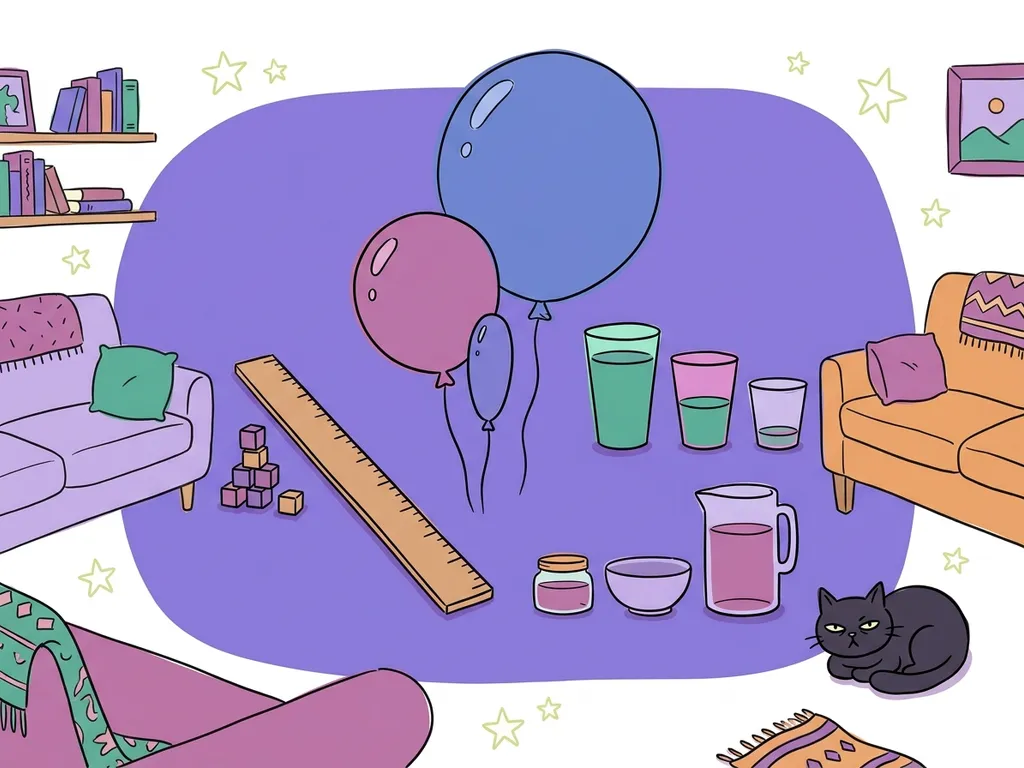
Measurement Words in English for Kids: Vocabulary and Activities works best with contrasts: long and short, tall and low, heavy and light, full and empty, hot and cold, fast and slow. Next, teach “What is its length?”, “How tall?”, “How heavy?”, “How much?”, and “How much time does it take?” Add units when your child can connect them to an object or action.
Should Children Learn Metric or US Customary Units?
Start with the system used at school and home. Metric units are widespread, while US customary units often appear in American books, media, and recipes. Children can learn both over time, but each activity should use one system. Label centimetres, metres, inches, kilograms, and pounds to prevent accidental mixing.
How Can a Child Practise Without Special Equipment?
Use comparisons, body movements, containers, and a phone timer. Your child can find something longer than a shoe, carry one light and one heavy object, compare two cups, or time an action in seconds. Non-standard units work too: measure a table in hand spans or a rug in footsteps, then compare different people’s answers.
What Should I Do If My Child Guesses the Wrong Measurement?
Treat an estimate as a prediction, not a test answer. Ask your child to explain the number and unit, then measure together. Compare the estimate and result in a full sentence: “My estimate was too high” or “The actual length was close to my estimate.” This focuses attention on reasoning, vocabulary, and accurate tool use instead of immediate correctness.
Apply the vocabulary in three steps:
- Start with one contrast, such as heavy and light.
- Practice one question and one complete answer each day.
- Try an estimate, measure the object, and explain the result.
Start your child's English journey today — book a trial lesson with LearnLink.
Stay updated on our latest tips and resources by following us on Instagram LearnLink.