Phrases with “Get” for Kids
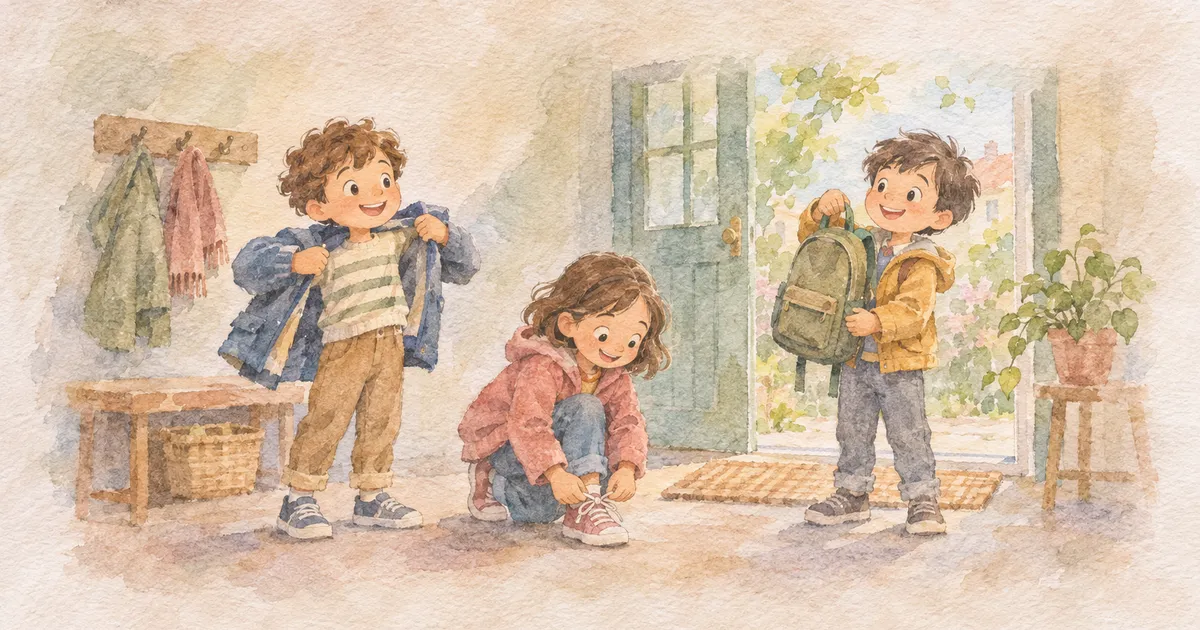
Five patterns explain “get”: get + noun means receive; get + adjective marks change; get + place expression marks arrival; get + particle forms a phrasal verb; get + to + verb shows opportunity. Phrases with “Get” for Kids: A Practical Guide connects each pattern to routines, travel, feelings, and school. Practise three examples daily, then change the subject, tense, or destination.
What Children Need to Understand About “Get”
“Get” has distinct jobs. “I get a message” means receive. “We get hungry after swimming” means become. “They get to class at eight” means arrive. The surrounding words reveal the intended meaning.
Use Phrases with “Get” for Kids: A Practical Guide as a reference map. Teach one meaning with two familiar examples. A younger child can act out “get up” and “get dressed.” An older child can sort “get a book,” “get nervous,” and “get to school” under receive, change, or arrival.
Translation can mislead bilingual learners. Pair each phrase with an event: receiving a parcel, changing weather, or reaching a station.
These groups guide meaning rather than provide fixed translations. Ask, “What is changing, received, or reached?” The answer identifies the correct sense.
How the Main Grammar Patterns Work
Before a noun, “get” can mean receive, obtain, bring, or fetch: “I got an email,” “Can you get your coat?” and “We need to get some water.” Its past form is “got,” never “getted”: “She got a sticker yesterday.”
Before an adjective, “get” describes change. “The soup gets cold” means it changes from warm to cold. Examples include get tired, get hungry, get wet, get angry, improve, and get lost. Phrases with “Get” for Kids: A Practical Guide groups examples by meaning so children recognise the idea of change.
Place expressions follow specific forms: “get to the park,” “get to class,” and “get to the station.” Yet “get home,” “get here,” and “get there” omit “to.” Teach these three forms as complete chunks.
Quick teaching tip
State a situation before the target wording: “The rain starts. We get wet.” Context makes the grammar visible and easier to recall.
Useful Phrases for Daily Life
Begin with routines: get up, get dressed, get ready, get washed, and get into bed. Arrange them by time: “I get up, get dressed, eat breakfast, and get ready for school.” Children can point or mime while speaking.
Travel combinations reflect movement. We get on and off a bus, train, bicycle, or plane. We get in and out of a car or taxi. Destinations take “get to”: “How do we get to the library?” Home omits “to”: “We got home late.”
Choose five expressions from the child’s week. Repeat them during routines, then vary each sentence. Changing the subject, time, or place builds flexible use without changing the core meaning.
Four phrase families
- Morning routine Get up, get dressed, and get ready before breakfast.
- Travel Get in the car, get on the bus, and arrive safely.
- Feelings and states Get excited, get tired, get cold, or get upset.
- Learning Get an answer, get help, and get better through practice.
How to Adjust Practice for Different Ages
For children, combine actions, objects, and one short contrast. Hold out a book for “get a book,” pretend to wake for “get up,” and put on a coat for “get dressed.” Let the child copy each item before finishing a sentence.
Children can sort examples under receive, become, arrive, and action. Next, change the tense: “I get tired after football,” “I got tired yesterday,” and “I will get tired if I stay up late.” The time changes; the meaning stays stable.
Older children can study less literal phrasal verbs. “Get along with” means have a good relationship; “get over” can mean recover from illness or a difficult event. Present each expression in a full sentence because the particle changes its meaning.
Myths and facts about “get”
Myth: Every use of “get” has one direct translation.
Fact: Its meaning comes from the noun, adjective, place expression, or particle that follows it.
Myth: Children must learn every “get” phrase together.
Fact: Small groups linked to familiar situations are easier to understand and practise accurately.
Common Mistakes and How to Correct Them
Learners often add “to” before home, here, or there. Say “We got home,” because these three place words omit “to.” Named destinations usually require it: “We got to the museum before lunch.”
Transport patterns cause confusion. Use “get on” for a bus, train, plane, or bicycle: transport we can stand, walk, or ride on. Use “get in” for a car or taxi. Their opposites are “get off” and “get out of.”
Another error is reading every phrase literally. “Get better” means improve or recover, not collect something named “better.” If word-by-word meaning sounds strange, read the full sentence and identify the result. Phrases with “Get” for Kids: A Practical Guide builds this phrasal-verb habit.
Practice Activities with Answers
Practise in three stages: choose between two forms, complete a gap, then create a true sentence about school, travel, or feelings.
Choose the Correct Form
1. We get on / get in the train at nine. 2. Please get on / get in the car. 3. They got to home / got home before dinner. 4. My shoes got wet / got a wet in the rain.
Answers: 1. get on; 2. get in; 3. got home; 4. got wet.
Ask the child to explain each choice briefly. An explanation distinguishes pattern knowledge from guessing.
Complete the Sentences
Use get, gets, getting, or got. 1. I ___ a message yesterday. 2. The sky is ___ dark. 3. What time do you ___ home? 4. Your English ___ better with steady practice.
Answers: 1. got; 2. getting; 3. get; 4. gets.
Return to Phrases with “Get” for Kids: A Practical Guide later and repeat the task with new subjects and times. Change “I get ready at seven” to “They got ready at eight.” This tests the construction and verb form.
Make It Personal
Finish these prompts with true or imaginary details: I get up at ___. I get to school by ___. I get excited when ___. Yesterday, I got ___. After practice, I get better at ___. Read each sentence aloud and check whether “get” matches the intended meaning.
When a word has several meanings or pronunciations, Cambridge Dictionary is a useful check before turning it into child-friendly examples.
Frequently Asked Questions
How Many Phrases with “Get” Should a Child Learn at Once?
Start with three to five expressions from one familiar setting, such as the morning routine. Practise them through speech, actions, and short sentences before adding a new group. Pace depends on age, attention, and prior English experience. Accurate use outweighs a long weekly list.
Why Does “Get” Have So Many Meanings?
“Get” combines with nouns, adjectives, places, and particles, which change its meaning. “Get a gift” means receive; “get cold” means become; “get there” means arrive. Phrases with “Get” for Kids: A Practical Guide teaches children to read the complete combination instead of translating “get” alone.
Should My Child Use “Get” in Formal Writing?
“Get” sounds natural in conversation and everyday writing. Formal school work may need a precise verb: “receive a certificate” instead of “get a certificate,” or “become tired” instead of “get tired.” First teach meaning, then adjust word choice to the setting.
What Is the Difference Between “Get” and “Got”?
“Get” is the base and present form: “I get home at five” and “They get ready quickly.” “Gets” follows he, she, or it: “She gets tired.” “Got” marks the past for every subject: “We got home late.” “Getting” describes an action or change in progress.
How Can I Practise These Phrases Without Worksheets?
Use routine comments: “Get your coat,” “We are getting ready,” or “What time did we get there?” Play mime games, sort expression cards by meaning, or correct a deliberately wrong sentence. Keep practice brief and require a new example for each phrase.
A short one-to-one lesson can show what level and pace fit your child — book a trial English lesson.
Stay updated on our latest tips and resources by following us on Instagram LearnLink.