Adverbs of Time and Place for Kids
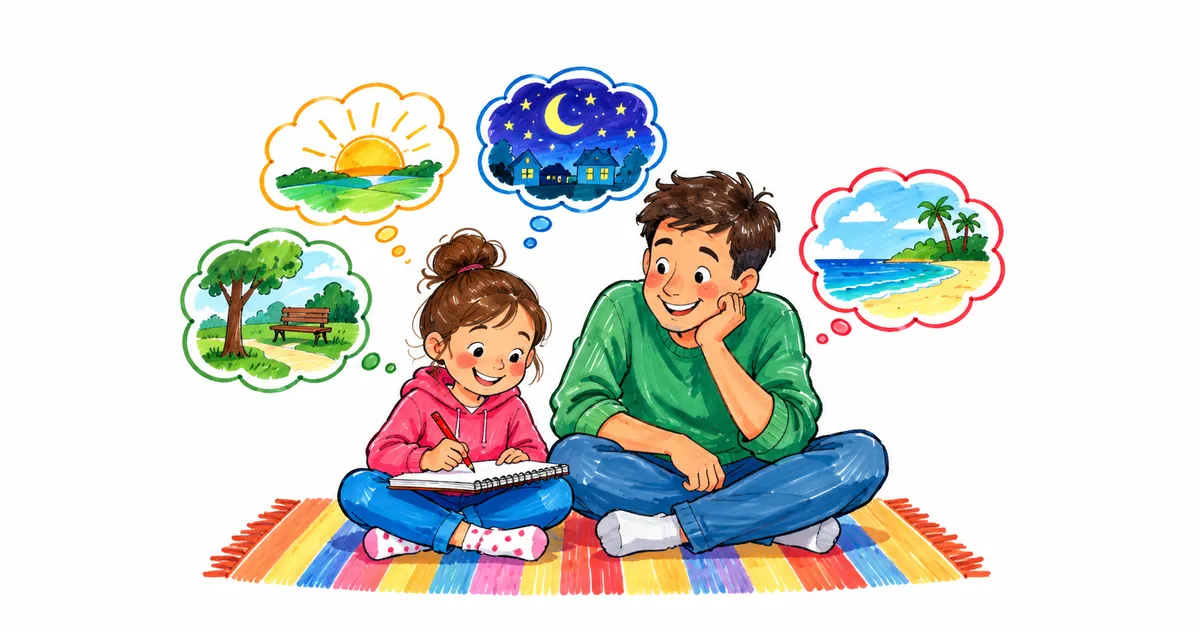
Adverbs of time tell us when or how often an action happens; adverbs of place tell us where it happens. Adverbs of Time and Place for Kids: A Practical Guide explains the difference through rules, examples, and practice. “We are leaving tomorrow” points to time; “Your shoes are downstairs” points to place. By asking “When?” and “Where?”, children can identify adverbs and make sentences more precise.
📥 Time and Place Adverb Practice Pack
Learn where and when actions happen, then practise building clear sentences.
Leave your email — we'll send the PDF to your inbox.No spam — the PDF plus one short reminder. Unsubscribe anytime.
What Children Need to Understand First
An adverb adds information to a verb, adjective, another adverb, or clause. Start with verbs. In “The children play outside,” “outside” tells us where they play. In “The children play today,” “today” tells us when.
Ask two questions: “When does it happen?” and “Where does it happen?” “Now,” “later,” “yesterday,” and “often” answer time questions. “Here,” “there,” “nearby,” and “upstairs” answer place questions.
When using Adverbs of Time and Place for Kids: A Practical Guide at home, begin with speech. Give an action: “The cat is sleeping.” Ask your child to add time or place: “The cat is sleeping now” or “The cat is sleeping upstairs.”
How These Adverbs Work in a Sentence
Time adverbs often appear at the end: “We will visit Grandma tomorrow.” Move one to the beginning to emphasise time: “Tomorrow, we will visit Grandma.” A longer opening phrase may need a comma.
Place adverbs often follow the verb or object: “Please sit here” and “Put the book there.” In “She carried the box upstairs,” “the box” stays beside the verb and “upstairs” follows it.
Adverbs of Time and Place for Kids: A Practical Guide separates single adverbs from phrases with the same function. “Outside” and “in the garden” answer “Where?” “Yesterday” and “after lunch” answer “When?” Children can use both forms before learning their formal labels.
Useful Rules and Examples
Adverbs of Time and Place for Kids: A Practical Guide follows three steps: identify the action, ask the right question, and find its answer. In “Our lesson starts soon,” “soon” answers “When?” In “Our lesson happens online,” “online” answers “Where?”
Frequency adverbs belong to the time group. “Always,” “usually,” “often,” “sometimes,” “rarely,” and “never” show how often an action happens. They come before most verbs: “We often read together.” They follow “be”: “The children are often cheerful.”
Meaning matters more than position. “Home” describes place in “We went home”; “today” describes time in “We stayed home today.” One sentence can contain both types, each answering a different question.
Putting Time and Place in the Same Sentence
When a sentence contains place and time, place often comes first: “We played in the park yesterday.” “In the park” answers “Where?” and “yesterday” answers “When?”
Time can move forward for emphasis: “Yesterday, we played in the park.” Its function stays unchanged. Word order is not an unbreakable formula; it reflects what the speaker stresses.
Across LearnLink lessons, our English tutors practise this skill through questions, movement, and descriptions. A tutor might ask, “Where is the pencil now?” or “When will you finish the picture?” The child chooses an adverb that adds specific information.
Common Mistakes and How to Correct Them
A frequent mistake is placing a frequency adverb between a verb and object: “She reads often books.” Write “She often reads books.” The adverb may appear later without an object: “She reads often.” Teach the standard pattern first, then introduce alternatives found in real texts.
Children may confuse adjectives and adverbs. “Quick” describes a noun in “a quick walk”; “quickly” describes the action in “He walked quickly.” Time and place adverbs may lack “-ly.” “Today,” “here,” and “outside” remain adverbs when they describe an action.
Adverbs of Time and Place for Kids: A Practical Guide helps prevent repetition. “Yesterday, we went outside yesterday” repeats the time. Keep one marker: “Yesterday, we went outside.” Ask whether every word adds information.
Practice Activities for Home or Lessons

Short tasks let children focus on meaning before spelling or punctuation. Begin orally with younger learners. Older children can write sentences and explain whether each answer expresses time or place.
Choose the Correct Adverb
Complete each sentence with one word from this set: outside, tomorrow, here, often, upstairs.
1. Please put your bag ____.
2. We will bake a cake ____.
3. The children are playing ____.
4. My brother is waiting ____.
5. We ____ listen to music after dinner.
Answers: 1. here, 2. tomorrow, 3. outside, 4. upstairs, 5. often.
After checking, ask your child to classify each answer as time, frequency, or place. Classification tests meaning rather than sentence rhythm.
Move the Time Expression
Rewrite each sentence with the time expression at the beginning.
1. We are visiting the library on Saturday.
2. The class will begin after lunch.
3. They played a word game yesterday.
Answers: “On Saturday, we are visiting the library.” “After lunch, the class will begin.” “Yesterday, they played a word game.”
Moving a time expression shows how position can change without changing function. Read both versions aloud and compare their emphasis.
Add Time and Place
Expand each short sentence by adding one time expression and one place expression.
1. The dog is sleeping.
2. We will meet.
3. My sister practises English.
Possible answers: “The dog is sleeping upstairs now.” “We will meet at the station tomorrow.” “My sister practises English at home every evening.” Other clear answers are also correct.
For a movement game, hide objects around a room and give clues: “The red pencil is nearby” or “Look upstairs later.” Your child finds the object, identifies the adverb, and creates a new clue. The game connects grammar with space and time.
For the rule wording, Wikipedia — English Grammar is a useful reference while the practice examples here stay adapted for children.
Frequently Asked Questions
What Is the Easiest Way to Explain Adverbs of Time and Place?
Start with “When?” and “Where?” Adverbs of Time and Place for Kids: A Practical Guide uses this distinction because children can apply it to familiar actions. In “We are eating now,” “now” answers “When?” In “We are eating outside,” “outside” answers “Where?” Introduce formal terms after your child recognises the difference.
Can One Sentence Contain Both Types of Adverb?
Yes. “The children played outside yesterday” includes place and time. “Outside” says where they played; “yesterday” says when. Place often precedes time at the end, but time can move forward for emphasis: “Yesterday, the children played outside.”
Are Phrases Such as “In the Kitchen” Adverbs?
“In the kitchen” is a prepositional phrase working as an adverbial, not a single adverb. It answers the same “Where?” question as a place adverb. Primary-age learners can group forms by function; older learners can distinguish adverbs from adverbial phrases.
Where Should Frequency Adverbs Go?
Frequency adverbs such as “often,” “usually,” and “never” generally precede most verbs: “Your child often reads aloud.” They follow “be”: “Your child is often ready early.” Expressions such as “every day” and “once a week” often appear at the end: “We practise every day.”
How Much Practice Does a Child Need?
A few focused examples work better than a long worksheet without discussion. Ask your child to describe daily actions with one time or place detail, then combine both. During reading, find the verb, ask “When?” or “Where?”, and explain what the answer adds.
Start your child's English journey today — book a trial lesson with LearnLink.
Stay updated on our latest tips and resources by following us on Instagram LearnLink.