English Board Game Vocabulary for Kids
Board game English for children has three parts: game objects, action verbs, and turn-taking phrases. English Board Game Vocabulary for Kids: Words and Activities teaches practical language such as “Roll the die,” “Move forward,” and “Whose turn is it?” Start with words required to play, then add phrases as confidence grows. Children need not memorise a long list first. They learn language by making choices, following rules, and speaking with other players.
Core Board Game Words and Phrases
Begin with nouns your child can see and touch. Point to each object while naming it, then teach the verbs needed for one turn. The table groups vocabulary by purpose, helping you select words for the game.
Use English Board Game Vocabulary for Kids: Words and Activities as a working set, not a test list. Four or five new items suit one game. Introduce “Your turn,” “My turn,” “Miss a turn,” and “Start again” during the first session because children need them often.
Before the game begins
- Name the board, cards, pieces, and die.
- Practise the two main action verbs.
- Say one complete model turn aloud.
- Check that your child understands the goal.
- Place a short phrase list beside the board.
Using the Words in Context
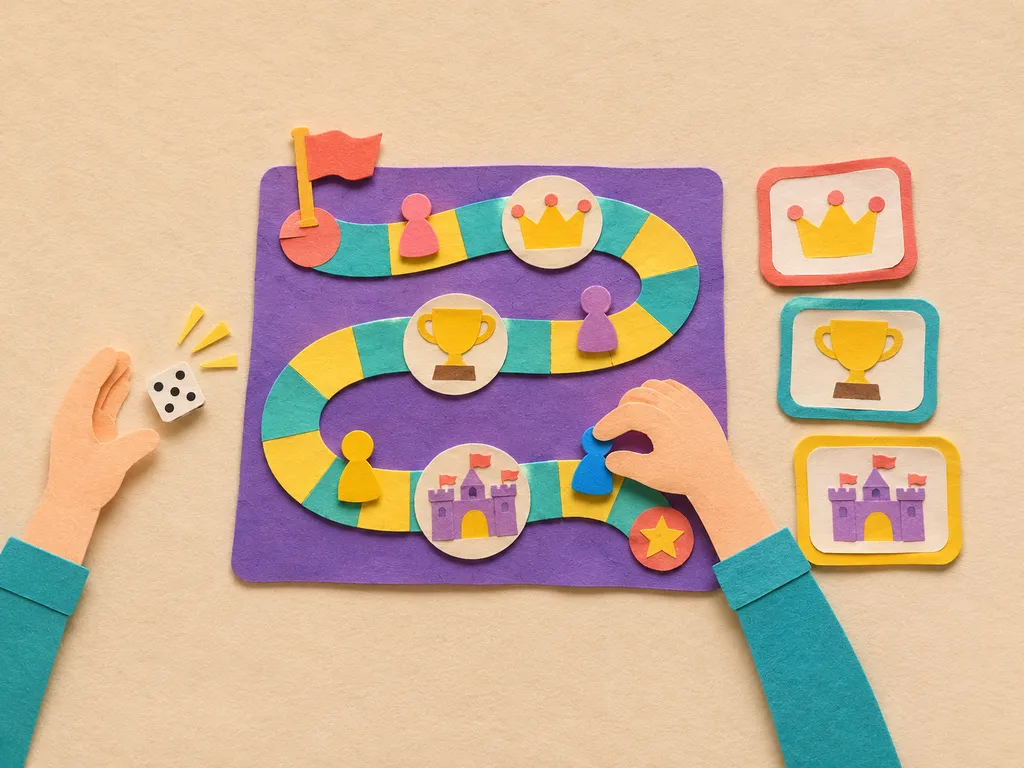
Words become practical when they move the game forward. Instead of drilling “die, piece, space,” connect them: “Roll the die. Move your piece three spaces.” Your child hears the action sequence and copies the complete instruction.
Model short exchanges. One player asks, “Whose turn is it?” Another answers, “It’s my turn.” Repair phrases include “Can you say that again?”, “Which one?”, “Do I move forward or back?”, and “What does this rule mean?”
Vocabulary from English Board Game Vocabulary for Kids: Words and Activities should grow with the game. A beginner may say, “Blue card, please.” A confident learner can say, “I would like the blue card because it completes my set.” Both responses serve a real purpose.
Board game language: myth and fact
Myth: Children must learn every word before they can play.
Fact: They can begin with core words and learn more through repeated turns.
Myth: Correct grammar matters more than keeping the game moving.
Fact: Communication comes first; brief corrections can follow the turn.
Activities for Different Ages
For school-age kids, use picture matching, colour paths, and movement games. Give one instruction at a time: “Pick one,” “Find the cat,” or “Move two spaces.” Encourage repetition, but accept pointing or one-word answers while the language is new.
For school-age kids, add choice and prediction. Before rolling, ask, “What number do you need?” After drawing, ask, “Will you keep it or trade it?” Children can become the caller, instructing players and checking whose turn comes next.
For school-age kids, use strategy games requiring reasons, plans, or negotiation. Players can explain, “I moved here to block that path,” or “I will trade this card for two tokens.” Multilingual families may discuss complex rules in a shared home language, then repeat game actions in English.
Practice Ideas That Fit into Family Time
For English Board Game Vocabulary for Kids: Words and Activities, follow a preview, play, and review rhythm. Preview five items, practise them during a short game, then recall three phrases after packing the board away.
The Silent-turn Challenge
Play one turn without speaking. Then your child describes each action in order: “I rolled a four, moved four spaces, and picked up a card.” Award one point for each correct action phrase.
Change one part of a familiar game instead of introducing a new game each time. Your child might name each number rolled, describe picture cards, or ask a full question before moving. Familiar rules preserve attention for speaking.
Keep correction brief: repeat the correct phrase naturally, then return the turn to your child.
During LearnLink lessons, our tutors can model language through game-like tasks, prompt fuller answers, and adjust difficulty. Parents can follow this pattern at home: provide a model, supply a missing word, then gradually withdraw support.
Common Mistakes and Simple Fixes
A frequent mistake is teaching isolated nouns. A child may know “piece” and “token” but cannot take a turn in English. Pair each noun with an action: “draw from the pile,” “place a token,” “shuffle the deck,” and “move your piece.”
Another mistake is stopping play after every error. If your child says, “I move three yesterday,” respond to the meaning: “Yes, you moved three spaces.” The response models correct English without creating a grammar test. Correct errors only when they block understanding or concern the target phrase.
Avoid changing the rules and language target together. Teach a new game with basic English, or practise harder speech through a familiar game. Stop while attention remains strong, and record two or three phrases for the next session.
- Choose five board-game words and review each meaning before starting play.
- Model one complete sentence, then ask your child to repeat it.
- Correct one mistake gently by restating the phrase and inviting another try.
- Use picture cards for three confusing words: dice, pawn, and turn.
- Praise accurate word use, then reuse the same vocabulary next round.
For the rule wording, British Council LearnEnglish Kids is a useful reference while the practice examples here stay adapted for children.
Frequently Asked Questions
How Many Board Game Words Should My Child Learn at Once?
Start with four or five new words or phrases for one game. Treat English Board Game Vocabulary for Kids: Words and Activities as a menu, not a weekly target. Repeat “my turn,” “roll the die,” and “move forward” in every session. Add items after your child uses earlier language with little prompting.
Should I Correct Every English Mistake During a Game?
No. Correct errors that prevent understanding or concern the target phrase. For smaller mistakes, repeat the sentence correctly and continue playing. If your child says, “She move two,” answer, “Yes, she moves two spaces.” The exchange remains natural while modelling correct grammar.
Can Board Games Help a Child Who Is New to Online English Lessons?
Yes. Board games give new learners a visible goal, repeated turns, and predictable phrases. These features reduce the new information handled at once. Begin with a familiar game, teach the English required for one turn, and support unfamiliar rules with gestures or home-language explanations.
What Can We Use If We Do Not Own English Board Games?
Use any suitable board game your family owns. Printed text need not be English when players supply spoken phrases. You can draw a paper path, add numbered spaces, and use coins as counters. Picture cards, building blocks, or matching pairs support the same verbs and turn-taking questions.
For your next practice session, follow these three steps:
- Choose five useful words or phrases.
- Play for 10 minutes and model each phrase when needed.
- Ask your child to say three complete phrases without prompting.
Start your child's English journey today — book a trial lesson with LearnLink.
Stay updated on our latest tips and resources by following us on Instagram LearnLink.