English Game Phrases and Activities for Kids
English Phrases for Playing Games: Words and Activities for Kids is a practical set of short expressions children can use during board games, team games, playground play, and digital games. Start with phrases that serve an immediate purpose: “Your turn,” “Can I play?” and “I won!” A child does not need a long word list before joining a game. Six to ten useful phrases are enough for the first session. Say each phrase, show its meaning through an action, and use it in several rounds. The game supplies a clear reason to listen, speak, and repeat.
Core Words and Phrases for Game Time
Begin with language for joining, taking turns, following rules, and responding to a result. These functions appear across cultures and game types. They also help children move beyond naming objects. A child who knows “ball” gains more speaking power from “Pass me the ball, please.”
Use English Phrases for Playing Games: Words and Activities for Kids as a menu, not a script. Choose one row from the table for a first lesson. Add another group only when your child can understand the earlier phrases during play.
Teach tone as well as meaning. “Give me the card” may sound sharp, while “Pass me the card, please” works well in friendly play. Children also need calm language for losing: “Good game,” “Maybe next time,” and “Let’s play again.”
Putting the Phrases into Practice Through Play
A phrase becomes useful when it is tied to a visible action. Hold the dice and ask, “Whose turn is it?” Hand them over after the answer. Move a counter while saying, “Move forward two spaces.” The object, gesture, and words support one another.
During a team game, model a short exchange: “Are you ready?” “Yes, let’s go!” Later, add choices such as “Pass to me,” “Over here,” and “Which way?” In a card game, useful exchanges include “Pick a card,” “Do you have a blue one?” and “I need one more.”
The examples in English Phrases for Playing Games: Words and Activities for Kids work because each line changes what happens next. Avoid stopping every round for a grammar explanation. Model the correct phrase, let play continue, and return to the form after the game if the same error keeps appearing.
Activities for Different Ages
For school-age kids, use movement and no more than four target phrases at once. Try a colour hunt with “Find something red,” “Over here,” “I found it,” and “Your turn.” A simple action game can practise “Jump,” “Stop,” “Turn around,” and “Try again.” Keep rounds short enough for the child to remember the language goal.
For school-age kids, board games, matching games, and guessing games allow fuller exchanges. One player asks, “Is it an animal?” or “Can it fly?” The other answers, “Yes, it can,” “No, it can’t,” or “Have another guess.” Children can also explain one rule before play begins.
For school-age kids, use strategy and negotiation. Ask players to agree on team roles, defend a choice, or change a rule in English. Useful phrases include “I agree,” “I have another idea,” “What if we…?” and “That seems fair.” Older learners may enjoy designing a short game and writing its instructions for another player to test.
Practice That Builds Confident Recall
Start with recognition. Say “Pick a card,” and let your child perform the action. Then reverse roles so the child gives the instruction. This move from listening to speaking lowers the load and makes meaning clear without translation.
For a five-minute routine, place six phrase slips beside a familiar game. A player takes one slip and must use that phrase naturally before the round ends. Reuse the same set on several days. Replace two phrases at a time rather than changing the whole set.
Try the Missing-phrase Challenge
Read these prompts aloud and let your child complete them: “It’s my ___.” “Whose ___ is it?” “Pick a ___.” “Good ___!” “Let’s play ___.” Accept a correct phrase, then use it in the next round of a real game.
Keep English Phrases for Playing Games: Words and Activities for Kids close to games your family already knows. Familiar rules leave more attention for language. Across LearnLink lessons, our tutors can also adjust the number of phrases, the pace, and the speaking demand to suit a child’s age and current English.
Common Mistakes and Simple Corrections
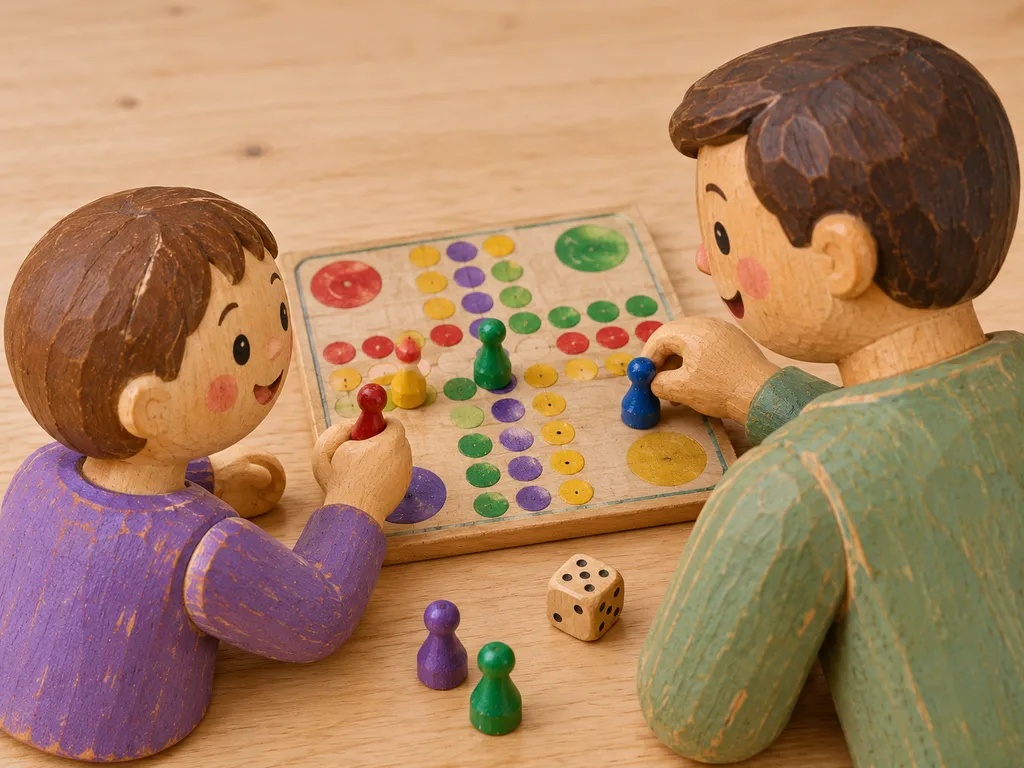
One common mistake is teaching too many isolated words. A list such as “dice, card, counter, score” helps with recognition but does not show a child how to participate. Pair each noun with an action: “Roll the dice,” “Pick a card,” “Move your counter,” and “What’s the score?”
Another mistake is correcting every sentence while the game is moving. Constant pauses can make a child speak less. If the meaning is clear, repeat the phrase correctly and continue: Child: “Me turn.” Adult: “Yes, it’s your turn.” Save a short review for the end.
Be careful with phrases that depend on the game or family culture. “You’re out” may be correct in one game and needlessly harsh in another. Teach neutral options such as “This round is over,” “You can join the next round,” or “Let’s check the rule.” Clear language and respectful play should develop together.
- Practice "English Phrases for Playing Games: Words and Activities for Kids" daily for 5-10 minutes with your child.
- Use real-life examples to reinforce learning — count toys, snacks, steps.
- Review progress weekly together with your child.
- Build vocabulary through repeated exposure in different contexts.
For the rule wording, British Council LearnEnglish Kids is a useful reference while the practice examples here stay adapted for children.
Frequently Asked Questions
How Many Game Phrases Should a Child Learn at One Time?
For a beginner, start with four to six phrases linked to one familiar game. Keep the same phrases for several rounds and bring them back on another day. When your child can respond without a prompt, add one or two new expressions. Older or more experienced learners may handle a larger set, but useful repetition matters more than the size of the list.
Should We Translate Every Phrase into Our Home Language?
Translation can help when a phrase is unclear, but it should not replace action and context. Show “Roll the dice” while rolling, or demonstrate “Move back one space” with a counter. In a multilingual family, a brief translation may save time. Then return to English so the phrase becomes connected to the game action rather than only to another language.
Which Games Are Best for Practising Spoken English?
Choose games with repeated turns, visible actions, and simple choices. Matching cards, guessing games, scavenger hunts, movement games, and many board games work well. Cooperative games are useful when competition makes a child quiet or upset. The best choice is a game your child understands and wants to play, because familiar rules create more room for speaking.
Can Beginners Use These Phrases Before They Know Much Grammar?
Yes. English Phrases for Playing Games: Words and Activities for Kids treats short expressions as complete tools for communication. A beginner can use “My turn,” “Try again,” or “Can I play?” before understanding every grammar rule inside them. Model the full form, respond to the meaning, and avoid demanding a grammar explanation. Accurate patterns can grow through repeated, purposeful use.
Want to see how these ideas work in a real lesson — try a LearnLink trial lesson.
Stay updated on our latest tips and resources by following us on Instagram LearnLink.