School Building Vocabulary for Kids
School Building Vocabulary for Kids: English Words and Activities teaches place names, people words, and phrases for navigating school. Children learn classroom, library, corridor, playground, teacher, and principal, then ask “Where is the gym?” or “May I go to the library?” Start with places seen each week; add people, directions, and requests. Each word serves a purpose, while older children can describe their school in detail.
Core Words and Phrases
Begin with eight to ten words from your child’s school or lesson materials. Use School Building Vocabulary for Kids: English Words and Activities as a phrase bank, not a spelling test. Build understanding and speech before reading and spelling.
The table groups school building vocabulary by function. Two regional forms appear where countries use different English terms.
Teach the local term first, then its alternative. Knowing lift and elevator helps multilingual children understand books, videos, and classmates from different places.
Using the Words in Context
School Building Vocabulary for Kids: English Words and Activities works when words become directions and descriptions. Pair each place with an action: read in the book area, eat in the cafeteria, exercise in the gym, and play in the playground. Action phrases stick better than isolated words.
Connect two or three places: “The music room is next to the office.” “The gym is behind the cafeteria.” “Go through the entrance and turn left.” Younger children can point while speaking; older learners can add floor numbers, landmarks, and reasons for each visit.
Practise questions and statements. One person asks, “Where is the science room?” The other answers, “It is upstairs, opposite the cafeteria.” The exchange covers school places, prepositions, and polite speech.
Activities for Different Ages
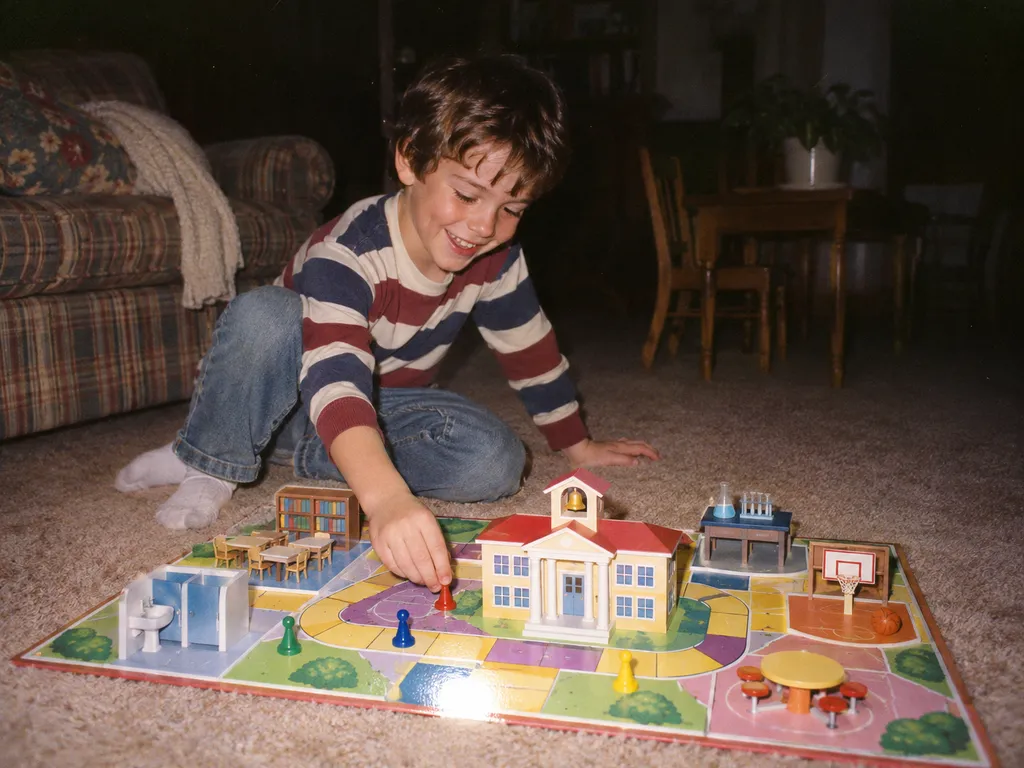
For school-age kids, use a toy figure and a floor plan with four places. Say, “Go to the classroom,” and let your child move the figure. Then swap roles. Focus on listening, pointing, and one short phrase.
For school-age kids, draw a school map together. Add a science room, gym, office, playground, and two classrooms. Ask for directions between places. Increase the challenge by moving one room or hiding a label.
For school-age kids, compare two school layouts, plan an ideal school, or explain an emergency route from a classroom to an exit. Request reasons: “The art room should be near the courtyard because pupils need space to carry materials.”
Practice Ideas for Home and Online Lessons
Turn School Building Vocabulary for Kids: English Words and Activities into a five-minute routine. On one day, label a map; on the next, give directions. Later in the week, describe a real or imagined school without the vocabulary list.
Three-clue School Challenge
Choose a school place without naming it. Give three clues: its purpose, location, and contents. For example: “We read there. It is next to the office. It has shelves.” Your child answers, “It is the library,” then gives the next clues.
Add movement. Place room cards around your home and give a route: “Start at the entrance, pass the office, and stop at the gym.” During online lessons, our LearnLink tutors can match map tasks to a child’s reading level and prompt complete answers.
Review through varied tasks instead of repeating cards. Use each word in a drawing, spoken clue, direction game, and short description to strengthen meaning and recall.
Correcting Common Mistakes
Children may confuse class and classroom. A class is a group of pupils or a lesson; a classroom is the room. Model both: “Our class has twelve pupils. Our classroom has twelve desks.”
Children may learn a place without its preposition. Practise in the cafeteria, on the first floor, next to the office, and opposite the gym. A map and two examples teach more than a long grammar talk.
Regional school words are not errors. Hallway and corridor, elevator and lift, principal and head teacher, or restroom and toilet may all be understood. Teach the school’s term first, then an alternative for wider understanding.
- Choose five school-building words and ask your child to label matching pictures.
- Model each word clearly, then have your child repeat it in a sentence.
- Contrast commonly confused places, such as classroom, library, cafeteria, and gym.
- Correct one mistake gently by repeating the full sentence with accurate vocabulary.
- Review the five words using a simple matching game with homemade cards.
When a word has several meanings or pronunciations, Cambridge Dictionary is a useful check before turning it into child-friendly examples.
Frequently Asked Questions
How Many School Building Words Should a Child Learn at Once?
Start School Building Vocabulary for Kids: English Words and Activities with six to ten words. Younger learners may need fewer words, movement, and pictures. Older children can handle a larger set grouped by purpose. Add vocabulary after your child understands and uses most of the first set in short phrases.
Should Children Learn British and American School Words?
Teach the word used at school, in a course, or in the community. Introduce an alternative found in books or media. Children need not use both in every answer; they should recognise lift and elevator while speaking consistently.
Is It Better to Teach Single Words or Full Sentences?
Start with one word, then build a phrase. “Gym” becomes “in the gym,” then “We exercise in the gym.” This manageable progression shows how English works. “Where is the gym?” gives children a reason to answer.
How Can a Multilingual Child Practise Without Translating Every Word?
Show meaning with a map, gesture, picture, or action before translating. Ask your child to point, move a figure, or follow a route. Translate only when meaning remains unclear. Direct links between English phrases and visible places speed understanding. For the next seven days, choose six place words, practise them for five minutes, and request one complete direction each day.
Start your child's English journey today — book a trial lesson with LearnLink.
Stay updated on our latest tips and resources by following us on Instagram LearnLink.