Sleep and Bedtime Vocabulary for Kids
English Sleep and Bedtime Vocabulary: Activities for Kids gives children words for the routines, objects, feelings, and actions linked to sleep. Begin with phrases your child can use that evening, such as “put on your pyjamas,” “turn off the light,” and “I feel sleepy.” Add new words in small groups, then practise them through movement, pictures, and short conversations. Older children can describe habits, dreams, and sleep problems in detail. Multilingual children may already know these ideas in another language, so connect English to familiar routines instead of teaching each word in isolation.
Core Words and Phrases for Bedtime
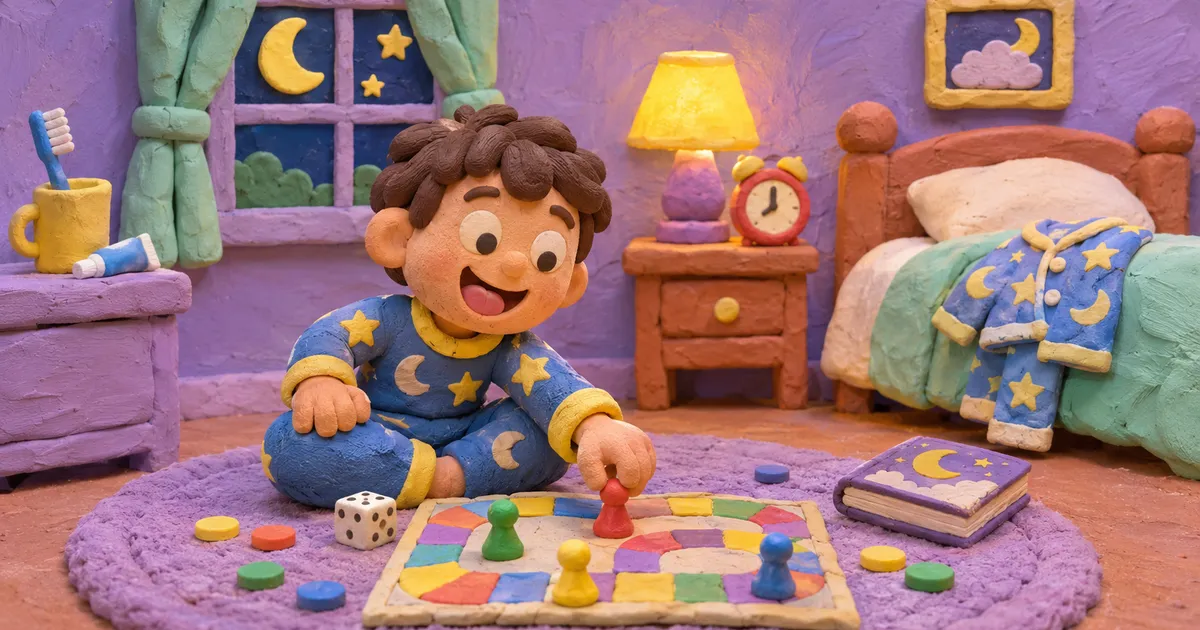
Start with four groups. Routine actions include yawn, brush your teeth, wash your face, put on your pyjamas, get into bed, and turn off the light. Bedroom objects include bed, pillow, blanket, sheet, mattress, night-light, and alarm clock. Let your child touch, point to, or act out each item.
The English Sleep and Bedtime Vocabulary: Activities for Kids guide also needs words for feelings and sleep itself: tired, sleepy, awake, asleep, dream, nightmare, rest, nap, bedtime, and morning. Teach whole phrases alongside single words: “I am tired,” “It is time for bed,” “I had a dream,” and “Please tuck me in.” A usable phrase is easier to remember than a word learned without context.
Using Bedtime Words in Context
A few expressions look alike but describe different moments. We go to bed when we lie down for the night, but we go to sleep when sleep begins. We wake up when we stop sleeping and get up when we leave the bed. Children grasp these differences faster by acting out the sequence.
Build a short exchange once the meanings are clear: “Are you tired?” “Yes, I am. I am going to bed.” Then change one part at a time: “Are you sleepy?”, “Is the light on?”, or “Where is your blanket?” The grammar stays steady while the bedtime vocabulary changes.
For children who can read, write three linked sentences: “I put on my pyjamas. I brush my teeth. Then I get into bed.” Older learners can add reasons and time links: “Before I go to sleep, I set my alarm because I need to wake up early.”
Activities for Different Ages
In this English Sleep and Bedtime Vocabulary: Activities for Kids guide, activities change with the learner’s age and attention span. For school-age kids, use a bedtime action game. Say “yawn,” “pull up the blanket,” or “close your eyes,” and let your child perform the action. Reverse the roles after a few turns so your child gives the instructions.
For school-age kids, make picture-and-phrase pairs. One card might show a pillow, while its partner says “Put your head on the pillow.” Mix the cards and ask your child to find each pair. You can place three routine pictures in the wrong order and ask, “What comes first?” and “What comes next?”
For school-age kids, use a routine interview or sleep diary. Ask about bedtime, morning habits, dreams, and differences between school days and weekends. Learners can compare answers: “I go to bed earlier than my brother.” Across lessons, our experienced LearnLink tutors adjust such tasks to the child’s language level rather than age alone.
Short Practice Ideas for Home
Use the English Sleep and Bedtime Vocabulary: Activities for Kids material in a five-minute routine, not a long test. Choose four or five expressions and reuse them for a few evenings. A parent might ask, “What do you need?” The child answers, “I need my blanket.” The same exchange can later include a pillow, night-light, glass of water, or alarm clock.
Try a missing-item game during the day. Put a pillow, blanket, book, and toy near the bed, then ask your child to close their eyes. Remove one object and ask, “What is missing?” For speaking practice, let the child describe its place: “The book was next to the pillow.”
Bedtime Detective
Read these clues aloud: “You put your head on it,” “It rings in the morning,” and “You may see one while you sleep.” Your child answers “pillow,” “alarm clock,” and “dream.” Next, ask your child to create three clues for you. Accept a clear description even when the grammar is not yet perfect, then repeat the answer in a correct full sentence.
Review the same language away from bedtime. Sort words into “before sleep,” “during sleep,” and “after sleep,” or create a six-step routine with drawings. At the end of the week, ask your child to retell the sequence without looking. If a word is forgotten, give a gesture or first sound before supplying the answer.
Common Mistakes and How to Correct Them

Children often say “I am sleep” instead of “I am sleepy” or “I am asleep.” Show the contrast with actions: a child rubbing their eyes is sleepy; a child with closed eyes is asleep. Use “sleep” as a verb in “I sleep for eight hours” and as a noun in “I need more sleep.”
Another frequent mix-up is “go to sleep” versus “go to bed.” Draw a timeline with getting into bed first and falling asleep later. Likewise, separate “wake up” from “get up.” A child can wake up, stay under the blanket, and get up ten minutes later.
Do not correct every sound while your child is speaking. Choose one point, model it, and continue the exchange. Multilingual learners may carry sound patterns or word order from another language — a normal part of learning. Meaning and confident use come first; pronunciation and grammar can be refined through repeated models.
- Practice five bedtime words tonight using a picture book your 4-year-old already loves.
- Use a simple routine chart with pajamas, teeth, and bed icons labeled in English.
- Try a two-minute bedtime song repeating "sleepy," "pillow," and "blanket" every night this week.
- Correct mispronounced words gently by repeating the correct form, not by saying "no."
- Review yesterday's three new words before introducing one new bedtime term tonight.
When a word has several meanings or pronunciations, Cambridge Dictionary is a useful check before turning it into child-friendly examples.
Frequently Asked Questions
How Many Bedtime Words Should My Child Learn at Once?
For English Sleep and Bedtime Vocabulary: Activities for Kids, begin with four to six words or phrases that fit your child’s routine. A younger learner might practise bed, pillow, blanket, sleepy, and good night. An older learner can handle a larger set with expressions such as fall asleep, set the alarm, and sleep through the night. Add new language when your child can recall and use most of the first set.
Should We Practise Bedtime Vocabulary at Night?
Night-time practice makes the meaning clear because the objects and actions are present. Keep it calm and brief so language work does not delay sleep. Games with movement, writing, or competition work better earlier in the day. At night, use short questions, label familiar objects, or repeat a routine: “Brush your teeth, put on your pyjamas, and get into bed.”
What If My Child Already Knows These Words in Another Language?
Use that knowledge as a bridge. Ask your child to match ideas across languages, notice words that sound alike, and explain any difference in use. There is no need to hide the other language. The goal is to connect the English phrase to a clear meaning and situation. Encourage a full English sentence after the connection is made, such as “I put my blanket on the bed.”
How Can I Check Progress Without Giving a Test?
Watch what your child can do with the words. Can they follow “turn off the light,” name objects without a prompt, and describe their routine in order? Ask for a short retelling after a few days or let your child teach the words to you. Record which phrases appear without help. Independent use in a new sentence is a stronger sign of progress than repeating a memorised list.
Start your child's English journey today — book a trial lesson with LearnLink.
Stay updated on our latest tips and resources by following us on Instagram LearnLink.