Space Words in English for Kids
Space Words in English for Kids are nouns, verbs, and adjectives for discussing the sky, planets, and space travel. Start with five to eight terms: sun, moon, star, Earth, planet, rocket, and astronaut. Show an image, say the word in a sentence, and ask your child to repeat it. Add actions and phrases after the child names the first set unaided.
📥 Space Words in English for Kids
Core space vocabulary, short speaking phrases, and independent practice for home
Leave your email — we'll send the PDF to your inbox.No spam — the PDF plus one short reminder. Unsubscribe anytime.
Core Words and Phrases
Start with words a child can picture. The six groups progress from visible sky objects to space travel. Younger children can study the first two; older learners can cover the full set.
Teach connected groups, not random lists. Space Words in English for Kids stick when a child links rocket with launch, astronaut with spacesuit, and telescope with distant stars. These pairs support sentence building.
Add chunks such as “on the Moon,” “in a rocket,” “far from Earth,” and “look through a telescope.” Complete phrases help children speak sooner than isolated labels.
How to Introduce the Words at Home
Teach Space Words in English for Kids in small sets. Show three picture cards, name each image, and ask your child to point. Then point to an image and request the word. Stop while attention remains strong.
Review the words the next day before adding one or two. Use “Show me the planet,” then “What is this?” and “What does a rocket do?” The prompts progress from recognition to recall and sentence building.
A multilingual child may understand a concept before learning its English label. Connect each new word with existing knowledge. Another home language can support accurate, confident English.
Using Space Vocabulary in Context

Words become practical inside meaningful sentences. Practise Space Words in English for Kids with reusable patterns: “I can see a star,” “The rocket is fast,” and “The astronaut can float.”
Ask questions with varied answers. “What can you see in space?” invites a list. “Where is the astronaut going?” adds a place. “Why does the astronaut need a helmet?” requires a reason.
Build a description from one picture: “This is a rocket. It is white and red. It is ready to launch.” Accept the answer, then request one extra detail.
Activities for Different Ages
Adapt the space theme to each English level. Match the task to your child’s language skill and attention span.
A younger child can progress with five practised words. An older learner needs prediction, comparison, and explanation alongside labels. In one-to-one online English lessons at LearnLink, our tutors can adjust the prompt while retaining the space theme.
Practice Ideas That Build Speaking Skills
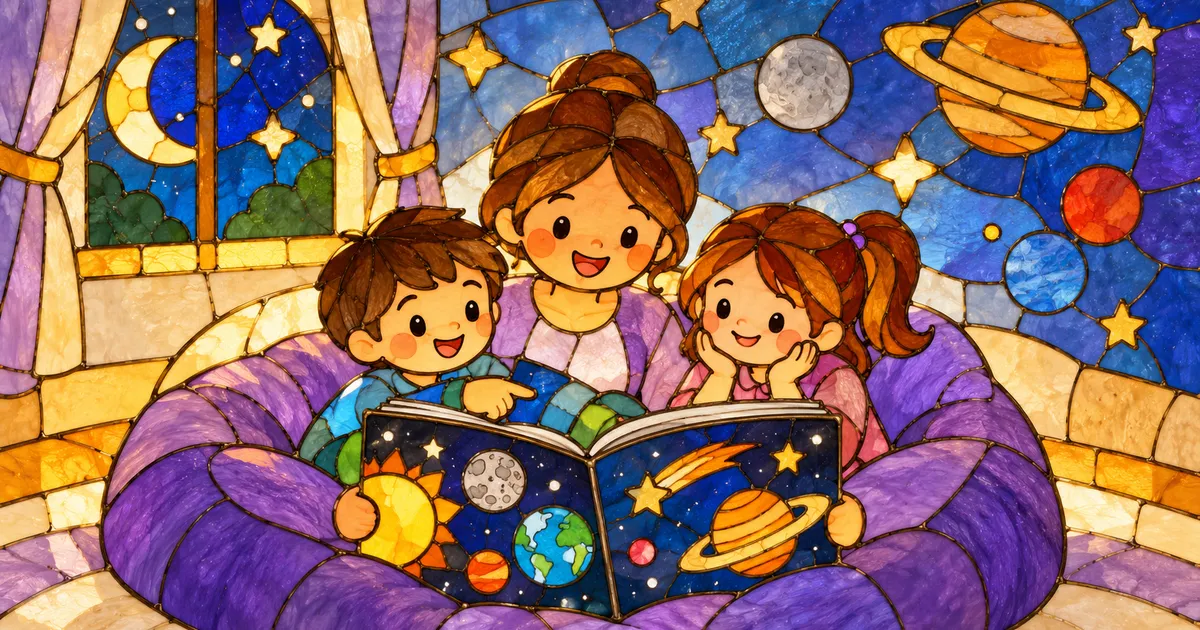
Use Space Words in English for Kids during play, drawing, and shared reading. Ask your child to draw a planet and describe its colour, size, weather, and inhabitants. An imaginary planet still demands precise English.
Mission Control Speaking Challenge
Choose five words from the table. Your child gives a two-sentence message using at least three. For example: “The rocket is ready to launch. The astronauts are going to the space station.”
Role-play gives each sentence a purpose. One person plays an astronaut; the other works at mission control. Ask “Are you ready?”, “What can you see?”, “Where will you land?”, and “What do you need?” Swap roles to practise asking and answering.
For review, play “Which word is missing?” Place six word cards on a table and read them together. Remove one while your child looks away. Ask for the missing card and a sentence using it.
Common Mistakes to Watch For
Children may say “a space” when they mean outer space. English uses space without an article in “Astronauts travel into space.” “A space” means an empty place, as in “There is a space beside the chair.”
Capital letters can change meaning. Earth names our planet, the Sun names the star at the centre of our solar system, and the Moon can name Earth’s moon. Other planets can have moons; distant systems can have suns.
Practise prepositions in complete phrases: “on the Moon,” “on Earth,” “in space,” and “into orbit.” During a game, note one error instead of interrupting each sentence. Model the correct phrase and review it after the child finishes.
- Practice five Space Words in English for Kids with flashcards today.
- Use picture cards to separate planets, stars, rockets, and astronauts clearly.
- Correct one pronunciation gently, then ask your six-year-old to repeat twice.
- Read a space picture book and check meanings before explaining new terms.
- Review four words at bedtime using a quick point-and-name game.
When a word has several meanings or pronunciations, Cambridge Dictionary is a useful check before turning it into child-friendly examples.
Frequently Asked Questions
How Many Space Words Should My Child Learn at One Time?
Begin with five to eight words. Space Words in English for Kids should fit a brief review and support at least one sentence. Keep the set until your child can recognise, name, and use most items unaided. Then add two or three words while reviewing earlier ones.
Should Our Tutors Teach Scientific Facts at the Same Time?
Yes, but keep each fact short and suitable for your child’s level. “Earth is a planet” gives the word meaning. Older children can explain or compare facts in longer sentences. Check detailed scientific claims in a trusted, current source before using them in lessons.
What If My Child Remembers the Words but Cannot Speak in Sentences?
Give a reusable sentence frame before requesting open speech. Try “I can see a ___,” “The ___ is moving,” or “An astronaut needs ___.” Model one answer, repeat the opening words, and pause. Withdraw the frame gradually as your child builds sentences independently.
How Often Should We Practise Space Vocabulary?
Practise for five to ten minutes on different days instead of holding one long session. Vary the task: point to pictures, describe a drawing, answer questions, or role-play a mission. Review older words after a break to retain them for speaking.
- Start with five to eight concrete words and one picture for each.
- Practice each word in a short phrase, question, and spoken sentence.
- Review the set on several days, then add two or three new items.
If your child needs steady speaking practice, start small — choose a trial lesson.
Stay updated on our latest tips and resources by following us on Instagram LearnLink.