Tips for Choosing English Teacher for a Child
Children under seven acquire language primarily through Total Physical Response and interactive play, which is why the most effective tips for choosing english teacher for a child focus on methodology rather than just a native accent. A successful match depends heavily on the tutor's experience with your child's specific age group and their approach to gentle error correction. You need an educator who maintains a dynamic pace to keep a young learner engaged for a full lesson. Here is exactly what to evaluate during your first trial session to ensure a productive fit.
📥 Trial Lesson Phrase Cards
Useful English phrases children can try with a new teacher during a first lesson
Leave your email — we'll send the PDF to your inbox.No spam — the PDF plus one short reminder. Unsubscribe anytime.
Why the Right Match Shapes More than Just Grades
A child who enjoys English lessons will practise outside them — humming a phrase, repeating a word from a show, correcting a sibling's sentence. That carry-over only happens when a teacher has built real confidence in the room. For learners between 4 and 8, confidence is the curriculum. No worksheet replaces a teacher who knows how to praise effort without sounding hollow, or pause long enough for a shy child to finish their own sentence.
For multilingual families — and many families joining LearnLink already speak two or three languages at home — the picture is slightly different. A child with two languages notices patterns and asks "why." A teacher who dismisses cross-language comparisons ("just don't think in French") shuts down a genuine asset. Good teachers let the child's home languages work as scaffolding rather than interference.
This is why the tips for choosing english teacher for a child that carry the most weight go beyond qualifications and accent. They reach into classroom behaviour: how a teacher listens, how they respond to a wrong answer, how quickly they spot frustration and adjust their approach.
Five Qualities Every Good Children's English Teacher Shares
Age-range experience is the first filter. A tutor who excels with teenagers may struggle to hold a 5-year-old's attention for 40 minutes, and the reverse is equally true. Ask directly: how many years have they worked with your child's specific age group? Concrete examples reveal more than a certificate — "I use songs and movement with 4-6-year-olds, then shift to short reading tasks by age 7" tells you far more than a qualification title alone.
Correction style is the second quality, and any solid set of tips for choosing english teacher for a child places this near the top. Research in second-language acquisition is consistent: over-correction in the early stages damages fluency. Good teachers recast errors ("You went to the park? Great!") rather than interrupting the flow to mark each mistake. Watch for this in a trial lesson — it is one of the clearest signals of genuine professional training.
The third quality is pacing: too fast leaves gaps, too slow creates boredom and disengagement. The fourth is cultural flexibility — adjusting examples to your child's world rather than defaulting to a single national culture at every turn. Across LearnLink lessons, our tutors help children build confident, everyday English step by step.
Online vs In-person: What Actually Differs

Most families now have a genuine choice between live online lessons and in-person tuition. Neither format is automatically better — the right one depends on your child's age, habits, and schedule. The table below maps the key practical differences so you can match the format to your child's current life, not an ideal scenario.
A 5-year-old new to screen-based learning may need several sessions before online lessons feel natural. A 10-year-old who travels often benefits from the consistency of a slot that follows them across time zones. Let your child's current habits shape the choice.
How to Read a Trial Lesson
A trial lesson is a job interview — the teacher is being assessed, not just the child. Come prepared. Did the teacher learn your child's name and use it throughout the session? Did they adjust when your child looked confused? Did the lesson have a clear shape: a warm-up, a main activity, a closing routine? Consistent structure lowers the cognitive load for young learners because they know what is coming next.
Pay attention to the talk ratio. In a well-run lesson for a 6-year-old, the child should be speaking or responding for more than half the time. A teacher who lectures for 20 of 30 minutes is not teaching communication — they are performing to an audience of one.
After the lesson, ask your child two questions: "Did you understand most of it?" and "Did you want to keep going at the end?" Understanding without engagement means the lesson was too easy. Engagement without understanding means it was pitched too high. Both should be present at once.
Six Questions to Ask Before You Book
These questions cut through most initial conversations quickly and reveal how a teacher actually works inside a lesson:
- How do you handle a child who refuses to speak?
- What does a typical 30-minute lesson look like for a child this age?
- How do you report progress to parents after each session?
- What happens if my child misses a lesson due to illness?
- Do you have experience with children who speak [child's home language]?
- How do you introduce new vocabulary — through context or through word lists?
Question 6 is a litmus test. Any teacher who answers "word lists" without qualification is working from an approach that second-language research has largely set aside. Vocabulary sticks when it arrives in context — a story, a short dialogue, a game — not when a child copies 20 words into a notebook.
Helping Your Child Settle with a New Teacher
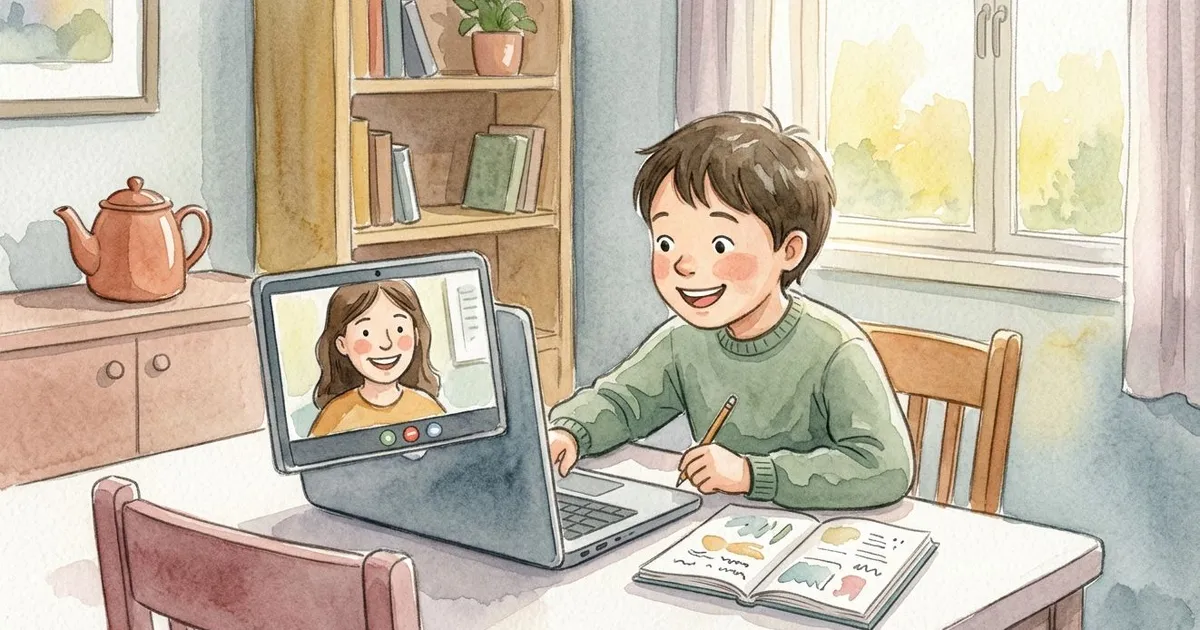
Even the right teacher needs four to six lessons before a young child fully settles. A consistent time slot — same day, same time, the same short pre-lesson routine (a snack, switching off the TV) — lowers anxiety before a single English word is spoken. Older children benefit from a concrete short-term goal: "ordering food in English" or "describing my room" gives purpose to exercises that might otherwise feel abstract.
Across LearnLink lessons, we see the fastest early-stage gains in children whose parents ask one question after each session: "What did you learn today?" Not drilling — just curious conversation. That question signals to a child that English matters at home, not only on a screen.
The tips for choosing english teacher for a child in this guide assume the teacher is doing their part. Your role as a parent is to hold the environment steady: a quiet space, a charged device if the lesson is online, no interruptions during the session, and genuine interest in what happened afterwards.
Quick Check: Does Your Shortlisted Teacher Pass the Basics?
After a trial lesson, answer these five questions honestly. Four or more "yes" answers means the teacher is worth a longer commitment.
1. Did the teacher adjust their approach when my child looked confused or lost?
2. Was my child speaking or responding for more than half the lesson?
3. Could the teacher clearly describe what to focus on in the next three lessons?
4. Did my child say something positive — or even just neutral — about the lesson afterwards?
5. Did the teacher avoid stopping the flow to correct every small mistake?
A "no" to question 2 or 5 is worth taking seriously, regardless of how the other answers go.
When a word has several meanings or pronunciations, Cambridge Dictionary is a useful check before turning it into child-friendly examples.
Frequently Asked Questions
How Many Lessons per Week Does a Child Need to Make Real Progress?
Two 30-45 minute lessons a week is the working minimum for children under 10. One lesson a week can maintain existing skills but rarely builds new ones at a pace parents notice within a school term. Children can make solid progress with two 45-60 minute sessions, especially when they engage with English content — videos, short books, games — between lessons.
At What Age Should I Start Looking for an English Teacher for My Child?
Structured lessons with a teacher work well from age 4, in short sessions of 20-25 minutes. Children this age absorb sound patterns quickly, so a teacher who prioritises listening and speaking over reading and writing is the right match. There is no single best starting age — earlier exposure to a well-matched teacher simply shortens the time to conversational ease.
Does the Choice of Online or In-person Format Affect How I Find a Teacher?
The tips for choosing english teacher for a child remain consistent at their core — age-range experience, correction style, and pacing apply equally to both formats. Online lessons add one extra check: does the teacher use the screen actively with shared activities and visual tools, or simply talk at a camera? A passive online lesson loses young children within minutes. In-person lessons need a distraction-free space and, for younger ages, a teacher who builds movement into the session.
How Do I Know If My Child's Current Teacher Is Not the Right Fit?
Three consistent signals: your child resists lessons without a clear reason (not tiredness or illness), their spoken confidence has not shifted in two months of regular sessions, or the teacher cannot explain what they are working on and why. One difficult lesson proves nothing. A pattern across four to six weeks is worth a direct conversation with the teacher — or a decision to find a better match.
Start your child's English journey today — book a trial lesson with LearnLink.
Stay updated on our latest tips and resources by following us on Instagram LearnLink.