Multiplication and Division Vocabulary for Kids
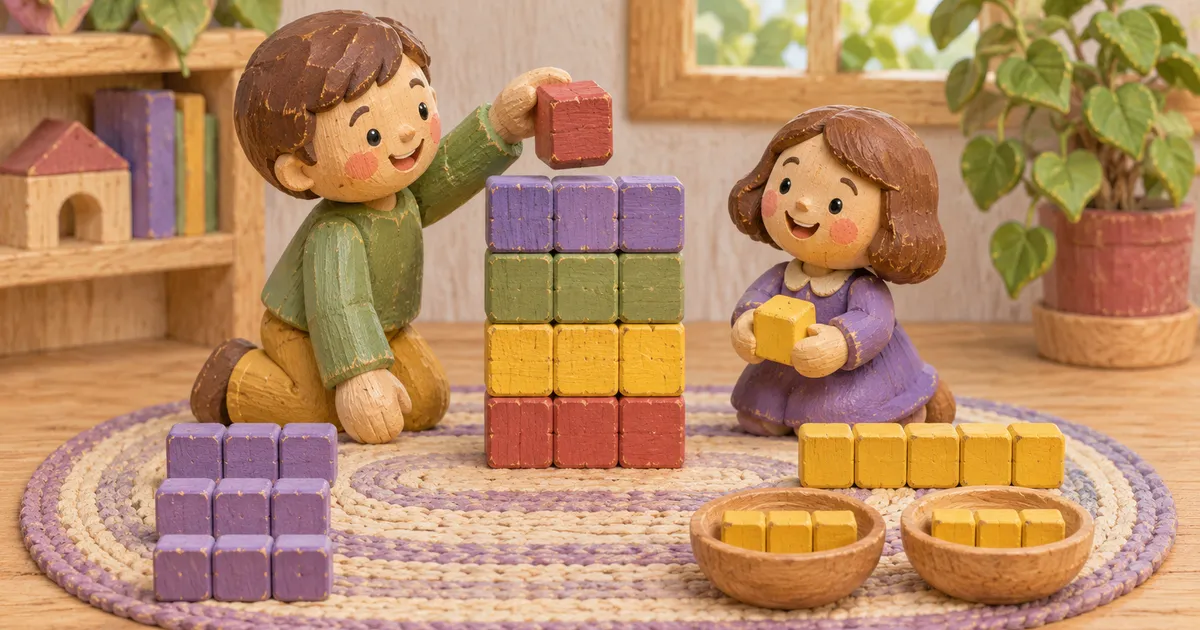
English Multiplication and Division Vocabulary: Words and Activities for Kids covers the words children use for equal groups, repeated addition, sharing, and splitting. A child may solve 3 × 4 yet struggle to explain “three groups of four” or “twelve divided by three.” Learning the maths and language helps children follow instructions, explain their thinking, and identify the required operation. Begin with objects and short spoken phrases. Add symbols and formal terms after the child understands the meaning.
Core Words and Phrases
Teach related words together. For multiplication, connect multiply, times, factor, and product. For division, link divide, share equally, divisor, and quotient. Children should hear each word, see its symbol, and use it in a sentence.
English Multiplication and Division Vocabulary: Words and Activities for Kids begins with everyday phrases: “groups of,” “shared between,” and “how many in each group?” Formal terms can then name familiar ideas.
Do not teach every term at once. Younger children need action words and group language. Older children can add factor, dividend, divisor, and quotient when schoolwork introduces them.
Using the Words in Context
English Multiplication and Division Vocabulary: Words and Activities for Kids becomes easier when one calculation has different descriptions. For 4 × 3 = 12, say: “four groups of three make twelve,” “four times three equals twelve,” and “the product of four and three is twelve.” The numbers remain fixed while the wording changes.
Reverse the relationship: “Twelve divided by four equals three,” “twelve shared equally between four groups gives three in each group,” and “four fits into twelve three times.” The examples connect multiplication and division as inverse operations.
Quick language tip
Ask your child to point to each number while speaking. The gesture links each word to its place in the calculation.
Say, Build, and Solve
Say “three groups of four.” Build them with buttons, blocks, or pasta. Write 3 × 4 = 12, then convert it to 12 ÷ 3 = 4. Ask your child to explain both equations aloud.
Activities for Different Ages
The pace of English Multiplication and Division Vocabulary: Words and Activities for Kids depends on the child’s maths knowledge and English level. A multilingual child may understand an operation before its English name. Accept pointing, moving objects, or another language while the English phrase is new.
Keep early practice oral and physical. A child can give two counters to each toy without reading an equation, then match spoken phrases to symbols and arrays. Older learners can explain why a method works and use formal terms in sentences.
Keep calculations manageable while introducing new English. If both the maths and vocabulary are difficult, reduce the numbers. Across LearnLink lessons, our tutors can model a short phrase, wait for the child’s response, and extend the answer.
Simple Practice at Home
Use household objects: socks, spoons, blocks, fruit, or cards. Ask your child to make four equal groups, place five objects in each, and describe the result. Change one element per round: the group count, objects per group, or target word.
Short question chains build understanding and speaking. Ask, “How many groups are there?”, “How many are in each group?”, “What is the product?”, and “Can you write the related division fact?” Expand one-word answers into sentences: “Twelve” becomes “The product is twelve.”
A five-minute practice routine
- Choose one multiplication or division phrase.
- Build one example with real objects.
- Say the complete calculation aloud.
- Write the matching equation.
- Change the numbers and repeat.
- Finish with one related inverse fact.
Games work when language remains central. Roll two dice and multiply the numbers, sort cards into equal groups, or find arrays in windows and floor tiles. Require one spoken sentence per turn instead of silent answers.
Common Language Mistakes
Children may say “four multiply three” instead of “four multiplied by three,” or use make where schoolwork expects equals. Model the correct phrase: “Yes, four multiplied by three equals twelve.” Brief correction preserves the child’s mathematical thinking.
Word order can cause confusion. In “twelve divided by three,” twelve is divided, not three. Demonstrate with twelve objects before writing the equation. For remainders, let the child share objects and observe what remains outside equal groups.
Two distinctions
Myth: Learning the symbols is enough.
Fact: Children need spoken phrases to follow instructions and explain their reasoning.
Myth: Formal terms should come first.
Fact: Grouping and sharing establish meaning before terms such as “quotient” and “divisor.”
Do not correct a child’s accent when the mathematical word is understood. Focus on meaning, word order, and the full phrase. Model pronunciation through calm repetition without making each answer a speech test.
- Write four equations and say each multiplication or division sentence aloud together.
- Correct “divide six with two” by modeling “divide six by two.”
- Sort eight vocabulary cards into multiplication words and division words.
- Use twelve counters to compare “three groups of four” with “twelve divided by three.”
- Ask your child to explain one mistaken equation using quotient, factor, and product.
When a word has several meanings or pronunciations, Cambridge Dictionary is a useful check before turning it into child-friendly examples.
Frequently Asked Questions
Which Multiplication and Division Words Should a Young Child Learn First?
Start with groups of, times, share equally, each, divide, and left over. These phrases connect to objects and actions. After your child can build and describe equal groups, add product, remainder, and other school terms. Dividend and divisor can wait until schoolwork requires them.
Should My Child Learn the Words or the Number Facts First?
Teach them together while keeping one side familiar. Use a known number fact to practise new English. For a new calculation, use short phrases and objects. Your child should connect the action, spoken sentence, and written symbol instead of memorising three separate pieces.
How Can a Multilingual Child Practise These Terms?
Let your child demonstrate the calculation with objects, drawings, or a familiar language before requesting the English sentence. Model one short phrase, then repeat it with new numbers. Comparing equivalent terms across languages can help, but school methods and word order may differ. Confirm meaning with an example.
How Often Should We Review This Vocabulary?
Review English Multiplication and Division Vocabulary: Words and Activities for Kids in five-minute sessions during the week. Practise the same words through different actions: build groups, draw an array, solve a word problem, and explain an inverse fact. Progress when your child understands and uses the phrase without prompting, then revisit it later.
If your child needs steady speaking practice, start small — choose a trial lesson.
Stay updated on our latest tips and resources by following us on Instagram LearnLink.