Online Adjective Games for Kids
An adjective describes a noun. A focused 10-minute activity follows three steps: recognise the word, choose it in context, and use it aloud. Effective online adjective games for kids present that sequence through visible, spoken choices. A child might match “rough” to a stone, compare two animals, or describe a picture before time expires. Strong games connect words with meaning, place adjectives in complete sentences, and give precise feedback. This guide helps families choose games by age, adjust the level, and add brief offline speaking tasks.
📥 Adjective Game Pack for Kids
Play, describe, compare, and use adjectives in everyday English
Leave your email — we'll send the PDF to your inbox.No spam — the PDF plus one short reminder. Unsubscribe anytime.
What an Effective Adjective Game Should Teach
Children need to understand an adjective’s role. In “the small dog,” the adjective describes the dog. In “the dog is small,” the same word follows the verb “is.” An effective game shows both patterns, not only isolated words.
The strongest online adjective games for kids require meaningful choices. Matching “striped” to a zebra checks comprehension. Choosing between “The soup is hot” and “The soup is square” tests meaning and grammar together. Spelling races belong later, after learners know the words.
Look for varied groups: colour, size, shape, texture, feelings, speed, sound, and opinion. Broad vocabulary moves children beyond easy pairs such as big and small and supports richer sentences: “The tiny, noisy bird is sitting on a thin branch.”
The bright lamp lit the room.
A tiny ant crossed the leaf.
She chose a round plate.
The tree has rough bark.
The excited child opened the box.
A swift fox ran past us.
We entered the quiet library.
They shared a delicious meal.
Choosing the Right Level for Your Child
Age offers a starting point, but reading skill and English experience matter. A multilingual eight-year-old may grasp complex ideas yet need English audio support. Stretch one skill at a time: new vocabulary, difficult spelling, and a fast timer should not appear together in the first round.
When trying online adjective games for kids, begin one level below frustration. If your child answers without thinking, add a speaking challenge. If guessing persists, remove the timer, replay the audio, or return to a smaller word set.
A Simple Routine for Home Practice
For younger children, limit sessions to about ten minutes and stop while attention remains steady. Start with two minutes of review, play one game, then use three of its adjectives in speech. Clicking the correct picture cannot prove independent sentence formation.
After an animal game, ask, “Which animal was slow?” or “Can you describe an animal without naming it?” Accept a short answer: “It is grey and heavy.” Then expand it together: “It is a large, grey animal with small ears.”
Use online adjective games for kids two or three times during the week, not for repeated rounds in one sitting. Note troublesome words. Across LearnLink lessons, our tutors place describing words into questions, comparisons, and short conversations instead of a memorisation list.
Practical Game Formats That Encourage Real-World Use
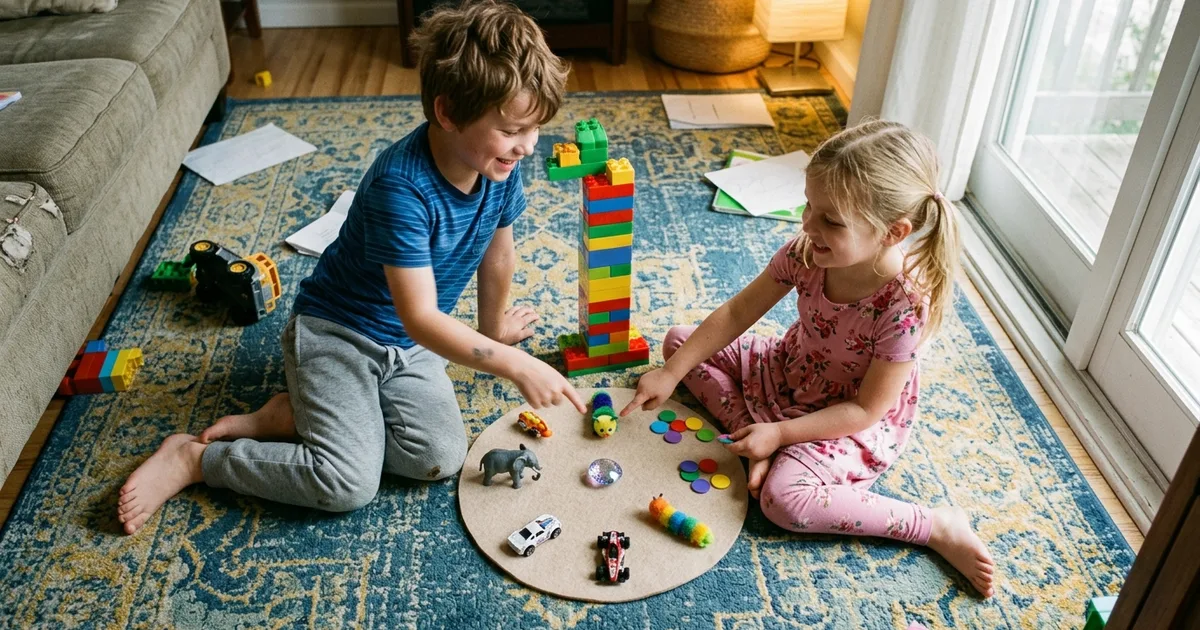
Picture sorting suits beginners. Group images as soft or hard, loud or quiet, and round or square. Older children can play “odd one out”: three objects are smooth, while one is rough. Ask for an explanation in a full sentence.
Clue games add speaking practice to online adjective games for kids. One player describes an onscreen object without naming it: “It is long, thin, and yellow.” The other player guesses. Demand greater precision by banning vague words such as nice, okay, and bad.
Practice 1: Choose the Adjective
Complete each sentence with the better word.
1. Ice feels cold / noisy.
2. A pillow is usually soft / squarely.
3. The child won the race because she was fast / rough.
4. We could not hear the quiet / enormous bell.
Answers: 1. cold; 2. soft; 3. fast; 4. quiet.
Practice 2: Make the Description Stronger
Replace the plain adjective with a more exact one.
1. a nice meal → a delicious meal
2. a big wave → an enormous wave
3. a bad smell → an unpleasant smell
4. a vague answer → a precise answer
Ask your child for one more possible adjective for each noun. Different answers work when the meaning fits.
Rules and Mistakes to Watch For
English adjectives keep the same form for singular and plural nouns. We say “a small cup” and “two small cups,” not “two smalls cups.” They have no masculine or feminine form. Other languages may differ, so cross-language errors are normal.
Another frequent error uses an adjective where English needs an adverb: “She sings beautiful” instead of “She sings beautifully.” An adjective describes a person, place, animal, or thing; an adverb often explains how an action happens.
Word order can cause trouble. Basic descriptions place the adjective before the noun: “a green jacket.” After linking verbs such as be, look, feel, and seem, it comes later: “The jacket looks green.” Correct one target at a time. During adjective-choice practice, do not interrupt every sentence to fix pronunciation.
- Try online adjective games for kids with your six-year-old for ten minutes today.
- Practice comparing three household objects using bigger, smaller, softer, and heavier.
- Use a favorite picture book to identify five adjectives before bedtime.
- Correct adjective order gently by repeating the sentence naturally without interrupting play.
- Review two common mistakes tomorrow, then praise one clear improvement.
For the rule wording, British Council LearnEnglish Kids is a useful reference while the practice examples here stay adapted for children.
Frequently Asked Questions
How Long Should My Child Play an Adjective Game?
Five to ten minutes is enough for most children. Older learners may work for fifteen minutes if the game varies its tasks. Finish with one spoken sentence or a description of a nearby object. That tests learning better than the score alone.
Are Games Enough for a Child to Learn Adjectives?
No. Games introduce words, provide repetition, and test recognition. Children must hear and use adjectives in stories, conversation, reading, and writing. After playing, ask your child to compare two toys, describe a meal, or explain how a character feels.
What Should I Do If My Child Keeps Guessing?
Pause the game and reduce the choices. Read each word aloud, connect it to a concrete example, then replay the item without a timer. Ask for a reason: “I chose rough because the tree bark is not smooth.” Continued guessing may signal excessive reading demands or unfamiliar vocabulary.
Can Multilingual Children Mix Adjective Rules from Different Languages?
Yes. A child may place the adjective after the noun, change its ending, or apply gender agreement because another known language uses those patterns. State the English pattern without criticising the other language: “In English, we say ‘a blue car.’” Brief comparisons help older children separate the rules.
How Can I Choose Safe Online Adjective Games for Kids?
Check each game before handing over the device. Look for direct instructions, suitable images, limited advertising, and no requests for a child’s full name, location, photograph, or contact details. Younger children should play within an adult’s sight. Check whether sound and timers can be disabled because both affect concentration.
- Start with a short game that matches your child’s reading level.
- Practice three useful adjectives aloud after each round.
- Ask your child to describe, compare, or explain without clicking.
- Record difficult words and review them later in new sentences.
If your child needs steady speaking practice, start small — choose a trial lesson.
Stay updated on our latest tips and resources by following us on Instagram LearnLink.