Antonym Activities and Examples for Kids
Antonyms are words with opposite meanings, such as big and small or open and closed. Learning antonyms for kids builds vocabulary and helps children compare objects, describe changes, and follow instructions. Start with pairs your child can see or act out: an open or closed door; a full or empty cup. Then place each word in a short sentence. Children remember opposites through speech, movement, and real settings.
Common Pairs of Opposites
A first set of antonyms for kids should cover familiar words from home, play, school, and daily routines. Teach three or four pairs at a time. Confirm that your child understands both words before adding more.
These 24 pairs cover several contrasts. Context affects some pairs: a small elephant is still larger than a big cat. Other pairs describe distinct states, such as open and closed. Teaching antonyms for kids with objects and complete sentences develops meaning beyond isolated labels.
Examples in Everyday Sentences
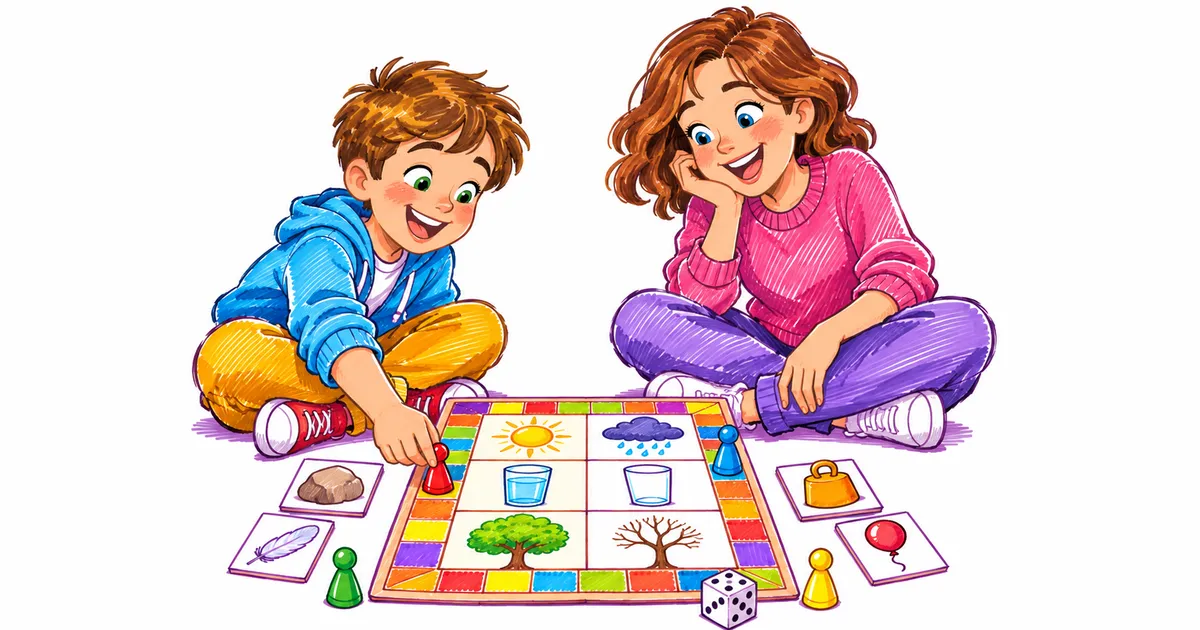
Move from single words to short contrasts once your child knows a pair. Try: “The soup is hot, but the juice is cold,” “My bag is heavy; your bag is light,” and “The shop is near, but the airport is far.” The word but highlights each contrast.
One word may have different opposites across settings. A light bag contrasts with a heavy bag, while a light room contrasts with a dark room. Practising contextual antonyms for kids prevents children from assigning every word one fixed partner.
Questions build speaking skills. Ask, “Is the bottle full or empty?” or “Which building is taller?” Request a complete answer: “The blue bottle is full.” Multilingual children may know the concept in another language first. Let them demonstrate it with an object or gesture, then provide the English words.
A Simple Teaching Routine
Introduce antonyms for kids with four steps: show, say, compare, and use. Show two objects or actions, pronounce each word, and ask your child to identify the correct example. Finish by making a sentence containing the contrast.
For fast and slow, roll a toy car at two speeds. For inside and outside, move a pencil case in and out of a school bag. For loud and quiet, clap both ways. Keep each action safe and distinct. Avoid turning every task into a memory test.
Across LearnLink online lessons, our tutors revisit word pairs through pictures, movement, questions, and conversation. At home, review for two or three minutes. Repeat the pair across several days with different examples: a full glass, a full box, then a picture of a full bus.
Activities for Different Ages
For school-age kids, make meaning physical. Give commands such as “Hands up; hands down” or “Stand inside the circle; stand outside the circle.” Hide a toy under a cushion, then place it on top. Visible contrasts remove the need for written definitions.
For school-age kids, use sorting and drawing. Write each word on a card, mix the cards, and match the pairs. Divide a page in half and draw a clean shoe on one side and a dirty shoe on the other. These activities make antonyms for kids concrete without long explanations.
For school-age kids, add context and precision. Learners can replace a word in a sentence, explain the change, or find multiple possible opposites. The opposite of hard might be soft in “a hard chair” but easy in “a hard question.” Older learners can write a short scene using five contrasting pairs.
Quick Opposite Hunt
Choose one room and find an object for each word: big, small, high, low, clean, dirty, full, and empty. Make four complete sentences, such as “The large box is full, but the small box is empty.” If a word does not fit the room, name an object that would.
Practice That Builds Recall
Combine recognition and speaking. In a “wrong word” game, point to a closed book and say, “The book is open.” Your child corrects the sentence. In a guessing game, provide one side of a pair: “I am thinking of the opposite of dry.” Both tasks demand more thought than repetition.
Stories and picture books support antonyms for kids. Pause at a strong contrast and ask one focused question: “Was the street busy or quiet?” Avoid stopping on every page. One or two selected pairs preserve the story’s flow and place each word in context.
Change the review task instead of repeating one exercise. A child might point to above on Monday, follow an instruction with above on Wednesday, and use it in a sentence on Friday. Track confusing words and revisit them with new objects or pictures.
Common Mistakes to Avoid
Teaching too many pairs at once limits time for meaning and use. Requiring only one-word answers causes another problem. Pointing and matching introduce a word; complete sentences show whether your child can apply it.
Do not treat every opposite as absolute. Water may feel hot compared with juice but cool compared with soup. Words such as big, old, fast, and expensive depend on the comparison. Concrete examples reveal this flexible aspect of antonyms for kids.
Translation can confirm meaning in a multilingual family, but it cannot replace English use. Return to English through a gesture, object, question, or sentence. Correct the whole phrase, not only the selected word: “a heavy bag” is natural, while a direct translation may not be.
- Practice five antonyms for kids using picture cards with ages five to seven.
- Read one familiar story and pause whenever your child can name an opposite.
- Use matching games with six opposite pairs, avoiding abstract words for beginners.
- Ask children aged eight to ten to explain each antonym pair aloud.
- Review three pairs tomorrow, correcting meaning before spelling or pronunciation mistakes.
When a word has several meanings or pronunciations, Cambridge Dictionary is a useful check before turning it into child-friendly examples.
Frequently Asked Questions
What Are Antonyms in Simple Words?
Antonyms are words with contrasting meanings. Examples include big and small, early and late, or enter and leave. Certain pairs name distinct states; others depend on comparison. A box can be big beside a cup but small beside a wardrobe. Concrete examples teach both meanings and their relationship.
At What Age Can a Child Learn Opposite Words?
Children can meet basic opposites from around age four through actions, pictures, and familiar objects. Begin with visible pairs such as up and down or full and empty. Older children can study context-dependent opposites. Choose a starting point based on your child’s English level and attention, not age alone.
How Many Word Pairs Should We Practise at One Time?
Begin with three or four pairs in a short session. When your child can identify each meaning and use the words in sentences, add more. For first-time online learners, a small set leaves time for listening and speaking. Regular review works better than covering a large list once.
How Can I Help My Child Remember Antonyms?
Use antonyms for kids in actions, choices, and short sentences. Open and close a box, sort long and short pencils, or find smooth and rough objects. Revisit each pair in a new setting days later. Recall strengthens when children recognise a word, pronounce it, and apply it to another example.
If your child needs steady speaking practice, start small — choose a trial lesson.
Stay updated on our latest tips and resources by following us on Instagram LearnLink.