Small Sentence in English for Kids
A small sentence in English for kids — typically three to six words built around a subject and verb — is the single most effective unit to teach first, because children aged four to seven can memorize and reproduce short patterns within days of hearing them. Research on early language acquisition shows that consistent daily practice with just five to ten target sentences accelerates confident output far faster than vocabulary lists alone. This guide walks you through the best sentence types to start with, how to practise them at home, and how to handle mistakes along the way.
📥 Small English Sentences Starter Pack
Printable phrase cards for helping children build confident first sentences at home.
Leave your email — we'll send the PDF to your inbox.No spam — the PDF plus one short reminder. Unsubscribe anytime.
Why Short Sentences Come First in English Learning
Young brains process language in chunks, not word by word. A sentence is the smallest chunk that carries a complete meaning — "The dog runs," "I like apples," "She is happy." When children hear and produce these patterns often, the structure becomes automatic before they ever think about grammar rules.
Research in second-language acquisition shows that children who begin with whole, functional sentences outperform those who drill isolated vocabulary lists. A word like "jump" is abstract; "The frog can jump" is a picture. The sentence anchors meaning to context, which is how children absorb their first language at home.
Across LearnLink lessons, our tutors introduce sentence frames — fixed structures with one or two changeable slots — from the very first session. A child learns "I see a ___" and fills the gap with "bird," "ball," or "tree." Within days, that frame belongs to them.
Five Sentence Patterns Young Learners Master Earliest
Not all structures are equally learnable. Five patterns appear in first-year English curricula because they are short, logical, and built from high-frequency words a child already hears every day.
- Subject + verb: "Birds fly." "Dogs bark." "She sleeps."
- Subject + verb + object: "I want milk." "He reads books."
- Subject + verb + adjective: "The sky is blue." "My hands are cold."
- There is / There are: "There is a cat." "There are two apples."
- Can / cannot: "I can swim." "She cannot run."
Each pattern is a template. Once a child owns the template, new vocabulary drops straight in. A 5-year-old who knows "I can ___" can produce dozens of sentences with just a handful of new verbs. That rapid output is what makes English feel manageable — and that feeling keeps young learners going.
Small Sentences by Age: A Practical Guide
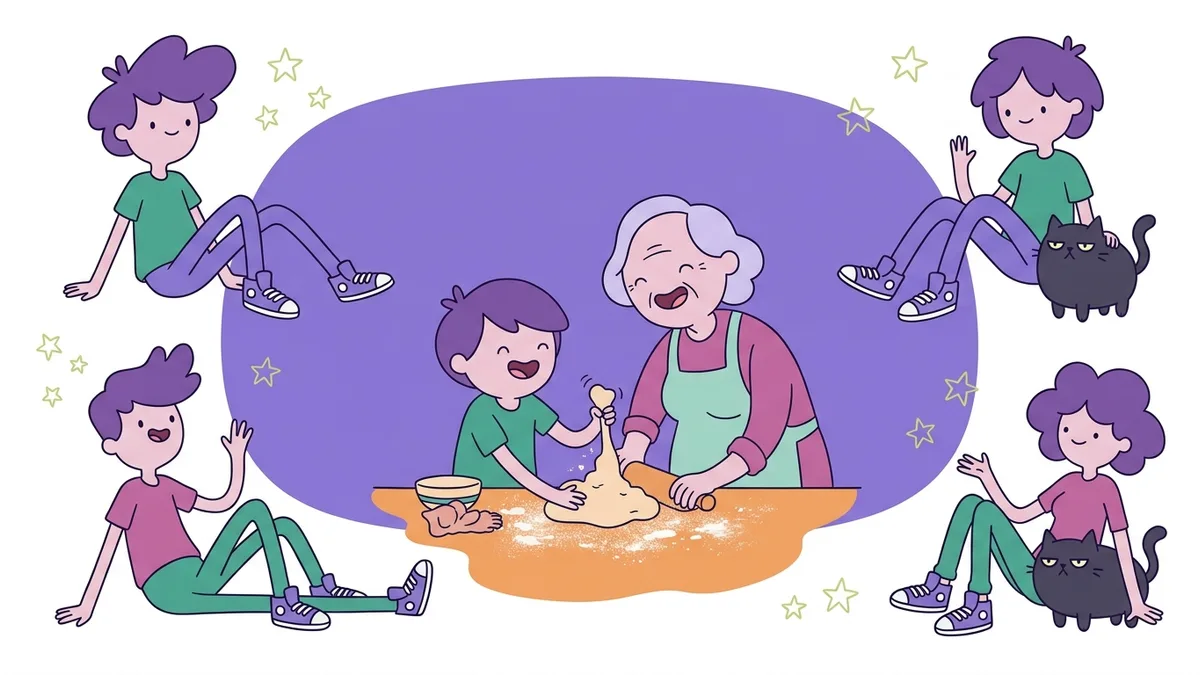
The right small sentence in English for kids depends on age. A 4-year-old and a 10-year-old are in completely different cognitive places, so sentence length, vocabulary, and context should differ accordingly.
These are starting points, not rigid ceilings. A bilingual 7-year-old who already reads in two languages may reach the 8-9 row quickly. A 10-year-old with no prior English exposure belongs at the 6-7 row until foundations are solid. Match the sentence to your child's current output, not their age on paper.
How to Practise Short English Sentences at Home
Daily practice does not require formal lessons. Fifteen minutes of active engagement beats two hours of passive screen time. The key is to make the sentence the unit of interaction, not the word.
Point at objects around the house and ask your child to make a sentence, not just name the thing. A cup on the table becomes "The cup is on the table" or "I drink from the cup." Photo books, walks to the park, mealtimes — all are sentence opportunities. Keep a small notebook where your child writes or draws one English sentence per day. At the end of the week, read them back together.
Try This at Home: The "Describe It" Game (School-age Kids)
Pick any object in the room — a book, a shoe, a glass of water. Set a one-minute timer. Your child says as many short English sentences about that object as they can: "The book is red." "It is big." "I read it." "It has pictures." Count the sentences together and celebrate any number above three. Next day, try a new object and beat yesterday's score.
Common Mistakes — And How to Handle Them
Young learners make predictable errors when they start building sentences. Knowing what to expect helps you respond calmly rather than correcting constantly, which can stall confidence.
The most common mistake is a missing verb: "The dog big" instead of "The dog is big." This is typical — many European and Middle Eastern languages drop the copula or place it differently. Rather than correcting, model the full sentence back: "Yes! The dog IS big." Your child hears the correct form without feeling at fault.
Word-order errors — "I apple want" — are equally common in the 4-6 age range. Model, do not correct. Repeated exposure to correct input reshapes the internal grammar far more reliably than explicit error correction at this age. Save direct grammar feedback for written work and older children aged 10 and above.
Songs, Stories, and Games That Build Sentence Habits
Children acquire sentence patterns through repetition, and entertainment delivers repetition without resistance. Songs with simple, repeated lyrics are sentence machines: "Head, Shoulders, Knees and Toes" teaches body-part sentences; "If You're Happy and You Know It" drills conditional structure long before a child knows what a conditional is.
Picture books read aloud work the same way. When a parent pauses mid-page and lets the child finish the sentence, the child is producing language, not just receiving it. Choose books where the sentence structure repeats page to page — that repetition is scaffolding, not boredom.
Board games and card games can carry language learning with one simple house rule: before taking a turn, every player must say a small sentence in English for kids. Any game becomes a sentence session with no preparation required.
How LearnLink Builds Sentence Skills Step by Step
Across LearnLink lessons, sentence-building is structured in clear stages. In the earliest sessions for school-age kids, our tutors work with two and three-word sentences tied to pictures and movement. By the middle stages, children produce five to eight-word sentences in short role-plays. In the older groups, they construct multi-clause sentences in real conversation.
Each lesson includes a production phase — not just listening and repeating, but creating. Children are given a context (a market, a playground, a family dinner) and asked to produce sentences that fit. The small sentence in English for kids that a 6-year-old says in a lesson is never just a drill; it is practice for a real interaction.
Parents receive brief session notes showing which sentence patterns their child used and which ones to reinforce at home. That loop between lesson and daily life is where lasting progress happens.
When a word has several meanings or pronunciations, Cambridge Dictionary is a useful check before turning it into child-friendly examples.
Frequently Asked Questions
How Long Should a Sentence Be for a 5-year-old Learning English?
For a 5-year-old beginning English, two to four words is the right target: "I want this," "The dog is big," "More please." Confidence and speed matter more than length at this stage. Once short sentences feel automatic — usually after six to eight weeks of regular practice — length increases naturally as vocabulary grows. Pushing for longer sentences before the short ones are fluent tends to produce hesitation rather than progress.
What Is the Best Way to Teach a Small Sentence in English for Kids at Home?
The most effective method is to use daily routines as prompts. At mealtimes, ask your child to describe what they see on the table in English. On a walk, ask for a sentence, not just a word. Keep sessions short — five to ten minutes — and always end on something your child can already do well. Momentum matters more than coverage.
Should I Correct My Child Every Time They Make a Grammar Mistake in a Sentence?
No. Constant correction shuts down speaking. Use the "confirm and expand" method instead: when your child says "She go school," you reply, "Yes, she goes to school — and what does she do there?" Your child hears the correct form in a natural response. Reserve explicit correction for written work or children aged 10 and above who are ready for grammar feedback.
At What Age Can Children Start Forming Complete English Sentences?
Children as young as 4 can produce functional two-word English sentences after consistent exposure — especially if they already speak another language, since sentence-structure knowledge transfers across languages. By school-age kids, most children with regular English input produce five to six-word sentences with reasonable accuracy. The key variable is not age but the amount of meaningful input the child receives each week.
Start your child's English journey today — book a trial lesson with LearnLink.
Stay updated on our latest tips and resources by following us on Instagram LearnLink.