School Supplies in English for Kids

School Supplies in English for Kids covers words children need to name, find, use, and organise classroom objects. Start with a pencil, notebook, ruler, scissors, glue, and backpack, plus phrases like “Can I borrow a pen?” and “Put the book on the desk.” This vocabulary helps learners follow instructions and join lessons without translating every object. Younger children can name items they handle daily; older learners can add precise terms and longer requests.
📥 My School Supplies Word Builder
Name, understand, and use everyday classroom objects
Leave your email — we'll send the PDF to your inbox.No spam — the PDF plus one short reminder. Unsubscribe anytime.
Why Words for Everyday Objects Come First
Concrete nouns connect with sight, touch, and action. A child can hold a pencil, open a notebook, or place an eraser beside a ruler. This direct link gives School Supplies in English for Kids an advantage over abstract vocabulary: children can see the meaning.
Classroom instructions combine objects with actions: “Take out your book,” “Draw a line,” and “Write your name.” Learning both parts helps a child understand what to do and name what they see.
Multilingual children can connect English directly to each object without translating. Show the item, say “scissors,” and use it in a short instruction. Direct association separates the languages and builds quick recall.
A Practical Starter Vocabulary
Begin with items found at home or in a school bag. School Supplies in English for Kids works best within real routines. Teach “pencil case” while packing, “glue” during a craft, and “folder” while storing papers.
Match the words to the child’s setting. A younger learner may need crayons and a lunch box before a highlighter or compass. An older learner may need a binder, calculator, and correction tape. Relevance beats list length.
Small Differences That Prevent Confusion
Related objects are not interchangeable. A pencil can be erased; a pen cannot. A marker draws a thick line, while a highlighter marks important text. Ask the child to select an object for an action: “Which one would you use to colour a large poster?”
British and American English differ. Children in the United States say “eraser”; British children often say “rubber.” “Backpack” and “school bag” may describe the same item. Teach the school’s preferred form first, then introduce the alternative.
Teach grammar beside the nouns. Contrast “a pair of scissors” with “two pencils,” and practise “this notebook” against “these notebooks.” School Supplies in English for Kids can develop articles, plurals, demonstratives, and prepositions through practical exercises instead of grammar lectures.
How to Teach Meaning Without Constant Translation
Use four steps: show, name, act, and recall. Hold up a ruler and say the word. Ask the child to touch it, measure an object, and name the ruler without help. After a break, place it among other supplies and ask, “Where is the ruler?”
Move from single words to sentence chunks. Instead of drilling “glue,” practise “a bottle of glue,” “Pass me the glue,” and “The glue is next to the scissors.” The child learns the word’s role in speech.
When real objects are unavailable, pictures should prompt action: pointing, sorting, drawing, packing, or describing. In lessons with our tutors, each new word accompanies a task, question, or choice.
What to Expect at Different Ages
Younger children benefit from brief sessions with objects, songs, and movement. Four or five words may fill one activity. Children can follow “Pick up the crayon” or “Put the pencil in the box” before producing full sentences.
At school age, learners can sort supplies by purpose, describe ownership, and request what they need. Key patterns include “This is my notebook,” “Whose ruler is this?” and “I need scissors for the project.” Children can write labels and short packing lists.
Older learners can compare items, explain choices, and handle less familiar vocabulary: “I prefer a mechanical pencil because it does not need sharpening.” The aim of School Supplies in English for Kids is progression from naming objects to using each word independently.
Practice Through School Routines
A five-minute routine can build recall. Before school, ask the child to name three items while packing. After a lesson, ask what they used and where each object is. Revisit difficult words on different days instead of drilling the entire set at once.
Fill in the Missing Object
Choose from: ruler, notebook, glue, sharpener.
1. I write my homework in my ______.
2. I measure the line with a ______.
3. My pencil is blunt, so I need a ______.
4. We use ______ to join the pieces of paper.
Answers: 1. notebook; 2. ruler; 3. sharpener; 4. glue.
Once the words are familiar, add a memory challenge. Place supplies on a table, allow twenty seconds to look, then cover them. The child names the objects or describes their positions, testing recall, articles, and prepositions together.
Answer with a Full Sentence
1. What do you use to cut paper?
2. Where do you keep your pencils?
3. Which school supply do you use most?
4. What is inside your school bag today?
Model: “I use scissors to cut paper.” Accept different answers when the sentence is correct and the object fits the action.
How to Check Real Progress
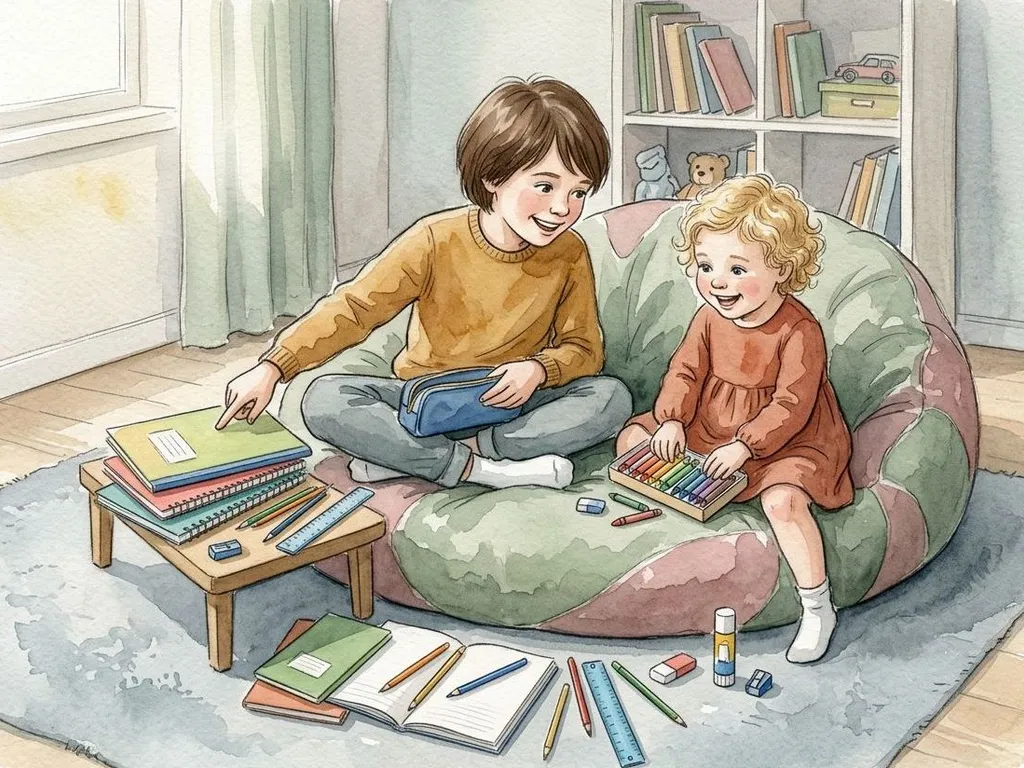
Recognition is only the first step. A child may point to a stapler after hearing its name but cannot name it independently. Check three stages: understanding the word, recalling it without a prompt, and using it in a sentence or request.
For a weekly check, use familiar objects. Ask the child to follow two instructions, name a group of items, and answer one open question. Note words needing support. School Supplies in English for Kids is secure when the learner uses the vocabulary during a real task, despite minor pronunciation or grammar errors.
- Track five School Supplies in English for Kids words in one picture book.
- Ask your six-year-old to name three classroom items without visual prompts.
- Repeat the same quiz after two days and record correct answers.
- Use real pencils, rulers, and notebooks to test recognition during play.
- Celebrate one independently recalled word, then practice missed words again.
For the child-development context behind this advice, American Academy of Pediatrics gives a broader reference point for parents.
Frequently Asked Questions
How Many School-supply Words Should a Child Learn at Once?
For a beginner school-age child, start with four to seven words linked to one activity. Review them in short sessions before expanding the set. Older children may handle a larger group, but recall matters more than list length. Add vocabulary after the child can identify most items and use a few in short sentences.
Should My Child Learn British or American School Words?
Teach the variety used by the child’s school, tutor, or main learning materials. Then introduce alternatives such as “eraser” and “rubber,” or “backpack” and “school bag.” Neither form is wrong. Children exposed to different varieties of English should know that both words may name the same object.
How Can I Tell Whether My Child Truly Knows a Word?
Use three checks. Ask the child to point to the object, show it and request its name, then ask a practical question such as “What do you use to measure a line?” The child knows the word when they can recall and use it without copying an adult.
Does This Vocabulary Show My Child’s CEFR Level?
No. Knowing School Supplies in English for Kids represents one part of language ability. CEFR levels assess listening, speaking, reading, writing, range, and control across many situations. School-supply vocabulary demonstrates everyday communication but cannot establish a level or predict exam performance alone.
What If My Child Already Speaks Two or Three Languages?
Connect each English word directly to its object whenever possible. Avoid testing multiple translations together. Multilingual children may understand a concept in one language but need time to retrieve its English label. Allow a few seconds to answer, accept natural accents, and revisit the word through physical action.
Start your child's English journey today — book a trial lesson with LearnLink.
Stay updated on our latest tips and resources by following us on Instagram LearnLink.